Disappointing model for ultrahigh-energy cosmic rays
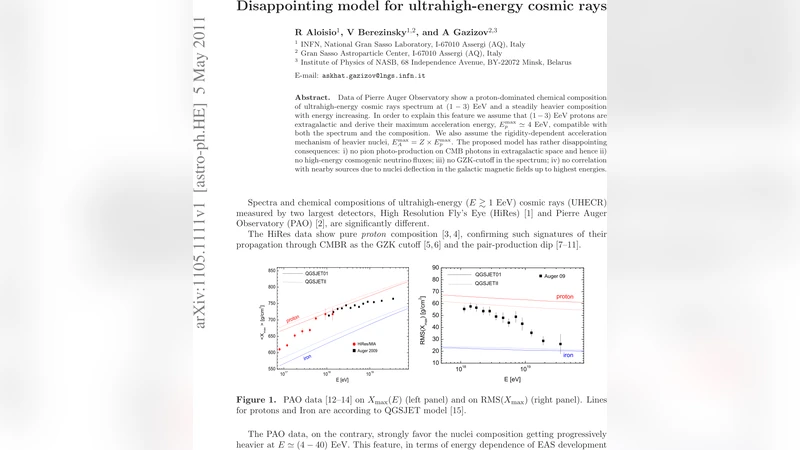
Data of Pierre Auger Observatory show a proton-dominated chemical composition of ultrahigh-energy cosmic rays spectrum at (1 - 3) EeV and a steadily heavier composition with energy increasing. In order to explain this feature we assume that (1 - 3) EeV protons are extragalactic and derive their maximum acceleration energy, E_p^{max} \simeq 4 EeV, compatible with both the spectrum and the composition. We also assume the rigidity-dependent acceleration mechanism of heavier nuclei, E_A^{max} = Z x E_p^{max}. The proposed model has rather disappointing consequences: i) no pion photo-production on CMB photons in extragalactic space and hence ii) no high-energy cosmogenic neutrino fluxes; iii) no GZK-cutoff in the spectrum; iv) no correlation with nearby sources due to nuclei deflection in the galactic magnetic fields up to highest energies.
💡 Research Summary
The paper addresses the apparent tension between the Pierre Auger Observatory (PAO) measurements, which show a proton‑dominated composition at 1–3 EeV and a steadily increasing fraction of heavier nuclei at higher energies, and the expectations from traditional ultra‑high‑energy cosmic‑ray (UHECR) models that predict a prominent GZK cutoff, abundant cosmogenic neutrinos, and source‑direction correlations. The authors propose a minimalist scenario built on two central assumptions: (i) the 1–3 EeV protons observed by PAO are extragalactic, and (ii) all nuclei are accelerated in sources with a rigidity‑dependent maximum energy, i.e. Emax(A)=Z·E0, where Z is the nuclear charge and E0 is a universal energy scale to be determined from data.
By modelling the extragalactic proton flux with a power‑law generation spectrum Qg(E)∝E−γg (γg ranging from 2.0 to 2.8) and assuming a homogeneous, non‑evolving source distribution (zmax=4), the authors normalize the flux to the PAO measurement in the 1–3 EeV band. For every plausible γg, they find that a proton maximum energy Emax p larger than about 4–6 EeV would overproduce the observed flux at ≈2–5 EeV, contradicting the PAO spectrum and composition data. Consequently, the data force Emax p≈4 EeV (±1 EeV).
The authors also explore diffusive propagation in intergalactic magnetic fields, adopting a Kolmogorov turbulence model with Bc≈1 nG, coherence length lc≈1 Mpc, and typical source separation d≈40 Mpc. Diffusion introduces a low‑energy “diffusive cutoff” around 1 EeV, naturally separating a steep Galactic component (presumably iron‑rich) from the flatter extragalactic proton component.
With the rigidity‑dependent acceleration law, nuclei with charge Z can reach energies up to Z·Emax p. Thus, at energies above ≈4 EeV, only nuclei with progressively larger Z survive, while lighter species disappear. This mechanism reproduces the PAO observation of a composition that becomes heavier with increasing energy. The authors illustrate a two‑component model (protons + iron) with γg=2.0 and Emax=4 Z EeV. The iron spectrum, calculated for a homogeneous source distribution, shows a sharp steepening around 20–30 EeV caused by photo‑disintegration on the cosmic microwave background (CMB) and infrared/ultraviolet backgrounds. The gap between the proton cutoff (≈2 EeV) and the iron cutoff (≈2.6×10¹⁹ eV) would be filled by intermediate‑Z nuclei (e.g., Si, Mg), smoothing the RMS(Xmax) curve observed by PAO.
The physical consequences of this “disappointing model” are profound. First, even the heaviest nuclei (iron) reach a total energy of only 10²⁰ eV, corresponding to a per‑nucleon energy of 2–4 EeV, well below the threshold for efficient pion production on CMB photons. Hence, the expected flux of cosmogenic neutrinos is essentially zero. Second, the classic Greisen‑Zatsepin‑Kuzmin (GZK) cutoff does not appear; the observed suppression in the PAO spectrum is instead attributed to iron photo‑disintegration and the diffusive cutoff. Third, because heavy nuclei are strongly deflected by the Galactic magnetic field, arrival directions bear little correlation with nearby astrophysical sources, eliminating the prospect of source identification through anisotropy studies. Fourth, the model predicts no high‑energy photon or neutrino signatures that could be detected by next‑generation observatories (e.g., AugerPrime, POEMMA, IceCube‑Gen2).
In summary, the authors demonstrate that a simple rigidity‑dependent acceleration scenario, constrained by the PAO composition and spectrum, can explain the observed transition from a light to a heavy composition without invoking a high‑energy proton component. However, this comes at the cost of eliminating several key signatures—GZK suppression, cosmogenic neutrinos, and source‑direction correlations—that have motivated much of the experimental effort in UHECR physics. The work thus presents a “disappointing” yet internally consistent picture of ultra‑high‑energy cosmic rays, highlighting the need for new observational strategies or theoretical ingredients to resolve the remaining puzzles.
Comments & Academic Discussion
Loading comments...
Leave a Comment