Categorical formulation of quantum algebras
We describe how dagger-Frobenius monoids give the correct categorical description of certain kinds of finite-dimensional 'quantum algebras'. We develop the concept of an involution monoid, and use it to construct a correspondence between finite-dimen…
Authors: Jamie Vicary
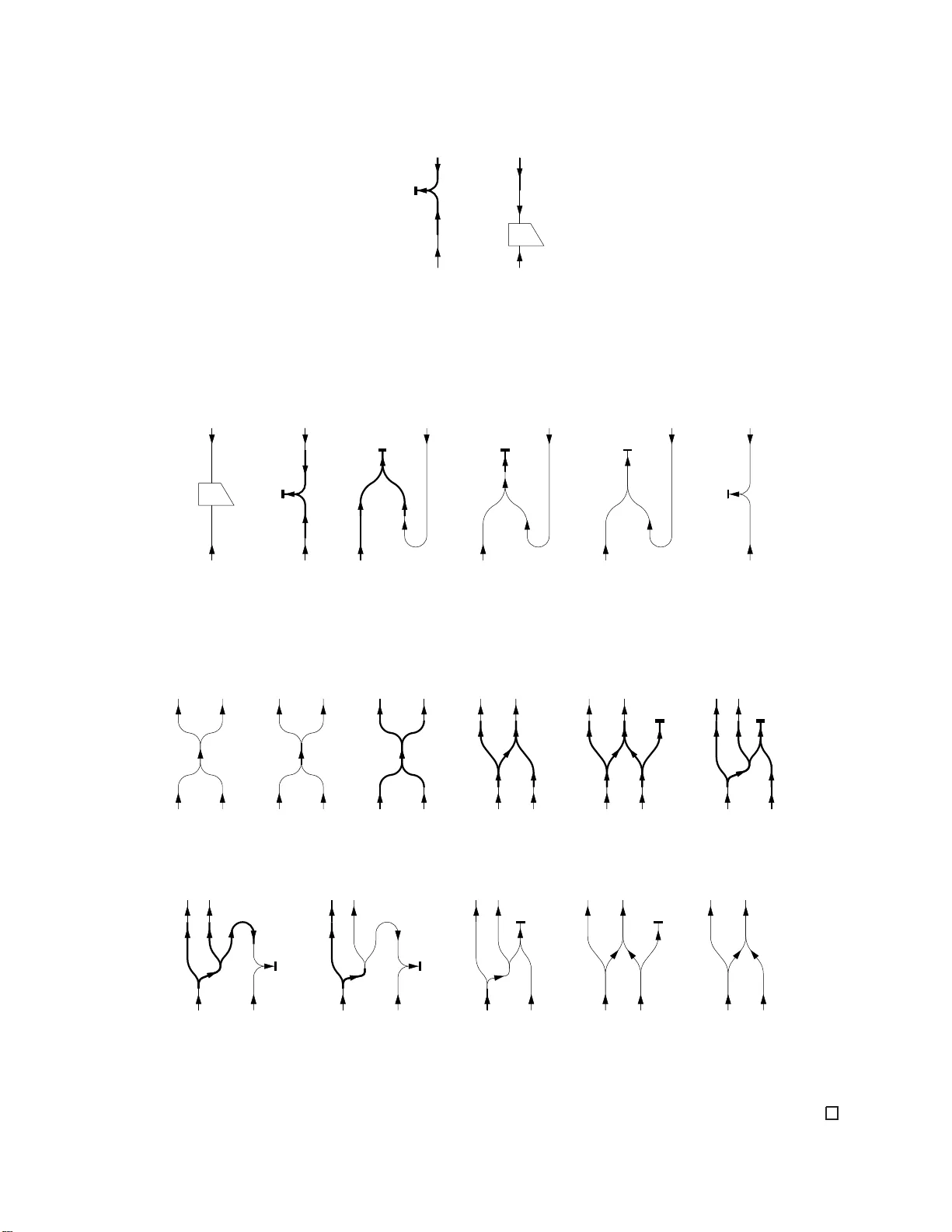
Categorical form ulation of finite-dimensiona l quan tum algebras Jamie Vicary Oxford Universit y Comput ing Lab o rato ry jami e.vi cary@co mlab.ox.ac.uk June 2 2 , 20 10 Abstract W e describ e ho w † -F rob enius monoids giv e the correct catego r ical description of certain kinds of finite-dimensional ‘quan tum algebras’. W e dev elop th e concept of an involution monoid , and use it to construct a corr esp ondence b et ween finite-dimensional C*-algebras and certain t yp es of † -F rob enius monoids in the category of Hilb er t spaces. Using this tec hnology , we recast the sp ectral theorems for commuta tive C*-algebras and for normal o p erators in to an explicitly catego r ical language, and we examine the case th at the r esults of mea s u remen ts do not form finite sets, b ut rather ob jects in a finite Boolean top os. W e describ e the relev ance of these results for top ological quantum field theory . 1 In tro ductio n The main purp ose of this pap er is to describ e ho w † -F rob enius monoids are the cor r ect to ol for formulating v arious kinds of finite-dimensional ‘quan tum a lg ebras’. Since † -F rob enius monoids hav e en tirely geometrical axioms, this give s a new w a y to lo ok at these traditionally algebraic ob jects. This difference in p ersp ectiv e can b e though t of as mov ing from an ‘internal’ to an ‘external’ viewp oint. T raditionally , we form ulat e a C*-algebra as the set of elemen ts of a v ector space, a lo ng with extra structure that sp ecifies how to m ultiply elemen ts, find a unit elemen t, a pply an in v olution and tak e norms. This is an ‘in ternal’ view, since w e are dealing directly with the elemen ts of t he set. The ‘external’ alternativ e is to ‘zo o m out’ in persp ectiv e: w e can no lo nger disc ern the indiv idual elemen ts of the C*- a lgebra, but w e can see more clearly how it relates to ot her v ector spaces, and these relationships g iv e an alternativ e w ay to completely define the C*- a lgebra. This metaphor is made completely precise by catego ry theory , and the pa ssage b et wee n these tw o types of viewp oin t is familiar in catego rical a pproac hes to algebra. 1 W e pro ceed in Section 2 by intro ducing our categorical setting, monoidal † - categories with duals, and defining a n in volution monoid, a categorical axiomatization of an inv olutiv e algebra. Section 3 in tro duces † -F r ob enius monoids, and explores some useful prop erties of them. W e sp ecialize to the category of Hilb ert spaces in Section 4 , and make the connection b et we en † -F rob enius monoids and finite-dimensional C*-algebras precise. An imp ortan t asp ect o f the con v entional study of C*-algebras are the sp ectral theorems, for comm utative C*-a lg ebras and f or normal op erators. The † -F rob enius p ersp ectiv e on C*-algebras allow s these theorems to b e presen ted categorically in the finite-dimensional case, and w e explore this in Section 5. W e also use the † -F robenius monoid formalism to explore the construction of alternative quantum theories. This w ork is r elev an t to the s tudy o f tw o-dimensional op en-closed top ological quan tum field theories (TQFTs), whic h mo del the quan tum dynamics of string-lik e top ological structures whic h can merge together a nd split apart. It was sho wn b y Lauda and Pfeiffer [22] t ha t suc h a theory is defined b y a symmetric F rob enius monoid equipp ed with extra structure. If w e also a dd the ph ysical requiremen t that the theory should b e unitary [7] then these b ecome symmetric † -F rob enius monoids, and th us finite-dimensional C*-a lg ebras by Lemma 3.11 and the results of Section 4. These are pr ecisely the correct kinds of algebras with whic h to construct a state-sum t r iangulation mo del for the TQFT [16, 21], and so w e can deduce the follo wing: the t wo-dimens io nal op en-closed TQFTs whic h arise from a state sum on a triangulation a re precisely the unitary such TQFTs, up to m ultiplication b y a scalar f a ctor. The results pres ented here are c lo sely tied to finite-dimens iona l algebras. The author is a ware of some w ork in progress on infinite-dimensional generalizations [5], whic h requires significan t ch a nges to the underlying algebraic structures. Ho w eve r, the imp ortance of the finite-dimensional case should not b e underestimated. In the s tudy of top ological qu a n tum field the o r y , in particular, it is often nec essary to restrict to finite-dimensional algebras f o r the constructions to b e w ell-defined, as a consequ ence of compactness of t he top olo gical category . The construction described here can b e generalized far b ey ond the scop e of the curren t pap er. In future w ork, w e will describ e how higher-dimensional ‘quan tum algebras’ can b e described as † -F rob enius pseudoalgebras, ‘w eak ened’ forms of F rob enius algebras whic h liv e in a monoidal 2-category . This extends resu lt s of Day , McCrudden and Street [13, 31]. These higher-dimensional quantum algebras include the fusion C*-cat ego ries of considerable imp ortance in the represen tation theory of quan tum groups [19] and in top ological quantum field theory [8]. Wh y † -F robenius monoids? The k ey prop erty of † -F rob enius mono ids whic h mak es them so useful is con tained in the follo wing observ ation, due to Co ec k e, P av lovic and the a uthor [12]. Let ( V , m, u ) b e an a sso ciativ e, unital algebra on a complex v ector space V , with multiplication map m : V ⊗ V ✲ V and unit map u : C ✲ V . W e can map any elemen t α ∈ V into the algebra of op erato rs on V b y constructing its right action, a linear map R α := m ◦ (id A ⊗ α ) : V ✲ V . 2 W e draw this righ t action in the follo wing w ay : P S f r a g r e p la c e m e n t s α The diagram is read f rom b ottom to top. This is a direct represen tation of our definition o f R α : v ertical lines represe nt the vec to r space V , the dot represen ts preparation of the state α , and the merging of the tw o lines represen ts the m ultiplication op eration m : V ⊗ V ✲ V . If V is in fact a Hilb ert space w e can then construct the adjoin t map R α † : V ✲ V . Will this adjo in t also b e the right action of some elemen t of V ? In the case that ( V , m, u ) is in fa ct a † -F r ob enius monoid , the answe r is y es. W e draw the adjoin t R α † b y flipping the diagram on a horizonal axis, but ke eping the arrows p oin ting in their o r ig inal direction: P S f r a g r e p la c e m e n t s α † The splitting of the line in to tw o represen ts the adjoint to the mu lt iplicatio n, and the dot represen ts the linear map α † : V ✲ C . The m ultiplication and unit morphisms of the † -F rob enius monoid, a long with their adjo ints, mu st ob ey the following equations (see Definition 3.3): = = = = On the left are the F rob enius equations, and on the righ t are the unit equations. The short horizon tal ba r in the unit equations represen ts the unit for the monoid, a nd the straight v ertical line represen ts the iden t ity homomorphism on the monoid. In fact, we also hav e t w o extra equations, since w e can tak e the adjo int of the unit equations. W e can use a unit equation and a F robenius equation to redraw the graphical represen tation of R α † in the follo wing w ay: P S f r a g r e p la c e m e n t s α † = P S f r a g r e p la c e m e n t s α † = P S f r a g r e p la c e m e n t s α † = P S f r a g r e p la c e m e n t s α † 3 W e therefore see t hat the adjoint of R α is indeed a right-action of some elemen t: R α † = R α ′ , for α ′ = (id A ⊗ α † ) ◦ m † ◦ u . T o b etter understand this tra nsfor ma t io n α ✲ α ′ w e apply it twice to ev aluate ( α ′ ) ′ , using the F ro b enius and unit equations and the fact that the † -functor is an inv olution: P S f r a g r e p la c e m e n t s ( α ′ ) ′ = P S f r a g r e p la c e m e n t s ( α ′ ) ′ ( α ′ ) † = P S f r a g r e p la c e m e n t s ( α ′ ) ′ ( α † ) † = P S f r a g r e p la c e m e n t s ( α ′ ) ′ α = P S f r a g r e p la c e m e n t s ( α ′ ) ′ α W e see that ( α ′ ) ′ = α , and so the op eration α ✲ α ′ is an in v olution. Since taking the adjoin t R α ✲ R † α is also clearly an inv olution, the mapping of elemen ts of the monoid into the ring of op erators on V is therefore involution-p r eserving , as it maps one inv olution into another. W e shall see that the mapping is injectiv e and preserv es the mu lt iplicatio n and unit of ( V , m, u ), so in fact w e ha v e a fully-fledged inv olution-preserving monoid embedding as describ ed by Lemmas 3.19 and 3.20. This observ ation is one reason wh y † -F robenius monoids are such p o w erful to ols. In fa ct, giv en that the algebra o f op erators on V is a C*-algebra with ∗ -in volution giv en by op erator adjoin t, and since an y in v olution-closed subalgebra of a C*-algebra is also a C*-algebra, we ha v e already sho wn that ev ery † -F robenius monoid in Hilb can b e giv en a C*-algebra norm. Ov erview of pap er W e b egin with a description of the categorical structure that w e will use to express our results. The categories w e will b e w orking with are monoidal † -c ate gories with duals , with non trivial coherence requiremen ts b et w een the monoidal structure, † -structure and dualit y structure. These can b e seen as not-necessarily-symmetric v ersions of the strongly compact- closed cat ego ries of Abramsky and Co ec k e [2, 3]. W e then describ e the concept of an involution monoid , a catego rical v ersion of the traditional concept of a ∗ -algebra, whic h replaces the an tilinear in v o lutio n with a linear ‘in v olutio n’ fro m an ob ject to its dual. W e pro ve some general results on in v olut io n monoids, † -F rob enius monoids a nd the relationships betw een them, and giv e a defin it io n of a sp e cial unitary † -F r ob e n ius monoi d . In Hilb , the category of finite-dimensional complex Hilb ert spaces and con tinuous linear maps, these monoids hav e particularly go o d prop erties, whic h w e explore. W e then use these prop erties to demonstrate in Theorem 4.6 that sp ecial unita ry † -F rob enius monoids in H ilb are the same a s finite-dimensional C*-a lg ebras. The spectral theorem for finite-dimensional comm utative C*- algebras is an imp o rtan t classical result, and w e dev elop a w a y to express it using the † -F rob enius to olkit. W e first summarize a result from [12], that the cat ego ry of commutativ e † -F rob enius monoids in Hilb is equiv a lent to the o pp osite of FinS et , the category of finite sets and f unctions. W e generalize this b y defining a monoidal † -category to b e sp e c tr al if its category of comm utativ e † -F rob enius monoids is a finitar y top os. W e also cons ider t he spectral theorem for normal 4 op erators, and give a w ay to phrase it in an abstract categorical w ay using the conc ept of internal diagon alization . Non trivial examples of sp ectral categories are provided b y categories of unitary repre- sen tations of finite group oids Hilb G , where G a finite group oid. In suc h a category , the sp ectrum of a comm utative generalized C * - algebra — that is, the sp ectrum of a comm uta- tiv e † - F rob enius monoid in ternal to the category — is not a set, but an ob j ect in a finitary Bo olean top os FinSet G . Categories of the form Hilb G can therefore be thought of as pro- viding alternativ e settings for quan tum theory , in whic h the log ic o f measuremen t outcomes — while still Bo olean — has a ric her structure. On a tec hnical leve l, we also note that this give s a new w ay to extract a finite group o id from its represen tatio n category , a s it is w ell-kno wn that the group oid G can b e iden tified in FinSet G as the smallest full generating sub category . Ac knowledge ments The commen ts of the ano nymous referees hav e greatly impro v ed this article, and I am also grateful to Samson Abramsky , Bruce Bartlett, Bob Co ec k e, Chris Heunen, Chris Isham and Dusk o Pa vlovic f o r useful discussions. I a m also grateful for financial supp ort fr o m EPSRC and QNET. Comm utative diagrams are rendered using P aul T aylor’s diagrams pac k ag e. 2 Structur e s in † -categ ories The † -functor Of all the cat ego rical structures that we will mak e use o f, the most fundamen t a l is the † -functor . It is an axiomatization of the o p eration of taking the a dj oin t of a linear map b et we en t wo Hilb ert spaces, and since kno wing the adjoin ts of all maps C ✲ H is equiv alen t to kno wing the inner pro duct on H , it a lso serve s as an axiomatization of the inner pro duct. Definition 2.1. A † -functor on a category C is a contra v ariant endofunctor † : C ✲ C , whic h is the identit y on ob jects and whic h satisfies † ◦ † = id C . Definition 2.2. A † -c ate gory is a category equipp ed with a particular choice of † -functor. These † -categor ies hav e a lo ng history , sometimes going by the name ∗ -c ate go ri e s . In particular, they ha ve b een well-use d in represe ntation theory , esp ecially b y Rob erts a nd collab orator s [14, 23] under the framew ork of C*-categories, and b y others in the study of in v a r ia n ts of top ological manifolds [32]. They ha ve also b een used to study the prop erties o f generalizations of quan tum mec hanics [1 0, 33], where it is not assumed that the underlying categories are C -linear. A useful ph ysical in tuition is that t he † -functor mo dels the time- rev ersal of pro cesses , and considering it as a fundamen tal structure giv es an in teresting new p ersp ectiv e o n the dev elopmen t of ph ysical theories [7]. Giv en a † -category , w e denote the action o f a † -functor on a morphism f : A ✲ B as f † : B ✲ A , and b y con v en tion w e refer to the morphism f † as the ad j o int of f . W e can no w mak e the following straigh tf o rw ard definitions: 5 Definition 2.3. In a † -category , a morphism f : A ✲ B is an iso metry if f † ◦ f = id A ; in other w ords, if f † is a retraction of f . Definition 2.4. In a † -category , a morphism f : A ✲ B is unitary if f † ◦ f = id A and f ◦ f † = id B ; in other w ords, if f is an isomorphism and f − 1 = f † . Definition 2.5. In a † -category , a morphism f : A ✲ A is self-adj oint if f = f † . Definition 2.6. In a † -category , a morphism f : A ✲ A is normal if f ◦ f † = f † ◦ f . Monoidal categories with duals W e will work in monoidal cat ego ries throughout this pap er, and we will require that eac h ob ject in our monoidal categories has a left and a righ t dual. In t he presence of a † -f unctor there ar e then some compatibility equations whic h w e can imp ose, whic h w e will describ e in this section. There is a n imp or tan t gra phical notation for t he ob j ects and morphisms in these categories [18 ] which w e will rely on hea vily . W e hav e already made use of it in the in tro duction. Ob jects in a monoidal cat ego ry are drawn as wires, and the tensor pro duct of t w o ob jects is dra wn as those ob jects side-b y-side; for consistency with the equation A ⊗ I ≃ A ≃ I ⊗ A , w e therefore ‘represen t’ t he tensor unit ob ject I as a blank space. Morphisms are represe nted b y ‘junction-b o xes’ with input wires coming in unde rneath and output wires coming out at the t o p, and comp osition of morphisms is represen ted b y the joining-up of input a nd output w ires. F or visual consis tency , the iden tity morphism on an ob ject is also not draw n. These principles are demonstrated by the follow ing pictures: P S f r a g r e p la c e m e n t s A B C g f h P S f r a g r e p la c e m e n t s A B C g f h P S f r a g r e p la c e m e n t s A A B C g f h P S f r a g r e p la c e m e n t s A A B C g f h Ob ject A or Morphism Morphism Morphism morphism id A f : I ✲ A id A ⊗ g h ◦ (id A ⊗ g ) W e will often omit the lab els o n the wires when it is obvious fr om the context whic h ob ject they represen t. W e now give the definition of duals, and describ e their graphical represen t a tion. Definition 2.7. An ob ject A in a monoidal category has a left dual if there exists an o b j ect A ∗ L and left-duality morp h isms ǫ L A : I ✲ A ∗ L ⊗ A and η L A : A ⊗ A ∗ L ✲ I satisfying the triangle equations: A A ⊗ A ∗ ⊗ A id A ⊗ ǫ L A ❄ η L A ⊗ id A ✲ A id A ✲ A ∗ A ∗ ⊗ A ⊗ A ∗ ǫ L A ⊗ id A ∗ ❄ id A ∗ ⊗ η L A ✲ A ∗ id A ∗ ✲ (1) 6 Analogously , an ob ject A has a ri g h t dual if there exists an ob ject A ∗ R and right-duality morphisms ǫ R A : I ✲ A ⊗ A ∗ R and η R A : A ∗ R ⊗ A ✲ I satisfying similar equations to those giv en ab ov e. It follows that an y tw o left (or righ t) duals for an ob j ect a r e canonically isomorphic. T o distinguish b et w een the ob jects A and A ∗ L , we add arrows to our wires, usually drawing an ob ject A with an up ward-po in ting arrow and dra wing A ∗ L with a dow nw ard- p oin t ing one. W e use the same notatio n for A ∗ R , whic h will not lead to confusion since w e will so on c ho ose our duals s uch that A ∗ L = A ∗ R for all ob jects A . W e represen t the dualit y morphisms b y a ‘cup’ and a ‘cap’ in the following w ay : P S f r a g r e p la c e m e n t s A A ∗ L P S f r a g r e p la c e m e n t s A A ∗ L ǫ L A : I ✲ A ∗ L ⊗ A η L A : A ⊗ A ∗ L ✲ I The reason f o r this is made clear b y the represen tation it leads to for the dualit y equations: P S f r a g r e p la c e m e n t s A A A ∗ L = P S f r a g r e p la c e m e n t s A A A ∗ L A P S f r a g r e p la c e m e n t s A ∗ L A A ∗ L = P S f r a g r e p la c e m e n t s A ∗ L A A ∗ L A ∗ L W e can therefore ‘pull kinks straigh t’ in the wires whenev er we find them. This is o ne reason that the gra phical represen tation is so p ow erful: the ey e can easily sp ot these simplifications, whic h w ould be muc h harder to find in an a lgebraic r epresen tat io n. Definition 2.8. A monoidal category has le ft duals (o r has right duals ) if ev ery ob ject A has an assigned left dual A ∗ L (or a righ t dual A ∗ R ), along with assigned duality mor phisms, suc h that I ∗ L = I and ( A ⊗ B ) ∗ L = B ∗ L ⊗ A ∗ L (or the equiv alen t with L replaced with R.) The order-rev ersing prop erty of the ( − ) ∗ L and ( − ) ∗ R op erations for the mono ida l tensor pro duct is imp o rtan t: it allo ws us to c ho ose a dual for A ⊗ B given duals of A and B indep enden tly . In the presence o f a br a iding isomor phism A ⊗ B ≃ B ⊗ A w e can suppress this distinction, but this will not b e av a ilable to us in g eneral. Definition 2.9. In a monoidal category with left or right duals, with an assigned le f t dual for eac h o b ject or a c hosen right dual for eac h ob ject, the left duality functor ( − ) ∗ L and righ t duality functor ( − ) ∗ R are con trav ar ia n t endofunctors that tak e ob jects to their assigned duals, and act on morphisms f : A ✲ B in the fo llo wing w ay: f ∗ L := (id A ∗ ⊗ η L B ) ◦ (id A ∗ ⊗ f ⊗ id B ∗ ) ◦ ( ǫ L A ⊗ id B ∗ ) (2) f ∗ R := ( η R B ∗ ⊗ id A ) ◦ (id B ∗ ⊗ f ⊗ id A ∗ ) ◦ (id A ∗ ⊗ ǫ R A ∗ ) (3) These definitions can b e understo o d more easily b y their pictorial represen tation: P S f r a g r e p la c e m e n t s f ∗ L f := P S f r a g r e p la c e m e n t s f ∗ L f P S f r a g r e p la c e m e n t s f ∗ L f f ∗ R := P S f r a g r e p la c e m e n t s f ∗ L f f ∗ R (4) 7 Monoidal † -categories with duals W e now inv estigate appropriate compatibility conditions in the case that o ur monoidal category ha s b o th duals and a † -functor. Definition 2.10. A monoidal † -c ate gory is a mono idal category equipp ed with a † -functor, suc h that the asso ciativit y a nd unit natural isomorphisms a r e unitary . If the monoidal category is equipp ed with natural braiding isomorphisms, then these mus t also b e unitary . W e will no t assume that our monoidal categories are strict. A go o d reference for t he essen tials of monoidal category theory is [24]. In a monoidal † - category w e can give a bstract definitions of some imp ortant terminology normally a sso ciated with Hilb ert spaces. Definition 2.11. In a monoidal category , the sc ala rs are the monoid Hom( I , I ). In a monoidal † -category , the scalars form a monoid with in volution. Definition 2.12. In a monoidal † -catego r y , a state of an ob ject A is a morphism φ : I ✲ A . Definition 2.13. In a monoidal † -category , the squar e d norm of a state φ : I ✲ A is the scalar φ † ◦ φ : I ✲ I . If our † -catego ry also has a zero ob ject, w e note that it is quite p ossible for the squared norm of a non-zero state to b e zero. F or this reason, as it stands, Definition 2 .13 seems a p o or abstraction o f the notion of the squared norm on a v ector space. In [33] w e de scrib e a w ay to ov ercome this problem, but it will not affect us here. Monoidal † -categories ha v e a simpler dualit y structure than man y monoidal categories, as the following lemma sho ws. Lemma 2.14. In a monoidal † -c ate gory, left-dual obje cts ar e als o right-dual obje cts. Pr o of. Give n an ob ject A with a left dual A ∗ L witnessed b y left- dua lity morphisms ǫ L A : I ✲ A ∗ L ⊗ A and η L A : A ⊗ A ∗ L ✲ I , we can define ǫ R A := η L A † and η L A := ǫ L A † whic h witness that A ∗ L is a righ t dual for A . Since left or righ t duals are alwa ys unique up to isomorphism, left duals must b e isomorphic to right duals in a monoidal † -category . W e will exploit this isomorphism to write A ∗ instead of A ∗ L or A ∗ R , and it follo ws that A ∗∗ ≃ A . Ho w ev er, this is not enough to imply that the functors ( − ) ∗ L and ( − ) ∗ R giv en in Definition 2.9 are na turally isomorphic; for this w e will require extra compatibility conditions. Definition 2.15. A monoidal † -c ate gory with duals is a monoidal † -category suc h that each ob ject A has an assigned dual ob ject A ∗ (either left or rig ht b y Lemma 2.14) with this assignmen t satisfying ( A ∗ ) ∗ = A , a nd assigned left and righ t duality morphisms for eac h ob ject, such that these assignmen ts a re compatible with the † - functor in the follo wing w ay: ǫ L A = η R A † = η L A ∗ † = ǫ R A ∗ η L A = ǫ R A † = ǫ L A ∗ † = η R A ∗ (( − ) ∗ L ) † = (( − ) † ) ∗ L (5) 8 Since the left and right duality morphisms can b e obtained from each other using the † -functor, from now on w e will only refer directly to the left-duality morphisms, defining ǫ A := ǫ L A and η A := η L A . W e note that there do es not ye t exist a precise theorem gov erning the soundness of the graphical calculus for this precise t yp e of monoidal category with duals, although w e fully exp ect that o ne could b e prov ed. The graphical calculus used in this pap er should therefore b e though t o f as a shortha nd for the underlying morphisms in the category , rat her than a calculational metho d in it s own righ t. The compatibility condition (( − ) ∗ L ) † = (( − ) † ) ∗ L lo oks asymmetrical, as it do es not refer to the right-dualit y functor ( − ) ∗ R . W e show that it is equiv alen t to tw o differen t compatibility conditions. Lemma 2.16. As a p art o f the definition of a monoi dal † -c ate gory with duals, the fol low ing c omp atibility c onditions would b e e q uivalent: 1 . (( − ) ∗ L ) † = (( − ) † ) ∗ L 2 . (( − ) ∗ R ) † = (( − ) † ) ∗ R 3 . ( − ) ∗ L = ( − ) ∗ R Pr o of. F ro m the first tw o sets of equations b et w een the dualit y mor phisms giv en in Defi- nition 2.1 5, it follows directly that (( − ) ∗ L ) † = (( − ) † ) ∗ R . W e combine this with condition 2 ab ov e to sho w that (( − ) ∗ L ) † = (( − ) ∗ R ) † , and since the † -functor is an in volution, it then follo ws that ( − ) ∗ L = ( − ) ∗ R . Since this arg umen t is rev ersible we ha ve sho wn that 2 ⇔ 3, and an analogo us argument demonstrates that 1 ⇔ 3 . In a monoidal † -catego ry the three give n conditions will therefore all hold, and in part icular the functors ( − ) ∗ L and ( − ) ∗ R will coincide. W e denote this unique duality functor a s ( − ) ∗ . W e use conditions 1 for D efinition 2.15 rather than the more symmetrical definition 3, since it follo ws from a general ‘philosophy’ of † -categories: wherev er sensible, require that structures b e compatible with the † -functor. W e can use this result to demonstrate a useful pro p ert y o f the dualit y functor ( − ) ∗ . Lemma 2.17. In a monoid al † -c ate gory with duals, the duality functor ( − ) ∗ is an in volution. Pr o of. The inv olution equation is (( − ) ∗ ) ∗ = id, a nd w e rewrite this using Lemma 2 .1 6 a s (( − ) ∗ L ) ∗ R = id. W riting this out in full, it is easy to demonstrate using the duality equations and the compatibility equations of Definition 2.15. Since the † -functor is also strictly in v olutive and comm utes with the dualit y functor, their comp osite is als o an in volutiv e functor. Definition 2.18. In a monoidal † -category with duals, the c onjugation functor ( − ) ∗ is defined o n all morphisms f by f ∗ = ( f ∗ ) † = ( f † ) ∗ . Since the † -functor is the iden tit y on ob jects, w e ha v e A ∗ = A ∗ for all ob j ects A . T o mak e this equality clear w e will write A ∗ exclusiv ely , and the A ∗ form will not b e used. F or an y mor phism f : A ✲ B w e can use these functors to construct f ∗ : A ∗ ✲ B ∗ , f ∗ : B ∗ ✲ A ∗ and f † : B ✲ A , and it will b e imp orta n t to b e able to easily distinguish b et we en these graphically . W e will use a n approa ch originally due t o Selinger [30], in t he 9 form a dopted by Co ec k e and Pa vlovic [11 ]. Giv en the gra phical represen tation o f the duality functor ( − ) ∗ giv en in (4), w e could ‘pull the kink straigh t’ on t he righ t-hand side of the equation. This would result in a r otation o f the junction- b o x for f by half a turn. T o ma ke this rotation visible we draw our junction-b oxes as w edges, rather than rectangles, breaking their sy mmetry . The dualit y ( − ) ∗ is giv en b y composing the conjug ation func to r ( − ) ∗ and the † -functor, and since geometrically a half- turn can b e built from t wo successiv e reflections, this gives us a complete geometrical sc heme for describing the actions of o ur f unctors: P S f r a g r e p la c e m e n t s A B A ∗ B ∗ A ∗ B ∗ f f ∗ f ∗ f † P S f r a g r e p la c e m e n t s A B A ∗ B ∗ A ∗ B ∗ f f ∗ f ∗ f † P S f r a g r e p la c e m e n t s A B A ∗ B ∗ A ∗ B ∗ f f ∗ f ∗ f † P S f r a g r e p la c e m e n t s A B A ∗ B ∗ A ∗ B ∗ f f ∗ f ∗ f † Our monoidal † - cat ego ries with duals are v ery similar to o ther struc tur es considered in the literature, suc h as C*-categories with conjuga t es [14, 34] and strongly-compact-closed categories [2, 3]. In these contex ts t he functors ( − ) ∗ and ( − ) ∗ also play an imp ortan t role. In volu t ion monoids An imp ortant to ol in functional analysis is the ∗ -algebr a : a complex, associative, unital algebra equipp ed with a n antilinear in volutiv e homomorphism f rom the algebra to itself whic h rev erses the order of multiplic a t io n. Category-theoretically , s uch a homomorphism is not very conv enien t to w o rk with, since mo r phisms in a category of v ector spaces are usually c hosen to b e the line ar maps. How eve r, if the v ector space has an inner pro duct, this induces a canonical an tilinear isomorphism from the v ector space to its dual. Comp osing this with the antilinear self-inv olution, we obtain a line ar isomorphism fr o m the v ector space to it s dual. This style of isomorphism is muc h more useful f rom a categorical p ersp ectiv e, and w e use it to define the concept of an involution mono i d . W e will demonstrate that this is equiv alen t to a con ve ntional ∗ - algebra when applied in a category of complex Hilb ert spaces. The natural setting for the study of these categorical ob jects is a categor y with a conjugation functor, as defined ab o v e. Definition 2.19. In a monoidal category , a monoid is an ordered t r iple ( A, m, u ) consisting of an ob ject A , a multiplic ation morphism m : A ⊗ A ✲ A and a unit morphism u : I ✲ A , whic h satisfy asso ciativity and unit equations: = = = (6) Definition 2.20. In a monoidal † -category with duals, an involution monoid ( A, m, u ; s ) is a monoid ( A, m, u ) equipped with a morphism s : A ✲ A ∗ called the line ar involution , 10 whic h is a morphism of monoids with resp ect to the monoid structure ( A ∗ , m ∗ , u ∗ ) on A ∗ , and whic h satisfies the invo l ution c o n dition s ∗ ◦ s = id A . (7) It f o llo ws from this definition that s and s ∗ are m utua lly in v erse morphism s, since applying the conjugation functor to the in volution condition give s s ◦ s ∗ = id A ∗ . W e also note that for an y suc h inv olution monoid s : A ✲ A ∗ and s ∗ : A ✲ A ∗ are parallel morphisms, but they are not necessarily the same. Definition 2.21. In a monoidal † -category with duals, giv en inv olution monoids ( A, m, u ; s A ) and ( B , n, v ; s B ), a mo r phism f : A ✲ B is a hom omorphism of involution monoids if it is a morphism of monoids, and if it satisfies the in volution-pr ese rvation c ondi- tion s B ◦ f = f ∗ ◦ s A . (8) If an ob ject B is self-dual, it is p ossible for the inv olution s B : B ✲ B to be the iden tity . Let ( B , n, v ; id B ) b e suc h an inv o lutio n monoid. In this case, it is sometimes p o ssible to find an em b edding f : ( A, m, u ; s A ) ⊂ ✲ ( B , n, v ; id B ) of in v olutio n monoids eve n when the linear in v olutio n s A is not trivial! W e will see an example of this in the next section. The fo llowing lemma establishes that the traditional concept of ∗ -algebra a nd the categorical concept of an inv olution monoid are the same, in an appropriate contex t. W e demonstrate the equiv alence f o r finite-dimensional algebras, since the category of finite- dimensional complex vec to r spaces forms a category with duals. How ev er, inv olutio n monoids are useful far more generally , a nd with a careful c hoice o f conjugatio n functor could b e used just as w ell to describ e infinite-dimensional algebras with a n in volution. Lemma 2.22. F or a unital, as s o ciative alge b r a o n a finite-dim ensional c omplex Hilb ert sp ac e V , t he r e is a c orr esp on d enc e b etwe en the fol low i ng structur es: 1. antiline ar maps t : V ✲ V which ar e involutions, an d which ar e or der-r eversing algebr a homomorphisms; 2. line ar m aps s : V ✲ V ∗ wher e V ∗ is the dual sp ac e of V , s atisfying s ∗ ◦ s = id V , and which ar e alge br a h omomorphisms to the c onjugate algebr a on V ∗ . F urthermor e, the natur al notions of homomorphism for t h e se structur es ar e a lso e quivalent. Pr o of. W e first deal with the implication 1 ⇒ 2. W e construct the linear isomorphism s b y defining s ◦ φ := ( t ( φ ) ) ∗ for an arbitrary morphism φ : C ✲ V . This is linear, b ecause b oth t and ( − ) ∗ are an t ilinear. It is a map V ✲ V ∗ since t ( φ ) is an ele ment of V , and the complex conjugation functor ( − ) ∗ tak es V to V ∗ . Chec king t he identit y s ∗ ◦ s = id V , w e ha v e s ∗ ◦ s ◦ φ = s ∗ ◦ ( t ( φ ) ) ∗ = ( s ◦ t ( φ ) ) ∗ = ( tt ( φ ) ) ∗∗ = φ. 11 The monoid homomorphism condition is demons tra ted similarly , for arbitrary s ta t es φ and ψ of V : s ◦ m ◦ ( φ ⊗ ψ ) = ( t ( m ◦ ( φ ⊗ ψ )) ) ∗ definition of s = ( m ◦ ( tψ ⊗ tφ ) ) ∗ t is or der-r eversing homomorph ism = m ∗ ◦ ( ( tφ ) ∗ ⊗ ( tψ ) ∗ ) or der-r eversing functoria lity o f ( − ) ∗ = m ∗ ◦ ( sφ ⊗ sψ ) definition of s s ◦ u = ( t ( u ) ) ∗ = u ∗ definition of s , t i s homomorp hism F or the implicatio n 2 ⇒ 1, w e define t ( φ ) := ( s ◦ φ ) ∗ for all elemen ts φ of V . The pro of that t has the required properties is similar to the pro of in v olved in the implication 1 ⇒ 2. The constructions of s and t in terms o f each other are clearly in v erse, a nd so the equiv alence has b een demonstrated. W e no w c hec k that homomorphisms b et w een these structures are the same. Our notion of homomorphism b et we en structures o f t yp e 2 is given b y that in D efinition 2.21, and there is a natural notio n o f homomorphism b et w een monoids equipp ed with an an tilinear self-inv olution. Consider a lg ebras ( A, m, u ) a nd ( B , n, v ) equipp ed with antiline a r in v olutive o r der- rev ersing homomorphisms t A : A ✲ A and t B : B ✲ B respectiv ely , and let f : A ✲ B b e an y con tin uous linear map. It will b e compatible with the in v olutions if t B ◦ f = f ◦ t A . Acting on some state φ of A , and constructing linear maps s A : A ✲ A ∗ and s B : B ✲ B ∗ in the manner defined ab o v e, we obtain t B ◦ f ◦ φ = s B ∗ ◦ ( f ◦ φ ) ∗ = s B ∗ ◦ f ∗ ◦ φ ∗ and f ◦ t A ◦ φ = f ◦ s A ∗ ◦ φ ∗ . Equating these and complex-conjugating w e ha v e s B ◦ f = f ∗ ◦ s A as required. Conv ersely , let ( A, m, u ; s A ) and ( B , n, v ; s B ) b e inv olution monoids in Hilb , and let f : A ✲ B again b e any linear map. If the inv olution-preserv at io n condition s B ◦ f = f ∗ ◦ s A holds, then applying an arbitrary state φ we obtain s B ◦ f ◦ φ = ( t ( f ◦ φ ) ) ∗ and f ∗ ◦ s A ◦ φ = f ∗ ◦ ( tφ ) ∗ resp ectiv ely for the left and right sides of the equation. Equating these a nd complex-conjugating, we obtain t ( f ◦ φ ) = f ◦ ( tφ ) as required. 3 Results on † -F rob enius monoids In tro ducing † -F robenius monoids W e b egin with definitions of the imp o rtan t concepts. Definition 3.1. In a monoidal category , a c omon o id is the dual concept to a monoid; that is, it is a n ordered triple ( A, n, v ) × consisting o f an ob ject A , a c omultiplic ation n : A ✲ A ⊗ A and a c ounit v : A ✲ I , whic h satisfy c o asso ciativity a nd c o unit equations: = = = (9) 12 If an ob ject has b oth a c hosen monoid structure and a c hosen comonoid structure, then there is an imp or t an t w a y in whic h these migh t b e compatible with each other. Definition 3.2. In a monoida l category , a F r o b enius structur e is a choice of monoid ( A, m, u ) and comonoid ( A, n, v ) × for some ob ject A , suc h that the m ultiplication m and the com ultiplication n satisfy the fo llo wing equations: = = (10) Reading these diagrams from b ottom to t o p, the splitting of a line repre sents the comulti- plication n , and merging of t wo lines represen ts the m ultiplication m . This geometrical definition of a F rob enius structure, although w ell-kno wn, is sup erficially quite differen t to the ‘classical’ definition in terms of an exact pairing. The equiv alence of these t wo definitions w as first observ ed by Abrams [1], and an accessible discussion of the differen t p ossible w ays to define a F r ob enius a lgebra is giv en in the b o ok b y Ko c k [20]. This geometrical definition w as first s ug g ested by Lawv ere, and w a s subseque ntly popularized in the lecture notes of Quinn [29]. An imp ort a n t prop erty of a F rob enius structure is that it can b e used to demonstrate that the underlying ob ject is self-dual. If we a re w o rking in a † -category , from any monoid ( A, m, u ) we can canonically obtain an ‘adjoint’ comonoid ( A, m † , u † ) × , and it is then natural to ma ke the followin g definition. Definition 3.3. In a monoidal † -category , a monoid ( A, m, u ) is a † -F r ob eni us monoid if it forms a F rob enius structure with its a dj o in t ( A, m † , u † ) × . This construction is similar to an abstr act Q-systems [23]. Giv en a † -F rob enius monoid ( A, m, u ), w e refer to m † as its com ultiplicatio n and to u † as its counit. In volu t ions on † -F robenius monoids W e now lo ok at the relationship b et wee n † - F rob enius monoids and the in volution monoids o f Section 2. W e will see that a † -F rob enius monoid can b e giv en the structure of an inv olutio n monoid in tw o canonical w ays, whic h in g eneral will b e differen t. Definition 3.4. In a monoida l † - category with duals, a † -F rob enius monoid ( A, m, u ) has a left inv o lution s L : A ✲ A ∗ and right involution s R : A ✲ A ∗ defined a s follows: = = s L := ( ( u † ◦ m ) ⊗ id A ∗ ) ◦ ( id A ⊗ ǫ A ∗ ) s R := id A ∗ ⊗ ( u † ◦ m ) ◦ ǫ A ⊗ id A (11) 13 In eac h case the second picture is just a conv enien t shorthand, which should literally b e in terpreted as the first picture. Thes e inv olutions in teract with the conjugat ion and transp osition functors in interes ting w ays, a s w e explore in the next lemma. Lemma 3.5. In a m o noidal † -c ate g ory with duals, the lef t and right involutions of a † -F r ob enius monoi d sa tisfy the fol lo w ing e quations: s L ∗ = s R , s R ∗ = s L (12) s L ∗ = s − 1 L , s R ∗ = s − 1 R (13) s − 1 L = s R † , s − 1 R = s L † (14) Pr o of. The equations (12) follow from the definitions of the inv olutions and the gra phical represen ta tion of the functor ( − ) ∗ , whic h rotates a diagram ha lf a turn ab out an axis p erp endicular to the page. The equations (1 3 ) f o llo w from the † -F rob enius and unit equations; taking the righ t- in v olutio n case, w e show this b y establishing that s R ∗ ◦ s R = id A with the following graphical pro of: = = = Applying the functor ( − ) ∗ to this e quation giv es s R ◦ s R ∗ = id A ∗ , establishing that s R and s R ∗ are in v erse; applying the functor ( − ) ∗ to this argumen t establishes that s L and s ∗ L are in v erse. The equations (14) follow from the equations (12) a nd (13) and the prop erties of the functors ( − ) ∗ , ( − ) ∗ and † . W e note that left a nd righ t in volutions could b e defined for arbitrary monoids in a monoidal † -category with duals, but they w ould not satisfy equations ( 1 3) and (14) a b o ve. W e now combine these results o n in v o lutio ns of † -F rob enius monoids with the concept of an inv olution mo no id fr om Section 2. Lemma 3.6. In a monoida l † -c ate gory with duals, given a † -F r ob enius monoid ( A, m, u ) w e c an c anonic al ly ob tain two invol ution monoids ( A, m, u ; s L ) and ( A, m, u ; s R ) , wher e s L and s R ar e r esp e ctively the left and right involutions asso ciate d to the monoid. Pr o of. W e deal with the righ t-inv olutio n case; t he left-in volution case is analogous. W e m ust sho w that s R : A ✲ A ∗ is a morphism of monoids, and that it satisfies the inv olution condition. W e first show that it preserv es m ultiplication, emplo ying the F rob enius, unit and asso ciativit y laws : = = = = = 14 W e omit the pro of that s R preserv es the unit, as it is straightforw ard. The in volution condition s R ∗ ◦ s R = id A follo ws from one of the equations (13) in Lemma 3.5. This leads us to the f o llo wing definition. Definition 3.7. In a monoidal † -catego ry with duals, a † -F r ob enius left- (or right- ) involution monoid is an in v o lution monoid ( A, m, u ; s ) s uch tha t the monoid ( A, m, u ) is † -F ro b enius, and suc h that the inv olution s is the left (or right) inv olution of the † - F rob enius monoid in the manner describ ed by Definition 3.4. A ho momorphism of † -F rob enius left- or righ t- in v o lution monoids w ould therefore b e required to preserv e the in v olut io n as w ell as the m ultiplicatio n and unit, as p er Definition 2.21. A useful property of † -F rob enius righ t-in volution monoids is describ ed by the following lemma, whic h giv es a necessary and sufficien t algebraic condition f or a monoid homomor- phism to b e an isometry . Lemma 3.8. In a mo n oidal † -c ate gory with duals, a ho momorphism of † -F r ob enius right- involution mono i d s is an isometry if and only if it pr ese rv e s the c ounit. Pr o of. Let j : ( A, m, u ) ✲ ( B , n, v ) b e a homomorphism b et w een † -F rob enius righ t- in v olutio n monoids. Assuming that j p r eserv es the counit, w e sho w that it is a n isometry by the follow ing graphical argumen t. The third step uses the fact that j preserv es the inv olut io n, the fifth that it is a homomorphism of monoids, a nd the sixth that it preserv es the counit. P S f r a g r e p la c e m e n t s j j † j ∗ = P S f r a g r e p la c e m e n t s j j † j ∗ = P S f r a g r e p la c e m e n t s j j † j ∗ = P S f r a g r e p la c e m e n t s j j j † j ∗ = P S f r a g r e p la c e m e n t s j j j † j ∗ = P S f r a g r e p la c e m e n t s j j † j ∗ = P S f r a g r e p la c e m e n t s j j † j ∗ = P S f r a g r e p la c e m e n t s j j † j ∗ No w instead assume that j is an isometry . It is a homomorphism, so w e hav e the unit- preserv a tion equation j ◦ u = v , and therefore j † ◦ j ◦ u = u = j † ◦ v . Applying the † -functor to this w e obta in u † = v † ◦ j , whic h is the counit-preserv ation conditio n. Sp ecial unitary † -F rob enius monoids W e will mostly b e in terested in the case when the t w o inv olutions are the same, and w e now explore under what conditions this holds. 15 Definition 3.9. In a monoidal † -category with duals, a † -F rob enius monoid is unitary if the left inv olut io n, or equiv a len tly the right in volution, is unitary . That these tw o conditions are equiv alen t follo ws f r o m Lemma 3.5. Definition 3.10. In a braided monoidal † -category with duals, a † -F rob enius monoid is b alan c e d-symmetric if t he following equation is satisfied: = (15) The term symmetric is standard (for example, see [20, Section 2.2.9]), and describ es a similar prop ert y tha t lac ks the ‘balancing lo o p’ on one of the legs of the right-hand side of the equation. In Hilb this lo o p is the iden tit y and so the concepts are the same, but this may not b e the case in other categories of in terest. Lemma 3.11. In a monoid al † -c ate gory w ith duals, the fol lowing pr op e rties of a † -F r ob enius monoid ar e e quivalent: 1. it is unitary; 2. it is b alanc e d-symme tric; 3. the left and rig h t involutions ar e the same; wher e pr o p erty 2 only a p plies if the monoidal structur e has a br ai ding. Pr o of. W e first give a graphical pro of that 3 ⇒ 2, using prop erty 3 to transform t he second expression in to the third: = = = = A similar ar g umen t shows that 2 ⇒ 3. F rom equations (14) o f Lemma 3 .5 it follows that 1 ⇔ 3, and so all three prop erties a r e equiv alen t. W e will mostly use the term ‘unitary’ to refer to these equiv alent prop erties, since it is more ob viously in kee ping with the general philosoph y of † -catego ries, that all structural isomorphisms should b e unitary . W e also note that if a † -F rob enius left- or righ t-inv olut io n monoid is unitary then w e can simply refer to it as a ‘ † - F rob enius inv olutio n monoid’, as the left a nd right in v o lutions coincide in tha t case. 16 One particularly nice feature of unitary † -F rob enius monoids is that we can canonically obtain an abstract ‘dimension’ of their underlying space from the m ultiplication, unit, com ultiplication and counit, as the follow ing lemma sho ws. In a category of v ector spaces and linear maps, this dimension will corresp ond t o the dimension of the vec t o r space. Definition 3.12. In a monoidal † -category with duals, the d i mension of an ob ject A is given b y the scalar ǫ A † ◦ ǫ A : I ✲ I , and is denoted dim( A ). Lemma 3.13. I n a monoida l † -c ate go ry with duals, giv e n a unitary † -F r ob en i us monoid ( A, m, u ) , dim( A ) = u † ◦ m ◦ m † ◦ u ; that is, the dimens ion of A is e qual to the squar e d n o rm of m † ◦ u . Also, dim( A ) = dim( A ) ∗ . Pr o of. W e demonstrate this with the fo llo wing series of pictures: dim( A ) = = = = = = = = dim( A ) ∗ The cen tral diagram is u † ◦ m ◦ m † ◦ u , so this prov es the lemma. The notion of t he dimension of a n ob ject is a crucial one in the t heory of monoidal categories with duals, and is studied in depth thro ughout the literature [9, 14, 23]. How eve r, w e do not rely on it heav ily in this pap er, and more axioms would be required for our category than those assumed here f o r the dimension to hav e go o d prop erties, suc h as b eing indep enden t of the choice of dualit y morphisms, or b eing an elemen t of the integers. W e now introduce one final prop ert y of a † -F rob enius monoid. Definition 3.14. In a monoida l † -category , a † -F rob enius monoid ( A, m, u ) is sp e cial if m ◦ m † = id A ; that is, if the com ultiplication is an isometry . The term sp e cial go es back to Quinn [29]. A sp ecial † -F ro b enius monoid is the same as an ab s tr act Q-system [2 3], and a us eful lemma pro ved in that refe rence is that if a monoid ( A, m, u ) satisfies m ◦ m † = id A , then it is necessarily a sp ecial † -F rob enius monoid. It simplifies the express io n for the dimension of the underlying space, as demonstrated b y this lemma. Lemma 3.15. In a monoidal † -c ate gory wi th duals, a sp e cial unitary † -F r ob enius mo n oid ( A, m, u ) has dim( A ) = u † ◦ u ; that is, the dimens ion of A is e qual to the squar e d norm of u . Pr o of. Straightforw ard from Lemma 3 .1 3. Endomorphism monoids Giv en an y Hilb ert space H , it is often useful to consider the a lgebra of b ounded linear op erators on H . These giv e the pro t ot ypical examples of C*-algebras, with the ∗ -inv olution giv en by taking the op erator adjoin t . In a monoidal c a tegory with duals we can c o nstruct 17 endomorphism monoi d s , whic h are categor ical analogues of these algebras o f b ounded linear op erators. These w ell-know n constructions, whic h go bac k at least to M¨ uger [27], form an imp ortant class of † -F rob enius monoids, and that they hav e part icularly nice prop erties. Definition 3.16. In a monoidal category , f o r an ob ject A with a left dual A ∗ L , the endomorphism mo noid End ( A ) is defined by End( A ) := A ∗ L ⊗ A, id A ∗ L ⊗ η L A ⊗ id A , ǫ L A . (16) The follo wing lemma describes a w ell-known connection b et wee n categorical duality and F rob enius structures. Lemma 3.17. In a mon oidal † -c ate gory with duals, an endomorphism mon o id is a † -F r ob enius monoid. Pr o of. That the † -F rob enius prop erty holds for an endomorphism monoid End ( A ) is clear from its graphical represen tation, which we giv e here: = = They ar e examples of the unitary monoids discussed in the previous section. Lemma 3.18. In a monoidal † -c ate gory with duals, endom orphism monoids ar e unitary. Pr o of. F ollowing equation (1 1) f o r the left inv olution asso ciated to a † -F ro b enius mo no id, w e obtain the fo llo wing: This is clearly the iden tit y on A ∗ ⊗ A . The r ig h t in volution is also the identit y , b y the conjugate of this picture. By Lemma 3.11 the † -F ro b enius monoid m ust therefore unitary . W e note tha t the order-rev ersing prop erty of the dualit y functor ( − ) ∗ is crucial here, as the only canonical c hoice of ‘iden tity ’ mor phism A ∗ ⊗ A ✲ A ⊗ A ∗ w ould b e the braiding isomorphism, but suc h a braiding is not necessarily presen t. Also, although the linear in v olutio n asso ciated with a n endomorphism monoid is the iden tity , the induced order- rev ersing antilin e ar in v olution on A ∗ ⊗ A is certainly not the identit y: it is g iv en b y t a king the name of a n op erator to t he name o f the adjoin t to tha t op erator, as can be c hec k ed b y going thro ugh t he corresp ondence describ ed in Lemma 2.22. 18 The follo wing lemma is a formal description of the in tuitiv e notion that an algebra should ha v e a homomo r phism in to the algebra of op erators on the underlying space, giv en by taking the rig ht action of each elemen t. Lemma 3.19. L et ( A, m, u ) b e a monoid in a monoida l c a te gory in which the obje ct A has a left dual. Then ( A, m, u ) has a mo n ic homomorphism into the en d o morphism monoid of A . Pr o of. The em b edding morphis m h : ( A, m, u ) ⊂ ✲ End( A ) is defined by h := (id A ∗ ⊗ m ) ◦ ( ǫ L A ⊗ id A ) , (17) whic h has the fo llo wing graphical represen tation: A ∗ ⊗ A A h ✻ = W e show that it is monic b y p ostcomp o sing with u ∗ ⊗ id A , whic h acts as a retraction: = = Next w e sho w that h preserv es the multiplication op eration, emplo ying a duality eq uatio n and the asso ciative law: = = Finally , w e sho w that the em b edding preserv es the unit, emplo ying the unit la w: = 19 Ho w eve r, as we saw in the intro duction, f o r the case of † -F rob enius monoids this em b edding ha s a sp ecial prop ert y: it preserv es an in volution. W e establish t his formally in the following lemma. Lemma 3.20. L et ( A, m, u ; s R ) b e a † -F r ob enius right-involution mo noid. T hen the c anoni- c al emb e dd ing of ( A, m, u ; s R ) into the † -F r ob enius involution mon oid End( A ) is a morphism of in volution monoids . Pr o of. By Lemma 3.19 the embedding mus t b e a morphism of monoids. Note that we do not need to sp ecify whether w e are using the left o r right in v o lution of End( A ), since by Lemma 3 .1 8 they are b o th the iden tit y . W e must sho w that this em b edding morphism k : A ⊂ ✲ A ∗ ⊗ A satisfies the in volution condition k = k ∗ ◦ s R giv en in D efinition 2.2 1. The pro of uses the F ro b enius law and the unit la w. = = = It is w ort h noting that a symmetry ha s b een broken; this lemma w ould not ho ld with ‘right- in v olutio n’ replaced with ‘left-in v olutio n’. This is a consequence of defining the underlying ob ject of our endomorphism mo no id to b e A ∗ ⊗ A ra ther than A ⊗ A ∗ . In a braided monoidal category there would b e no essen tial difference, but w e are w orking at a higher lev el of generalit y . An em b edding lemma W e finish this section b y demonstrating another general property of † -F rob enius inv olutio n algebras. Just as ev ery in volution-closed subalgebra of a finite- dimensional C*-algebra is also a C*-a lg ebra, w e will show that every in volution-closed submonoid of a † -F rob enius in v olution monoid is also † -F rob enius. The next section mak es this analogy with C*-algebras precise, but we can prov e it here as a general result a b out † -F rob enius algebras. Lemma 3.21. In a m onoidal † -c ate gory with duals, let ( A, m, u ; s ) b e an involution monoid with an invo lution-p r eserving † -emb e dding into a † -F r ob enius left- (or right-) involution monoid. Then ( A, m, u ; s ) is itself a † -F r ob enius left- (or rig ht-) inv o l ution monoid. Pr o of. W e will deal with the left-in volution case; the right-in v olution case is ana lo gous. Let p : ( A, m, u ; s ) ⊂ ✲ ( B , n, v ; t ) b e a † -em b edding of an in volution monoid in to a † -F rob enius left-in volution monoid. The † -embedding prop ert y means that p † ◦ p = id A . In our gr a phical represen ta tion w e will use a thin line for A and a thick line for B , and a transition b etw een these types of line for the em b edding morphism p . The in volution-preserv atio n condition 20 t ◦ p = p ∗ ◦ s is then represen ted b y the follow ing picture: P S f r a g r e p la c e m e n t s p = P S f r a g r e p la c e m e n t s p ∗ s Applying complex conjugatio n to p † ◦ p = id A w e obtain p ∗ ◦ p ∗ = id A ∗ , and applying t his to the equation pictured ab ov e w e obtain s = p ∗ ◦ t ◦ p . Also, from the monoid homomorphism equation p ◦ u = v we obtain u = p † ◦ v , a nd t herefore u † = v † ◦ p by applying the † -functor. Using these equations, along with the m ultiplication compatibilit y equation p ◦ m = n ◦ ( p ⊗ p ), w e obtain the fo llo wing: P S f r a g r e p la c e m e n t s s p ∗ = P S f r a g r e p la c e m e n t s p p ∗ = P S f r a g r e p la c e m e n t s p = P S f r a g r e p la c e m e n t s p = P S f r a g r e p la c e m e n t s p = P S f r a g r e p la c e m e n t s p The in v olution is therefore the left inv olution ass o ciated to t he monoid. W e now sho w that the monoid is in fact a † -F rob enius monoid. T o start with we use the fact tha t p is an isometry and that it preserv es multiplication, along with the unit law of the monoid and the F r o b enius law: = = = = = W e now emplo y the fa ct that p preserv es the inv olution, and then essen tially p erform the previous f ew steps in rev erse order: = = = = The pro of for the other F rob enius law is exactly a nalogous. W e ha ve demonstrated that t he monoid ( A, m, u ) is † -F rob enius, and since w e hav e sho wn that the in v olutio n s is the left in v olutio n asso ciated to the monoid, it follows that ( A, m, u ; s ) is a † -F ro b enius left- in v olutio n monoid. 21 4 Sp ecial unitary † -F rob eni us monoids in Hilb F rom now on w e will mainly w ork in Hilb , the category of finite-dimensional complex Hilb ert spaces and linear maps, whic h is a symmetric monoidal † -category with duals. Sp ecial unitary † -F rob enius monoids ha v e particularly go o d prop erties in this setting. The following lemma con t a ins the imp ortan t insigh t due to Co ec k e, P a vlovic and the author, as describ ed in the intro duction and in [12]. Lemma 4.1. In Hilb , a † -F r ob enius rig ht-involution mon o id admits a norm making it i n to a C * - algebr a. Pr o of. By Lemma 3.20 a † -F rob enius rig ht-in v olution monoid ( A, m, u ) has an inv olution- preserving em b edding in to End( A ), whic h is a C*-algebra when equipp ed with the op erator norm. The in v o lution monoid ( A, m, u ) therefore admits a C*-algebra no r m, tak en from the no r m on End( A ) under the em b edding. Since the algebra is finite-dimensional, the completeness requiremen t is trivial. W e will also require t he following imp ort a n t result, which demonstrates a crucial abstract prop ert y of the cat ego ry Hilb . Lemma 4.2. In Hilb , iso m orphisms of sp e cial unitary † -F r ob enius involution monoid s pr eserve the c ounit. Pr o of. An y sp ecial unitary † -F rob enius inv olutio n monoid is in particular a † -F rob enius rig h t- in v olutio n monoid, and so admits a norm with whic h it b ecomes a C*-algebra b y Lemma 4.1. Finite-dimensional C*- algebras are semisimple, and are therefore isomorphic to finite direct sums o f matrix algebras in a canonical wa y; an isomorphism b etw een t wo finite-dimensional C*-algebras is then giv en b y a direct sum of pairwise isomorphisms of matrix algebras. W e therefore need only show that the lemma is tr ue for sp ecial unitary † -F rob enius in volution monoids whic h are matrix algebras, with inv olution giv en by matrix a djoin t. Let ( A, m, u ; s ) and ( B , n, v ; t ) be sp ecial unitary † -F rob enius in volution monoids whic h are b oth isomorphic to some matrix algebra End( C n ). Any isomorphism b etw een them m ust ha v e some decomp o sition into isomorphisms f : ( A, m, u ; s ) ✲ End( C n ) and g : End( C n ) ✲ ( B , n, v ; t ). The statemen t that g ◦ f preserv es the counit is equiv alent to the statemen t that the out side diamond of the follo wing diagra m comm utes: C ( A, m, u ; s ) u † ✲ ( B , n, v ; t ) v † ✛ End( C n ) T r ✻ ≃ g ✲ ≃ f ✲ (18) W e will show that each triangle separately commu t es, and therefore tha t the en tire diagram comm utes. W e fo cus on the tria ngle inv o lving the isomorphism g ; the treatmen t of the other triangle is analogous. Our strategy is to show that ρ g := 1 n · v † ◦ g is a tracial state 22 of End ( C n ). It tak es the unit to 1, since 1 n · v † ◦ g ◦ ǫ L B = 1 n · v † ◦ v = 1 n · dim( B ) = 1 n · n = 1, where w e used t he fact that g is a homomo r phism and Lemma 3.15; t his is the reason that w e require the † -F r o b enius monoid to b e s p ecial. W e can simplify the action of ρ g on positive elemen t s in the following w ay , where φ : I ✲ C n ∗ ⊗ C n is a n arbitrary nonzero state of End( C n ), and φ ′ is the result of applying the inv olution to this stat e: P S f r a g r e p la c e m e n t s nρ g g φ φ ′ g φ † g † = P S f r a g r e p la c e m e n t s n ρ g g φ φ ′ g φ † g † = P S f r a g r e p la c e m e n t s n ρ g g φ φ ′ g g φ † g † = P S f r a g r e p la c e m e n t s n ρ g g φ φ ′ g φ † g † = P S f r a g r e p la c e m e n t s n ρ g g φ φ ′ g φ † g † = P S f r a g r e p la c e m e n t s n ρ g g φ φ ′ g φ † g † The expression on the right-hand side is the squared norm of g ◦ φ , whic h is p o sitiv e b ecause the inner pro duct in Hilb is nondegenerate and φ is nonzero; this sho ws that ρ g tak es p ositiv e elemen t s to nonnegativ e real num b ers, and so is a state of End( C n ). By Lemma 3.11 the in v olutio n monoid E nd ( A ) is balanced-symmetric, and since w e are in Hilb , the balancing lo op can b e neglected; this means that ρ g ◦ ( a ⊗ b ) = ρ g ◦ ( b ⊗ a ) for all a, b ∈ End( A ), and so ρ g is tracial. Altogether ρ g is a tracial state of a matrix algebra. How ever, it is a standard result that the matrix algebra on a complex n -dimensional v ector space has a unique tracial state giv en b y 1 n T r (for example, see [28, Example 6.2.1]). It follows tha t ρ g = 1 n T r, and so the tria ngle commutes as required. W e can combin e this with an earlier lemma t o obtain a v ery useful result. Lemma 4.3. In Hilb , isomorphisms of sp e cial unitary † -F r ob e nius involution monoids ar e unitary. Pr o of. Straightforw ard from Lemmas 3.8 and 4.2. Giv en a † - F rob enius monoid in H ilb , we will show that scaling the inner pro duct on the underlying complex v ector space pro duces a family of new † -F ro b enius monoids. W e first note t he following relationship b et we en scaling inner pro ducts and adjoints t o linear maps. Lemma 4.4. L e t V b e a c om plex v e ctor sp ac e with inner pr o duct ( − , − ) V and let f : V ⊗ n ✲ V ⊗ m a line ar map, with the adjo i n t f † under this inn er pr o duct. If the in- ner pr o duct is sc ale d to α · ( − , − ) V for α a p ositive r e al numb er, the adjoint to f b e c omes α m − n f † . Pr o of. W riting the scaled inner pro duct as ( ( − , − ) ) V and denoting the adjoint to f un- der this scaled inner pro duct as f ‡ , we m ust hav e ( ( f ◦ x, y ) ) V ⊗ m = ( ( x, f ‡ ◦ y ) ) V ⊗ n . Us- ing ( ( − , − ) ) V ⊗ n = α n · ( − , − ) V ⊗ n and making the substitution f ‡ = α m − n f † , we obtain ( f ◦ x, y ) V ⊗ m = ( x, f † ◦ y ) V ⊗ n whic h holds b y the definition of f † , and so f ‡ is a v alid adjoin t to f under the new inner pro duct. 23 Lemma 4.5. F or a † -F r ob en i us monoid ( A, m, u ) , s c aling the inne r pr o d uct on A by an y p ositive r e al numb er gi v es rise to a new † -F r ob enius monoid. Mor e over, this sc aling pr ese rves unitarity. Pr o of. This is easy to sho w using the previous lemma. The † -F rob enius equations will all b e scaled b y the s a me factor since the y are all comp osed from a single m and m † , so they will still hold. The unitar ity prop ert y is an equation inv olving an m a nd a u † on eac h side, and so b oth sides of t his equation will also scale by the same fa ctor. W e are now ready to pr ov e o ur main corresp ondence theorem b et we en finite-dimensional C*-algebras and symmetric unitary † -F ro b enius monoids. Theorem 4.6. In Hilb , the fol lowin g p r op erties of an involution monoid ar e e quivalent: 1. it admits a no rm making it a C*-algebr a; 2. it admits an i n ner pr o duct making it a sp e cial unitary † -F r ob enius i n volution monoid; 3. it admits an i n ner pr o duct making it a † -F r ob e n ius rig h t-involution monoid. F urthermor e, if these pr o p erties hold, then the structu r es in 1 and 2 ar e admitte d uniquely. Pr o of. First, w e p oin t out that the norm of prop ert y 1 is not directly related to the inner pro ducts of prop erties 2 or 3, in the usual w a y b y which a norm can b e obtained from an inner pro duct, and sometimes vice-v ersa. In fact, the nor m of a C*-algebra will usually not satisfy the para llelogram iden t ity , and so cannot arise directly from any inner pro duct. W e b egin by sho wing 1 ⇒ 2. W e first decomp ose our finite-dimensional C*-algebra into a finite direct sum of matrix alg ebras. F or any suc h matrix algebra, an inner pro duct is giv en by ( a, b ) := T r( a † b ), whic h is normalized suc h t ha t T r(id) = n f or a matrix a lgebra acting on C n . This giv es an endomorphism monoid End( C n ) in Hilb for eac h n , whic h is a unitary † -F rob enius mono id as describ ed b y Lemmas 3 .17 and 3.18. Suc h a monoid is no t special unless it is one- dimensional; we ha ve m ◦ m † = n · id A ∗ ⊗ A , where m is the m ultiplication for the endomorphism monoid. W e rescale the inner pro duct, replacing it with ( ( a, b ) ) := n T r( a † b ). As describ ed by Lemma 4.4, writing the adjoint of m under this new inner pro duct a s m ‡ , we will ha v e m ‡ = 1 n m † , and m ◦ m ‡ = id A ∗ ⊗ A . By Lemma 4.5 this preserv es the in volution and the unitarit y of the monoid, and so w e obtain a sp ecial unitary † -F rob enius monoid with the same underlying alg ebra and in v o lution as the o riginal matrix algebra. T aking the direct sum of these f or each matrix algebra in the decomp o sition giv es a sp ecial unitary † -F rob enius in volution monoid, with the same underlying algebra and in v olutio n as the or ig inal C*-alg ebra. The implication 2 ⇒ 3 is trivial, a nd the implication 3 ⇒ 1 is con tained in Lemma 4.1, so the three prop erties are therefore equiv alent. W e no w show that, if these prop erties hold, the norm and inner pro duct in prop erties 1 and 2 are admitted uniquely . It is w ell- known that a C*-algebra admits a unique norm. No w assume that a finite-dimensional complex ∗ -algebra has tw o distinct inner pro ducts, whic h giv e rise to tw o sp ecial unitary † -F rob enius in v olution monoids. Since these monoids hav e 24 the same underlying set of elemen ts and the same inv olution, there is an obvious in v olutio n- preserving isomorphism b etw een them g iven b y the iden tity on the set of elemen ts. But by Lemma 4.3 any isomorphism of sp ecial unitary † -F ro b enius inv olution monoids in Hilb is necessarily an isometry , and therefore unitary , and so the inner pro ducts on the t wo monoids are in fact the same. As a result, w e can demonstrate some equalities and equiv alences of categories. Theorem 4.7. The c ate g o ry of finite-dimensional C*-algebr as is 1. e qual to the c a te gory of sp e cial unitary † -F r ob e nius involution m onoids in Hilb ; 2. e quivalent to the c ate gory of unitary † -F r ob e nius involution m onoids in Hilb ; and 3. e quivalent to the c ate gory of † -F r ob enius right-involution monoids in Hilb ; wher e al l of these c ate gories have involution-pr eserving monoid ho m omorphisms a s mor- phisms. Pr o of. W e pro ve 1 by noting that the ob jects of the category o f finite-dimensional C*-algebras are the same a s the ob jects in the category of sp ecial unitary † -F rob enius in volution monoids in Hilb , since in b oth cases they are in v olution monoids satisfying one of the first t w o equiv alen t properties of Theorem 4.6, which can only b e satisfied uniquely . The morphisms are also the same, and so the categories are equal. F or 2 and 3, we note that b o th of these t yp es of structure admit C*-algebra norms by Lemma 4.1. This g iv es rise to functors from the categories of 2 and 3 to the category of finite-dimensional C*- algebras. These f unctors are full and fa ithful on hom-sets, since the hom-sets ha v e precisely the same definition in both categories, consisting of all in volution- preserving a lgebra homomorphisms. Th ese functors are also surjectiv e on o b jects, since giv en a finite-dimensional C*- algebra, by Theorem 4.6 w e can find an inner pr o duct on the underlying v ector space s uch that the ∗ -algebra is in fact a special unitary † -F rob enius in v olutio n monoid. Recall that the latter are the o b jects in the categories of 2 and 3. Since the tw o functors are full, faithful and surjectiv e, they are therefore equiv a lences. Our use o f the adjectiv e ‘equal’ here p erhaps deserv es some explanation. It is only appropriate give n the w ay tha t w e hav e defined the categories of C*-algebras and of sp ecial unitary † -F rob enius monoids, with ob jects b eing ∗ -algebras that hav e the pr o p erty of admitting an appropriate norm or inner pro duct. Had w e instead defined the o b jects as b eing ∗ -algebras e quipp e d with their norm or inner product, then the categories w ould not b e equal but isomorphic. Ha ving demonstrated the equiv alence b et we en finite-dimensional C*-algebras and † -F rob enius mono ids, it b ecomes clear tha t Lemmas 3 .1 9 and 3.20 a re precisely the finite-dimensional noncomm utative Gelfand-Naimark theorem, that an y abstract finite- dimensional C*-algebra ha s an inv olution- preserving em b edding in to the algebra of b ounded linear op erators on a Hilb ert space. It is striking tha t these lemmas are quite easy to pro ve from the † -F rob enius monoid p oin t of view, compared to the traditional C*- algebra p ersp ectiv e. How ev er, to pro ve Theorem 4.6 w e used the decomp osition theorem for 25 finite-dimensional C*- algebras from which the finite-dimensional noncomm utativ e Gelfand- Naimark theorem trivially follo ws, so t his do es not constitute a new pro of; for this, w e w ould need a more direct w ay to establish the link betw een finite-dimensional C*-a lgebras and † -F rob enius monoids. In contrast, some prop erties of C*-a lgebras are har der to demonstrate from the p ersp ec- tiv e of † -F rob enius monoids, as demonstrated b y Lemma 3.20. The pro of of that lemma required 14 applications of iden tit ies, while the corresp onding prop ert y of finite-dimensional C*-algebras, that any in volution-closed subalgebra is also a C*- a lgebra, is trivial. 5 Generalizi n g the sp ectral theorem Classical structures and sp ectral categories As a consequence of b eing able to define finite-dimensional C*-algebras in t ernally to a category , w e a r e also able to state the finite-dimensional sp ectral theorem categorically . As an introduction to this, we first giv e a brief summary of some of the main ideas of [12]. W e start b y in tro ducing an imp ort an t connection b etw een c ommutative † -F rob enius monoids and finite sets. Definition 5.1. In a braided monoidal category , a monoid is c ommutative if the braiding and the multiplic a tion satisfy the c ommutativity equation: = (19) Theorem 5.2. The c ate gory of c om mutative † -F r ob enius mo noids in Hilb with involution- pr eservi n g 1 monoid homomorphisms as morphisms is e q uiva l e nt t o the opp o s i te of F inSet , the c ate gory of finite sets. Pr o of. A comm utativ e † -F rob enius monoid in Hilb is ba la nced-symmetric, since the balanc- ing is the iden tity in that category , and is therefore unitary b y Lemma 3.11. By Theorem 4.6, the categor y being constructed is therefore isomorphic to the categor y of finite-dimensional comm utativ e C*-algebras w ith algebra homomorphisms as morphisms. W e apply the spec- tral theorem fo r comm uta t ive C*-alg ebras to obtain the desired result. Put more stra ig h tforwardly , a ch o ice of comm utativ e † -F rob enius monoid o n a Hilb ert space defines a basis for that Hilb ert space. In fact, the bases fo r eac h space are in precise corresp ondence to the sp e cial comm utative † -F rob enius monoids, as migh t b e exp ected from our Theorem 4.6 ; the same basis will b e determined b y man y differen t † -F rob enius monoids. Theorem 5 .2 motiv ates the follo wing definition: 1 In fact, this inv o lution-preserv atio n condition is not req uir ed: as demonstrated in [12], every homomor - phism o f finite-dimensional commutativ e C* algebras is involution-preserving. 26 Definition 5.3. In a braided monoida l † -category , a classic al structur e is a comm utative † -F rob enius monoid. If the underlying ob ject is A , then w e say that it is a class i c al structur e on A . Classical structures w ere first describ ed b y Co ec k e and P avlo vic in [11 ], and the philosoph y of that pap er — that a classical structure represen ts the p o ssible outcomes of a measuremen t — is emb r a ced here. Definition 5.4. Given a braided monoidal † -category Q , its c ate gory of classic al structur es C( Q ) is the category with classical structures in Q for ob jects, a nd inv olution-preserving monoid homomorphisms a s morphisms. Using this notation, the result in Theorem 5.2 can b e written as C( Hilb ) ≃ FinSet op . (20) These results giv e a new p ersp ectiv e on the relationship b etw een finite-dimensional Hilb ert spaces and finite sets. W e can construct a co v aria nt forgetful functor F or get : C( Hilb ) ✲ Hilb whic h tak es a classical structure to its underlying Hilb ert space. W e can also construct a cov ariant functor F r e e : FinSet op ✲ Hilb , whic h tak es a set to a Hilb ert space freely generated b y taking that set as an ortho no rmal basis, and a function b et we en sets to the adjoin t of the linear map t ha t ha s the same actio n on the c hosen basis . Using the equiv alence C( Hilb ) ≃ FinSet op implied b y Theorem 5.2, we see that the func- tors F or get and F r e e are naturally isomorphic. W e ha v e t w o quite differen t p o in ts of view, whic h are b oth equally v alid: a set is a Hilbert space with the ex tra structure of a special comm utativ e † - F rob enius monoid, and a Hilb ert space is a set with t he extra structure of a complex vec to r space. One p ossible p oint of view is that a classical structure represen ts a me a s ur ement p erformed on the underlying Hilb ert space, or rather, on the ph ysical system whic h has that Hilb ert space a s its space of states. T o sa y ‘the p ossible results of a measuremen t form a finite set’ can then b e directly interpreted by the formalism: if w e are doing our quan tum theory in a braided monoidal † - category Q , it is simply the statemen t that C( Q ) ≃ FinSet . The emergen t ‘classical logic’ with whic h w e reason ab out t hese measuremen t results is then more ‘p ow erful’ when the category C( Q ) has more interesting prop erties; for example, it could b e a fully-fledged elemen ta r y top o s, as for the case of Hilb . With this in mind, we mak e the follow ing definition: Definition 5.5. A braided monoidal † -category Q is sp e ctr al if C( Q ) is an elemen tary to p os. Sp ectral catego r ies can b e though t of as generalized settings for quan tum theory which admit a particularly go o d ‘generalized sp ectral theorem’, o r in whic h measuremen t outcomes admit a particularly go o d logic. W e describ e a class of sp ectral categories in Theorem 5.11, whic h ha v e finite Bo olean top oi as their categories of classical ob jects. W e briefly men tio n a connection to other work. D¨ or ing and Isham [15] hav e deve lop ed a top os-theoretic approach to analyzing the logical structure of theories of phy sics, in whic h a quantum system is explored through the preshea v es on the partially-o rdered 27 set of comm utativ e subalgebras o f a v on Neumann a lgebra. In finite dimensions von Neumann algebras coincide with C*- algebras, and therefore a lso with sp ecial unitary † -F rob enius monoids in H ilb b y Theorem 4.6. Giv en a † -F rob enius monoid of this type, the partially-ordered set of special commu ta tiv e sub- † -F rob enius monoids can b e constructed categorically , and so D¨ oring-Isham to p oses can b e constructed directly from any sp ecial unitary † -F rob enius monoid in an y braided monoidal † -category . The tec hniques of that researc h program can then b e employ ed; in particular, w e can test whether a generalized Ko c hen-Sp ec k er theorem holds. In fact, w e suggest that this approa c h could b e used quite generally to connect the ideas of D¨ or ing and Isham to other w ork on monoida l categories in the fo undations of quan tum ph ysics, suc h a s that of Abramsky , Coec ke and others [4, 10]. The sp ectral theorem for normal op erator s W e no w turn to the sp ectral theorem for normal op erat o rs, whic h sa ys that a normal op erator on a complex Hilb ert space can b e diagonalized. F or complex Hilb ert spaces this follo ws from the sp ectral theorem fo r comm utative C*-a lg ebras, since an y normal op erator generates a comm utativ e C*-a lgebra and the spectrum of this algebra p erforms the diagonalizat io n. This will not necessarily be the case in an arbitrary monoidal † -category , with C*-a lgebras replaced b y sp ecial unitary † -F rob enius monoids. Ho w ev er, w e can nonetheless giv e a direct categorical description of diagona lization. W e pro ceed b y introducing t wo different categorical prop erties whic h capture the g eo- metrical e ssence of the sp ectral theorem for normal opera t o rs, and then sho wing that they are equiv a lent. Definition 5.6. In a monoidal category , an endomorphism f : A ✲ A is c omp atible with a monoid ( A, m, u ) if the following equations hold: P S f r a g r e p la c e m e n t s f = P S f r a g r e p la c e m e n t s f = P S f r a g r e p la c e m e n t s f m ◦ ( f ⊗ id A ) = f ◦ m = m ◦ (id A ⊗ f ) (21) Definition 5.7. In a braided monoidal † -catego ry , an endomorphism f : A ✲ A is interna l ly diagonalizable if it can b e written as an action of an elemen t of a comm utative † -F rob enius algebra on A ; that is, if it can b e written as P S f r a g r e p la c e m e n t s f = P S f r a g r e p la c e m e n t s φ f f = m ◦ ( φ f ⊗ id A ) , (22) 28 where m : A ⊗ A ✲ A is the m ultiplication of a comm uta tiv e † -F rob enius algebra and φ f : I ✲ A is a state of A . Lemma 5.8. An end o morphism f : A ✲ A is internal ly diagonal i z a ble if and only if it is c omp atible with a c ommutative † -F r ob eni us monoid. Pr o of. Assume that f is in ternally diagonalizable b y the action of an ele ment φ f : I ✲ A of a comm utat ive † -F r o b enius monoid ( A, m, u ), so t hat f = m ◦ ( φ f ⊗ id A ). The following pictures mus t b e equal by the asso ciat ivity and comm utativit y law s, where the m ultiplication is the morphism m : P S f r a g r e p la c e m e n t s φ f = P S f r a g r e p la c e m e n t s φ f = P S f r a g r e p la c e m e n t s φ f = P S f r a g r e p la c e m e n t s φ f φ f The first picture is f ◦ m , the second is m ◦ ( f ⊗ id A ) and the fo urt h is m ◦ (id A ⊗ f ), and so f is compatible with the comm utative † -F r ob enius monoid ( A, m, u ). Conv ersely , assuming compatibilit y of f with a comm uta tiv e † -F rob enius monoid ( A, m, u ) and defining φ f = f ◦ u , w e hav e m ◦ ( φ f ⊗ id A ) = m ◦ ( ( f ◦ u ) ⊗ id A ) = f ◦ m ◦ ( u ⊗ id A ) = f and so f is internally diagonalizable. W e no w sho w that any inte r na lly-diagonalizable endomorphism m ust b e normal, by the prop erties o f comm utativ e † - F rob enius monoids. Lemma 5.9. If an endomorph i s m f : A ✲ A is in ternal ly diagonalizab le, then it is norm al. Pr o of. The statemen t that f is inte rna lly diago nalizable is equiv alent to the statemen t that f can b e written as the left-action of a comm utative † -F rob enius monoid. By comm utativity this is the same as a rig h t action, and using the nota tion o f the in tro duction w e write this as R α for a n elemen t α ∈ A . W e then hav e f ◦ f † = R α ◦ R α † = R α ◦ R α ′ , where α ′ is defined as in the in tro duction. By comm utat ivity w e ha ve R α ◦ R α ′ = R α ′ ◦ R α , and so f ◦ f † = f † ◦ f . Ev ery in ternally diagonalizable endomorphism is normal, but is ev ery normal endomorphism in ternally diag onalizable? This is precisely the con tent of the con ve ntional sp ectral theorem for normal op erators, and so in Hilb the answ er is y es. Lemma 5.10. In Hilb , eve ry normal end o morphism f : A ✲ A is internal ly diagonaliz- able. 29 Pr o of. This follow s from the conv en tio nal sp ectral theorem for normal op era t o rs. W e choose an orthonormal basis set a i : C ✲ A , for 1 ≤ i ≤ dim( A ), suc h tha t eac h vec to r a i is an eigen v ector for f . The orthonormal pro p ert y can b e expressed as a † i ◦ a j = δ ij id C . This basis set is uniquely determined if and only if f is nondegenerate. W e use the morphisms a i to construct a monoid ( A, m, u ) on A as follows: m := dim( A ) X i =1 a i ◦ ( a † i ⊗ a † i ) u := dim( A ) X i =1 a i It is straigh tf orw ard to sho w tha t this monoid is in fa ct a † -F rob enius mono id, whic h copies the c hosen basis f o r A . Since this monoid only copie s eigen v ectors of f it follo ws that it is compatible w ith f in the s ense of Definition 5.6, and s o b y Lemma 5.8, the morphism f is in ternally diago na lizable. Classical structures in categories of unitary finite-group r epresentations An imp ortant class of ‘generalizations’ of FinSet is given b y the finitary top oses . A top os [26] is a catego r y where the op erations familiar from traditional constructiv e logic can all b e defined; in pa r t icular, unions, pro ducts, function s ets and p ow ersets are all a v ailable. T ec hnically , a top os 2 is a category with a ll finite limits, in w hich eve r y ob ject has a p o wer ob ject; the other constructions just men tio ned can then b e derive d. An example is the category of finite G -sets, for a finite group G : ob jects are finite sets equipp ed with a G - action, and morphisms ar e functions b etw een the underlying sets whic h are compatible with the gr o up actions. That suc h a category is in fact a top os is far fro m o bvious, and relies o n p o werful general theorems [25]. Giv en the explicit c o nnection betw een FinSet and Hilb established by the e quiv alence FinSet op ≃ C( Hilb ), it is natural to ask whether t here exist g eneralizations of H ilb whic h ha v e other finitary topoi as their categories of classical structures. A to p os obtained in this w ay could b e in terpreted as giving the classical coun terpart to a quantum theory , in contrast to the D ¨ oring-Isham top oses discussed o n page 27 which giv e a direct top os-theoretical view of the quan tum s tructure it self. A heuristic a rgumen t puts a s t umbling blo c k in fron t of an y suc h attempt. 3 A strik ing feature of many to p oses is that the la w of excluded middle can fail, and as a consequence, giv en a sub ob ject of an ob ject in the top os, t he union of the sub ob ject and its complemen t can fail to give the original o b ject. F or a giv en Hilb ert space, a go o d w ay to ch a racterize its sub ob jects is b y the pro jectors on the space. Tw o pro jectors P and Q on a Hilb ert space r epresen t disjoin t sub o b jects if P Q = 0, and in tha t case their union a s sub ob jects is represen ted b y the pr o jector P + Q . W e no w w or k in a category inten ded as a generalization o f H ilb , ass uming only that it is a † -category with hom-sets whic h are complex v ector spaces. Pro jectors can b e defined in 2 Exp erts will notice that this is the definition of a n elementary topos, the mo st basic t yp e of top os . 3 I a m grateful to Christo pher Isham for this argument. 30 this setting as endomorphisms P satisfying P † = P 2 = P , and we can describe disjoin tness and union using our catego r ical structure in the manner just describ ed. Giv en any pro jector P w e will b e a ble t o use the complex v ector space structure of the hom- sets to construct a new pro jector (1 − P ) , where 1 is the iden tity on the space. This new pro jector is disjoin t with P , and giv es the identit y under union with P , using the general definitions of these terms giv en ab o v e. In a sens e, it therefore seems that the la w of exclude d middle holds. T o av o id this conclusion either t he † -functor m ust g o so that pro jectors cannot b e straigh tfor wardly defined, or the complex num b ers m ust go so that we cannot ask that the hom-sets b e v ector spaces ov er them, but b oth are core parts of t he mathematical f o rmalism of quantum mec hanics w hich cannot b e lightly a bandoned. W e will skirt around this argumen t by fo cusing on t ho se top oses for whic h the excluded middle do es hold: the Bo o lean top oses, or a t least a finitary sub class of these. W e will fo cus on the follow ing types of category: Definition 5.11. A fini te q uantum Bo ole an top o s is a symmetric mono ida l † -category whic h has a strong symmetric monoidal † -equiv alence to a category Hilb G of finite-dimensional unitary represen tations of some finite gro up oid G , where Hilb is the category of finite- dimensional complex Hilb ert spaces and con tinuous linear maps. Definition 5.12. A finite Bo ole an top os is a category equiv alent to a top os of t he form FinSet G for some finite group oid G , where FinSet is the t o p os of finite sets a nd functions. Theorem 5.13. T h e c ate g o ry of classic al structur es in a finite quantum Bo ole an top os is e quivalen t to a finite Bo ole an top os , and every finite Bo ole an top os ari s e s in this way. Pr o of. Let Q b e a finite quantum Bo olean top os, fo r whic h by definition there exists a strong symmetric monoidal † - equiv alence Q ≃ Hilb G for a finite group o id G . There is a canonical forgetful † -preservin g functor F : H ilb G ✲ Hilb that take s a unitary G -represen tatio n to the Hilb ert space on whic h G is acting. By abuse o f notation we will also write F : Q ✲ Hilb , suppressing the equiv alence Q ≃ Hilb G . A comm utative † -F rob enius monoid ( A, m, u ) in Q giv es a comm utativ e † -F ro b enius monoid ( F ( A ) , F ( m ) , F ( u ) ) in Hilb , and therefore defines a ba sis for the Hilb ert space F ( A ) b y Theorem 5.2. Eac h ob ject A of Q , via the e quiv alence with Hilb G , is actually a † -functor A : G ✲ Hilb , a nd fo r each g ∈ G the mor phism A ( g ) : F ( A ) ✲ F ( A ) is a unita r y linear map in Hilb . The morphisms F ( m ) and F ( u ) are in tertwine rs, whic h can b e expressed b y the follow ing comm uting diagram that holds fo r all g ∈ G : F ( A ) ⊗ F ( A ) A ( g ) ⊗ A ( g ) ✲ F ( A ) ⊗ F ( A ) F ( A ) F ( m ) ❄ A ( g ) ✲ F ( A ) F ( m ) ❄ F ( I ) F ( u ) ✻ = = = = = = = = = = = = = = = = = = = = F ( I ) F ( u ) ✻ Read differen tly , this diagram is also precisely the condition for A ( g ) to b e a monoid homomorphism for the comm utative † -F ro b enius mo no id ( F ( A ) , F ( m ) , F ( u ) ) in Hilb . Since 31 the morphism A ( g ) is inv ertible, it m ust act as a perm utat ion of the basis of F ( A ) defined b y the monoid, and the comm utative † -F rob enius monoid ( A, m, u ) therefore corresp onds to an action of the group oid G on this basis. Ev ery finite G - action must arise in this w ay , since any G -action on a finite set giv es rise to a linear G -represen tatio n on the complex Hilb ert space with basis giv en b y elemen ts of the set. Morphisms b et w een comm utativ e † -F rob enius monoids ha ve adjoints whic h a ct a s set-functions for the induced bases, and these adjoin ts are compatible w it h the induce d G -actio ns on the basis elemen ts. It follows that the category o f commutativ e † -F rob enius monoids in Q ≃ Hilb G is equiv alen t to the opp osite of the category FinSet G . Another w a y to phrase this result is that the pro cess of taking G -preshea ves — either of sets, or of Hilb ert spaces — comm utes with the pro cess of forming the category of classical ob jects: C( Hilb G ) ≃ C( Hilb ) G ≃ FinSet G . (23) F or the functor category Hilb G w e tak e only unitary represen tations, or equiv alently † -preserving functors where the † -functor on G tak es a morphism to its inv erse. It is this result which motiv at es the t erm ‘finite q ua ntum Bo olean top os’. W e also note tha t w e can use this to recov er the finite group oid G f rom its unitary represen tation categor y H ilb G , since FinSet G yields G as its smallest f ull g enerating sub categor y (see [25, Chapter 6]) . Giv en the similarit y b et w een the presheaf-st yle definitions 5.11 and 5.12, the lemma p erhaps seems art ificial. In fact, it is know n that finite quan tum Bo olean to p oses can b e de- scrib ed axiomatically; it follows from the Dopliche r- Rob erts theorem [14] that, using the ter- minology of Baez [6 ], they are precisely the finite-dimensional ev en symmetric 2-H*- a lgebras. W e also exp ect that finite Bo o lean top oses w o uld admit a direct axiomatization, although w e do not attempt to giv e one here. Giv en the result describ ed here it is in teresting to consider a generalization to ar bitr ary finite-dimensional symmetric 2-H*-a lgebras. By a g eneralization of the Doplic her-R o b erts theorem [6, 17] t hese ar e kno wn to b e the represen tation cat ego ries of finite s up er gr oup oids . Ho w eve r, we are not aw are of a ny extensions of o ur results that c a n be pro v ed along these lines. References [1] Low ell Abrams. Tw o-dimensional top ological quantum field theories and Frob enius algebras. Journal of Knot T h e ory and its R amific ations , 5:569 – 587, 1996. [2] Samson Abramsky and Bob Co eck e. A categorical seman tics of quan tum proto cols. Pr o c e e dings of the 19th A n nual I EEE Symp osium on L o gic in Comp uter Scienc e , pages 415–425, 2 004. IEEE Computer Science Press. [3] Samson Abramsky and Bob Co ec ke . Abstract ph ysical t r a ces. The ory and Applic ations of Cate gories , 1 4(6):111–1 24, 20 05. 32 [4] Samson Abramsky and Bob Co ec ke. Handb o o k of Quantum L o gic and Quantum Structur es , v olume 2, c hapter Categorical Quantum Mec hanics. Elsevier, 2008 . [5] Samson Abramsky and Chris Heunen. Classical structures in infinite-dimensional categorical quantum mec hanics. In preparation, 201 0 . [6] John C. Baez. Higher-dimensional algebra I I: 2-Hilb ert spaces. A d vanc es in Mathemat- ics , 127 :125–189, 1997. [7] John C. Ba ez. Structur al F oundations of Quantum Gr avity , chapter Quantum Quan- daries: A Category-Theoretic P ersp ectiv e, pag es 240–265 . Oxfor d Univ ersit y Press, 2006. [8] Bo jko Bak alo v and Alexander Kirillov. L e ctur es on T ensor Cate gories and Mo dular F unctors . American Mathematical So ciet y , 2001. [9] John W. Barrett and Bruce W. W estbury . Spherical categories. A d v anc es in Mathe- matics , 14 3 (2):357–37 5, 199 9. [10] Bob Co eck e and Bill Edw ards. T o y quantum catego r ies. In Quantum Physics and L o gic 2008 , Electronic Notes in Theoretical Computer Science, 2008. T o app ear. [11] Bob Co ec ke and Dusk o Pa vlovic. The Mathem a tics of Quantum Com putation a nd T e chnolo gy , c hapter Quantum Measuremen ts Without Sums. T aylor and F rancis, 2006. [12] Bob Co ec ke, Dusk o Pa vlovic, and Jamie Vicary . Comm utative dagger- F rob enius algebras in FdHilb are orthogonal bases. (RR-0 8 -03), 2008. T ec hnical Rep ort. [13] Bria n Da y , P addy McCrudden, and Ross Street. Dualizations and antipo des. Applie d Cate goric al Structur es , 11:229–260, 2003. [14] Sergio Do plicher and John E. Rob erts. A new dualit y theory for compact groups. Inventiones Mathematic ae , 98:157–218 , 1989. [15] Andreas D¨ oring and Chris Isham. New Structur es in Physic s , c hapter ‘What is a Thing?’: T o p os Theory in the F oundations of Phy sics. 2 008. [16] Masafumi F ukuma, Shinobu Hosono, and Hik aru Kaw a i. La ttice top olog ical field theory in tw o dimensions. Communic ations in Mathematic al Physics , 161 ( 1):157–175 , 1994 . [17] Hans Halv orson and Mic hael M ¨ uger. Handb o ok of the Philosophy of Physics , chapter Algebraic quantum field theory . North Holland, 2006 . [18] Andr´ e Joy al and R oss Street. The geometry of tensor calculus I. A dvanc es in Mathematics , 88:5 5–112, 199 1. [19] Christian Kassel. Quantum Gr oups , v olume 155 of Gr aduate T exts in Mathema tics . Springer-V erlag, 1 995. 33 [20] Joa c him Ko ck . F r ob enius Algebr as and 2 D T op olo gic al Quantum Field The orie s . Cam bridge Univ ersit y Press, 2004 . [21] Aaro n D. Lauda and Hendryk Pfeiffer. State sum construction of tw o -dimensional op en- closed top olo g ical quan tum field theories. Journal of Knot The ory and its R am ific ations , 16:1121–1 163, 2 007. [22] Aaro n D . Lauda a nd Hendryk Pfeiffer. Op en-closed strings: Tw o-dimensional extended TQFTs and Frob enius algebras. T op olo gy and its Applic ations , 155(7):6 23–666, 2008. [23] Ro b erto Longo and John E. R ob erts. A theory o f dimension. K-The ory , 1 1:103–159 , 1997. [24] Saunders Mac Lane. Ca te gories for the Working Mathematicia n . Spring er, 1997. 2nd edition. [25] Saunders Mac Lane and Iek e Mo erdijk. She aves in Ge om e try and L o gic . Springer, 1 992. [26] Colin McLarty . Elementary Cate go ri e s , Elem e ntary T op oses . Oxford Univ ersit y Press , 1995. [27] Michae l M ¨ uger. F rom subfactors to categories and top ology I. Frob enius algebras in and morita e quiv alence of tensor categories. Journal of Pur e and Applie d Algebr a , 180:81– 157, 2003. [28] G erald J. Murph y . C*-Algebr as and Op er ator The ory . Academic Press, 1990. [29] F rank Quinn. Ge om e try and Quantum F i e ld The ory (Park City, UT, 1991 ) , chapter Lectures on Axiomatic T op ological Quan tum Field Theory , pages 323–4 53. American Mathematical So ciet y , Provid ence, RI, 19 95. [30] Pete r Selinger. Dagger compact closed categories and completely p ositiv e maps. In Pr o c e e dings of the 3r d International Worksho p on Quantum Pr o g r ammin g L anguages (QPL 2005) , 2007. [31] Ro ss Street. F rob enius monads and pseudomonoids. Journal of Mathematic al Physics , 45:3930–3 948, 2 004. [32] Vladimir T ura ev. Q uan tum Invaria n ts of Knots a n d 3-Manifo l d s , v olume 18 of de Gruyter Studies in Mathematics . W a lt er de Gruyter, Berlin, 1994. [33] Jamie Vicary . Completeness of dagger-categories and the complex n umbers. Journal o f Mathematic al Physics , 2 010. T o app ear. [34] Pasq ua le Zito. 2-C*- categories with non-simple units. A dvanc es in Mathematics , 210:122–1 64, 20 07. 34
Original Paper
Loading high-quality paper...
Comments & Academic Discussion
Loading comments...
Leave a Comment