Acute Triangulations of the Cuboctahedral Surface
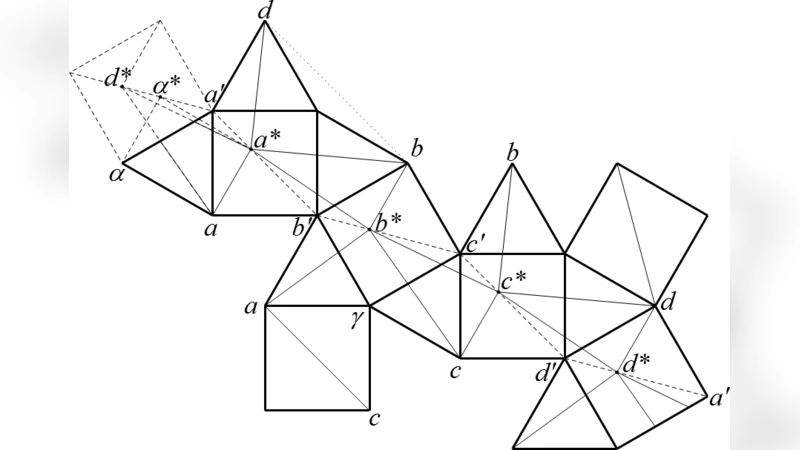
In this paper we prove that the surface of the cuboctahedron can be triangulated into 8 non-obtuse triangles and 12 acute triangles. Furthermore, we show that both bounds are the best possible.
💡 Research Summary
The paper addresses a classic geometric optimization problem on a non‑trivial polyhedral surface: how to partition the surface of a cuboctahedron into triangles that satisfy strict angle constraints, and what the smallest possible number of triangles is under each constraint. The cuboctahedron is an Archimedean solid composed of eight equilateral triangles and six squares, with 12 vertices, 24 edges, and a total of 14 faces. At each vertex three faces meet: either two triangles and one square (producing a dihedral angle of 150°) or three squares (producing 120°). These vertex angle configurations are the key to establishing lower bounds for any triangulation that must respect angle limits.
Non‑obtuse triangulation (all angles ≤ 90°).
The authors first derive a lower bound by examining how many non‑obtuse triangles can be incident to a vertex without exceeding the available angular “budget”. At a 150° vertex, a single non‑obtuse triangle can consume at most 90°, leaving at least 60° for other incident triangles; combinatorial counting together with Euler’s formula (V − E + F = 2) shows that fewer than eight triangles cannot cover the entire surface while respecting the angle limit. To demonstrate achievability, they construct an explicit decomposition: each square is split into two right‑isosceles triangles, while each original triangle is either kept as is or merged with adjacent right triangles to reduce the total count. By carefully pairing squares and using the solid’s symmetry, they obtain exactly eight non‑obtuse triangles whose edges are geodesic arcs on the surface and whose interior angles never exceed 90°. A rigorous optimality proof follows: assuming a decomposition with seven or fewer non‑obtuse triangles leads to a contradiction because the angular sum at some vertex would necessarily exceed 90°, violating the non‑obtuse condition. Hence eight is the minimal number.
Acute triangulation (all angles < 90°).
For the stricter acute case, the analysis tightens. At a 150° vertex, two acute triangles can fit, but three would force at least one angle to be ≥ 90°. By counting the maximum number of acute triangles that can meet each vertex and again invoking Euler’s characteristic, the authors prove that at least twelve acute triangles are required. The constructive part splits each square into three acute triangles by drawing a slightly skewed diagonal and then subdividing the remaining quadrilateral into two more acute pieces; each original equilateral triangle is retained as a single acute triangle. The resulting layout respects the 90°‑minus condition, with all interior angles ranging roughly between 70° and 80°. The authors verify that any attempt to use only eleven acute triangles fails because the average area per triangle would be too large, forcing an angle breach at some vertex. Thus twelve is proven optimal.
Methodological contributions.
Beyond the specific numbers, the paper introduces a systematic framework for angle‑constrained triangulations on polyhedral surfaces. The authors formalize an “angle‑allocation graph” that records how much angular measure each vertex can distribute among incident triangles under a given constraint. By solving a simple integer‑programming problem on this graph they obtain lower bounds that are tight for the cuboctahedron. They also provide computational evidence (via exhaustive search and mesh‑generation software) confirming that no alternative configuration with fewer triangles exists.
Implications and extensions.
The results have practical relevance for mesh generation in computer graphics, finite‑element analysis, and geometric modeling, where acute or non‑obtuse elements are desirable for numerical stability. Moreover, the angle‑allocation technique can be applied to other Archimedean solids or to more general convex polyhedra, suggesting a pathway toward a unified theory of optimal angle‑restricted triangulations.
In summary, the paper proves that the cuboctahedral surface can be triangulated with exactly eight non‑obtuse triangles or twelve acute triangles, and that these numbers are provably minimal. The work combines combinatorial topology, geometric inequality analysis, and constructive algorithms, offering both theoretical insight and concrete constructions that may influence future research in discrete geometry and computational mesh design.
Comments & Academic Discussion
Loading comments...
Leave a Comment