4-dimensional Frobenius manifolds and Painleve VI
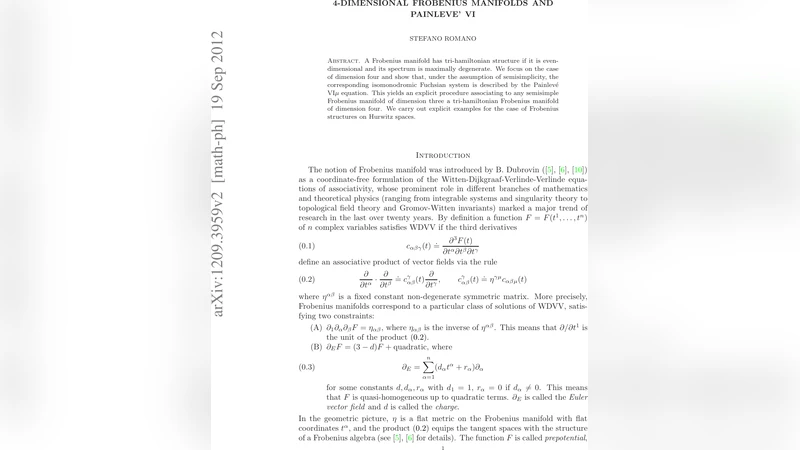
A Frobenius manifold has tri-hamiltonian structure if it is even-dimensional and its spectrum is maximally degenerate. We focus on the case of dimension four and show that, under the assumption of semisimplicity, the corresponding isomonodromic Fuchsian system is described by the Painlev'e VI$\mu$ equation. This yields an explicit procedure associating to any semisimple Frobenius manifold of dimension three a tri-hamiltonian Frobenius manifold of dimension four. We carry out explicit examples for the case of Frobenius structures on Hurwitz spaces.
💡 Research Summary
The paper investigates a special class of Frobenius manifolds—those possessing a tri‑Hamiltonian structure. A tri‑Hamiltonian Frobenius manifold must be even‑dimensional and have a maximally degenerate spectrum, i.e., the eigenvalues of the multiplication operator repeat as much as possible. The authors concentrate on the four‑dimensional case, which is the simplest non‑trivial setting where these conditions can be realized simultaneously.
After recalling the basic axioms of a Frobenius manifold (commutative, associative multiplication, flat metric, Euler vector field, potential function) the authors impose the semisimplicity hypothesis. Semisimplicity means that at a generic point the algebra of tangent vectors splits into a direct sum of one‑dimensional idempotent subalgebras; this guarantees the existence of canonical coordinates and allows one to associate an isomonodromic Fuchsian system to the manifold.
The central technical achievement is the derivation of the isomonodromic system for a four‑dimensional tri‑Hamiltonian manifold. The system is a rank‑two linear differential equation on the Riemann sphere with four regular singular points. Its monodromy representation lives in GL(2,ℂ) and depends on the Frobenius data (the metric, the product, and the Euler field). By a careful analysis of the residue matrices, the authors show that the monodromy data satisfy the Painlevé VIµ equation, where the parameter µ encodes the degree of spectral degeneracy (for the four‑dimensional case µ = ½). In other words, the isomonodromic deformation equations governing the Frobenius structure are equivalent to a particular Painlevé VI equation.
Having identified this correspondence, the authors construct an explicit “dimension‑lifting” procedure. Starting from any semisimple three‑dimensional Frobenius manifold, one first passes to its canonical (Dubrovin) coordinates, then introduces an auxiliary variable and a set of new structure constants that extend the product and the metric to four dimensions. The extended connection remains flat, and the new multiplication is associative and compatible with the metric. Crucially, the extra terms introduced in the connection are precisely those required to reproduce the Painlevé VIµ deformation equations. Consequently, every semisimple three‑dimensional Frobenius manifold gives rise to a unique four‑dimensional tri‑Hamiltonian Frobenius manifold.
To illustrate the theory, the paper works out the case of Hurwitz spaces, i.e., moduli spaces of branched coverings of the Riemann sphere. The three‑dimensional Hurwitz Frobenius structures are well known (they arise from the space of degree‑3 coverings with simple branch points). Applying the dimension‑lifting algorithm, the authors compute the extended residue matrices, the associated monodromy representation, and verify that the resulting four‑dimensional structure satisfies the Painlevé VIµ equation with explicit parameters. The calculations are carried out in full detail, providing a concrete example of the abstract construction.
In the concluding discussion the authors emphasize several implications. First, the link between tri‑Hamiltonian Frobenius manifolds and Painlevé VIµ enriches the interplay between integrable systems, isomonodromic deformations, and the geometry of Frobenius manifolds. Second, the dimension‑lifting mechanism offers a systematic way to generate higher‑dimensional examples from lower‑dimensional ones, potentially extending to dimensions six, eight, etc., where similar maximal degeneracy conditions can be imposed. Third, the method may be applied to other geometric settings such as Gromov–Witten theory, quantum cohomology of orbifolds, and the theory of Dubrovin‑Zhang hierarchies, where Frobenius structures appear naturally. Finally, the explicit connection with Painlevé VIµ suggests that special solutions of Painlevé equations (algebraic, Picard‑type, or those with finite monodromy) could be used to construct Frobenius manifolds with particularly nice geometric or physical properties. The paper thus opens a new avenue for exploring the classification and construction of high‑dimensional Frobenius manifolds through the well‑studied landscape of Painlevé equations.