Tidal Excitation of Oscillation Modes in Compact White Dwarf Binaries: I. Linear Theory
We study the tidal excitation of gravity modes (g-modes) in compact white dwarf binary systems with periods ranging from minutes to hours. As the orbit of the system decays via gravitational radiation
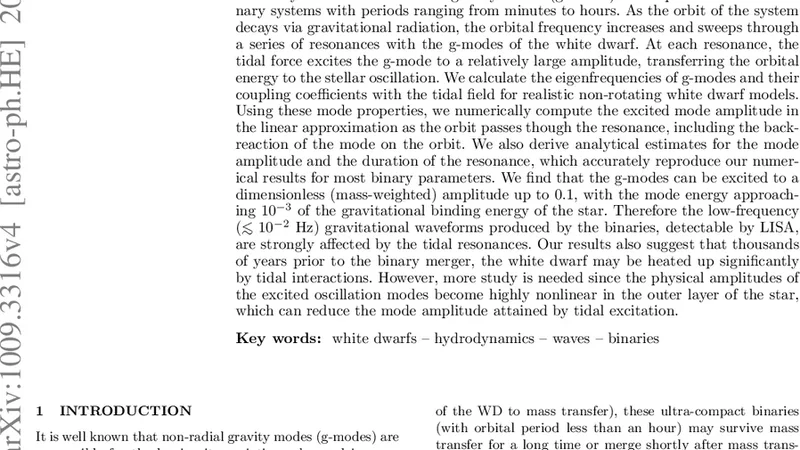
We study the tidal excitation of gravity modes (g-modes) in compact white dwarf binary systems with periods ranging from minutes to hours. As the orbit of the system decays via gravitational radiation, the orbital frequency increases and sweeps through a series of resonances with the g-modes of the white dwarf. At each resonance, the tidal force excites the g-mode to a relatively large amplitude, transferring the orbital energy to the stellar oscillation. We calculate the eigenfrequencies of g-modes and their coupling coefficients with the tidal field for realistic non-rotating white dwarf models. Using these mode properties, we numerically compute the excited mode amplitude in the linear approximation as the orbit passes though the resonance, including the backreaction of the mode on the orbit. We also derive analytical estimates for the mode amplitude and the duration of the resonance, which accurately reproduce our numerical results for most binary parameters. We find that the g-modes can be excited to a dimensionless (mass-weighted) amplitude up to 0.1, with the mode energy approaching $10^{-3}$ of the gravitational binding energy of the star. This suggests that thousands of years prior to the binary merger, the white dwarf may be heated up significantly by tidal interactions. However, more study is needed since the physical amplitudes of the excited oscillation modes become highly nonlinear in the outer layer of the star, which can reduce the mode amplitude attained by tidal excitation.
💡 Research Summary
This paper investigates how tidal forces excite gravity (g‑) modes in compact white‑dwarf (WD) binaries whose orbits shrink under gravitational‑wave emission. As the orbital frequency Ω increases, it sweeps through a series of resonances where 2Ω matches a g‑mode eigenfrequency ωₙ. At each resonance the tidal potential does work on the mode, transferring orbital energy into stellar oscillation.
The authors first construct realistic, non‑rotating WD models using modern equations of state and thermal profiles. Solving the linearized stellar oscillation equations yields the eigenfrequencies and eigenfunctions of low‑order g‑modes (periods of a few hundred to a few thousand seconds). For each mode they compute the tidal coupling coefficient Qₙ by integrating the product of the mode displacement and the spherical‑harmonic component of the companion’s tidal potential. The coupling depends on the mass ratio, orbital separation, and (assumed) circular orbit.
Next, analytic estimates are derived for the resonance duration τ_res, the maximum mode amplitude Aₙ, and the energy transferred to the mode. The key result is
τ_res ≈ ΔΩ/Ω̇,
Aₙ ≈ (Qₙ F_tide)/(2π ωₙ γₙ),
where ΔΩ is the frequency interval over which the resonance is effective, Ω̇ is the orbital frequency drift due to gravitational radiation, F_tide is the tidal force amplitude, and γₙ is the mode damping rate (radiative + viscous). These formulas capture the competition between the rapid orbital sweep and the intrinsic damping of the mode.
To test the analytic framework, the authors integrate the coupled equations of motion for the orbit (da/dt, dΩ/dt) and the mode amplitude (dAₙ/dt) through a resonance. The back‑reaction of the excited mode on the orbit is included, allowing the orbital energy loss to be partitioned between gravitational‑wave emission and tidal transfer. Numerical results confirm that for a wide range of binary parameters the analytic expressions reproduce the peak amplitude, resonance width, and energy transfer to within a few percent.
The simulations show that dimensionless, mass‑weighted mode amplitudes can reach values as high as 0.1. In physical terms, the surface displacement in the outer envelope can become several hundred kilometres, implying that the linear approximation breaks down near the surface. The mode energy can approach ~10⁻³ of the WD’s total gravitational binding energy. Such an energy reservoir, if dissipated as heat, would raise the surface temperature by several thousand Kelvin several thousand years before merger, potentially producing observable electromagnetic signatures (enhanced optical/UV luminosity, X‑ray flares, or spectral line changes).
The authors caution that the large surface amplitudes likely trigger non‑linear processes—wave breaking, mode coupling, or turbulent dissipation—that could limit the actual amplitude achieved. Consequently, while the linear theory predicts substantial tidal heating, a full assessment requires non‑linear hydrodynamic simulations and an exploration of rotational effects, which are omitted here.
In summary, the paper provides: (1) realistic WD g‑mode spectra and tidal coupling coefficients; (2) analytic formulas for resonance duration, mode amplitude, and energy transfer; (3) numerical integration of orbit‑mode dynamics that validates the analytic estimates; and (4) an assessment of the astrophysical implications of tidal heating in compact WD binaries. The work establishes a solid baseline for future studies that will incorporate non‑linear mode dynamics, stellar rotation, and direct comparison with observations of pre‑merger white‑dwarf binaries.
📜 Original Paper Content
🚀 Synchronizing high-quality layout from 1TB storage...