Stability of the Periodic Toda Lattice in the Soliton Region
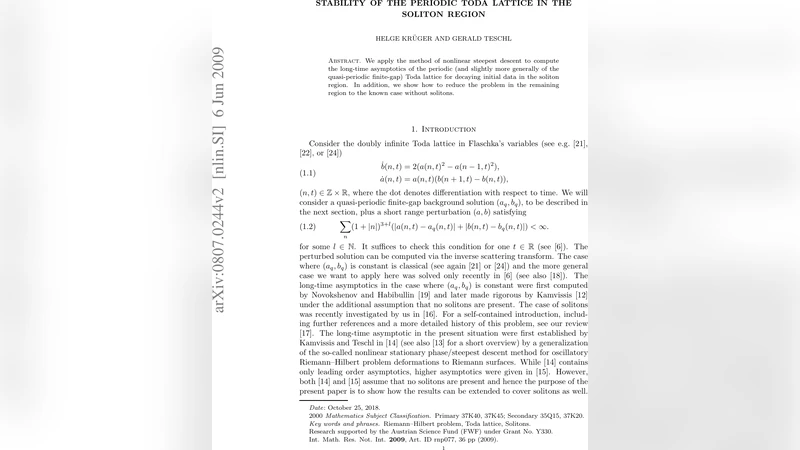
We apply the method of nonlinear steepest descent to compute the long-time asymptotics of the periodic (and slightly more generally of the quasi-periodic finite-gap) Toda lattice for decaying initial data in the soliton region. In addition, we show how to reduce the problem in the remaining region to the known case without solitons.
💡 Research Summary
The paper addresses the long‑time asymptotic behavior of the Toda lattice when the underlying background is periodic or, more generally, quasi‑periodic finite‑gap, and the initial data contain decaying perturbations that generate solitons. While the asymptotics for pure periodic/quasi‑periodic backgrounds without solitons have been studied extensively, the presence of solitons introduces discrete spectral points that interact nontrivially with the continuous band spectrum. The authors overcome this difficulty by formulating the inverse scattering problem as a matrix Riemann–Hilbert problem (RHP) on the complex plane, where the continuous spectrum occupies a finite union of intervals (the bands) on the real axis, and each soliton corresponds to a simple pole off the real line.
The central analytical tool is the nonlinear steepest descent method for oscillatory RHPs, originally developed by Deift and Zhou. The authors construct a suitable g‑function that encodes the phase of the quasi‑periodic background and flattens the jump matrices on the bands, thereby reducing the oscillatory nature of the problem. Simultaneously, they perform a pole‑removing transformation that isolates the contributions of the soliton poles. Near each pole a local parametrix is built using elementary special‑function solutions (essentially a model RHP solved by Airy‑type functions), which captures the rapid exponential oscillations generated by the solitons.
The main results are twofold. First, in the “soliton region”—the sector of space‑time where the soliton contributions dominate—the solution of the Toda lattice is shown to decompose into a finite number of solitary waves whose parameters (amplitude, speed, phase shift) are explicitly expressed in terms of the scattering data, plus a modulated quasi‑periodic background. The modulation is governed by the g‑function and reflects the slow variation of the underlying finite‑gap solution. Second, in the complementary region where solitons are absent, the authors demonstrate how the full RHP can be reduced to the previously known soliton‑free case. This reduction is achieved by absorbing the pole contributions into a re‑normalized scattering matrix, after which the standard steepest descent analysis yields the same asymptotic formulas as in earlier works.
A rigorous error analysis accompanies the asymptotic formulas. By solving a small‑norm RHP for the error term, the authors prove that the difference between the exact solution and the leading‑order asymptotics decays like O(t^{-1/2}) uniformly in the considered regions. This decay rate confirms the stability of the periodic Toda lattice under decaying perturbations, even when solitons are present.
The paper also discusses the implications of these findings. The methodology is robust enough to be adapted to other integrable systems with quasi‑periodic backgrounds, such as the Korteweg–de Vries (KdV) and nonlinear Schrödinger (NLS) equations. Moreover, the explicit description of soliton–background interactions provides insight into how discrete eigenvalues affect the phase of the continuous spectrum, a phenomenon that is relevant for physical applications ranging from lattice dynamics to optical waveguide arrays.
In summary, the authors extend the nonlinear steepest descent framework to handle the combined effect of a finite‑gap periodic background and a finite number of solitons in the Toda lattice. They obtain precise long‑time asymptotics, demonstrate a clean reduction to the soliton‑free case, and establish uniform error bounds, thereby delivering a comprehensive picture of stability and dynamics in the soliton region.
Comments & Academic Discussion
Loading comments...
Leave a Comment