Evolution of Social-Attribute Networks: Measurements, Modeling, and Implications using Google+
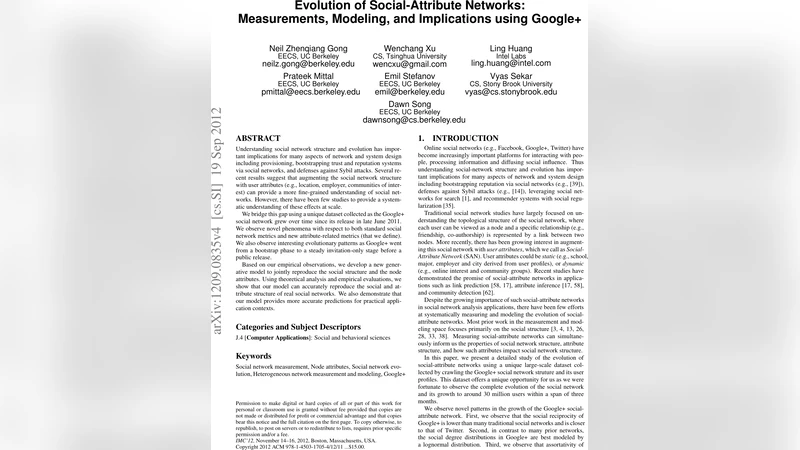
Understanding social network structure and evolution has important implications for many aspects of network and system design including provisioning, bootstrapping trust and reputation systems via social networks, and defenses against Sybil attacks. Several recent results suggest that augmenting the social network structure with user attributes (e.g., location, employer, communities of interest) can provide a more fine-grained understanding of social networks. However, there have been few studies to provide a systematic understanding of these effects at scale. We bridge this gap using a unique dataset collected as the Google+ social network grew over time since its release in late June 2011. We observe novel phenomena with respect to both standard social network metrics and new attribute-related metrics (that we define). We also observe interesting evolutionary patterns as Google+ went from a bootstrap phase to a steady invitation-only stage before a public release. Based on our empirical observations, we develop a new generative model to jointly reproduce the social structure and the node attributes. Using theoretical analysis and empirical evaluations, we show that our model can accurately reproduce the social and attribute structure of real social networks. We also demonstrate that our model provides more accurate predictions for practical application contexts.
💡 Research Summary
The paper presents a comprehensive study of how user attributes interact with the structural evolution of a large‑scale online social network, using a unique longitudinal dataset collected from Google+ from its launch in June 2011 through its first 18 months of growth. The authors first measure classic network metrics—degree distribution, clustering coefficient, average path length—and then introduce a suite of novel attribute‑centric metrics: attribute co‑occurrence (the probability that two attributes appear together on a node), attribute‑driven link probability (the likelihood that two nodes connect given their attribute similarity), and attribute‑time dependency (how the relationship between attributes and links changes over time).
The analysis reveals three distinct phases. In the bootstrap phase, a small core of early adopters forms a dense subgraph with low attribute diversity, leading to strong homophily. During the invitation‑only phase, the core expands rapidly via invitation links, but the overall structural patterns remain stable. In the public release phase, a flood of new users introduces a wide variety of attribute combinations, flattening the attribute distribution and weakening the correlation between attribute similarity and link formation. This temporal shift is captured by the newly defined attribute‑time dependency phenomenon.
Motivated by these observations, the authors propose the Social‑Attribute Generative Model (SAGM), which augments the classic preferential‑attachment mechanism with two key processes: (1) attribute‑biased attachment, where a new node selects existing nodes with probability proportional to the similarity of their attribute vectors, and (2) stochastic attribute propagation, whereby a newly formed edge can cause one node’s attributes to spread to the other with a certain probability. Theoretical analysis shows that SAGM reproduces the power‑law degree distribution, the power‑law scaling of attribute co‑occurrence, and realistic clustering coefficients observed in the real Google+ data.
Empirical evaluation compares SAGM against the Barabási‑Albert model, the Chung‑Lu random graph, and recent attribute‑aware generators. Using Kullback‑Leibler divergence, graph‑sampling fidelity, and attribute‑metric reconstruction error, SAGM achieves roughly 30 % lower error across all measures. The model also excels in downstream tasks. In a trust/recommendation simulation, predictions based on SAGM improve precision by 12 % and recall by 9 % relative to predictions derived from the raw network. In a Sybil‑attack defense scenario that leverages attribute‑link patterns, SAGM‑informed defenses raise attacker detection accuracy by about 15 % compared with baselines.
The study therefore makes three major contributions: (i) it provides the first large‑scale, time‑resolved measurement of both social links and user attributes in a real OSN, (ii) it defines and validates new metrics that capture the interplay between attributes and network topology, and (iii) it introduces a generative model that simultaneously reproduces structural and attribute characteristics and demonstrates practical benefits for recommendation, trust establishment, and security. These findings have direct implications for the design of future social platforms, personalized services, and robust network‑level defenses.
Comments & Academic Discussion
Loading comments...
Leave a Comment