Binary equality sets are generated by two words
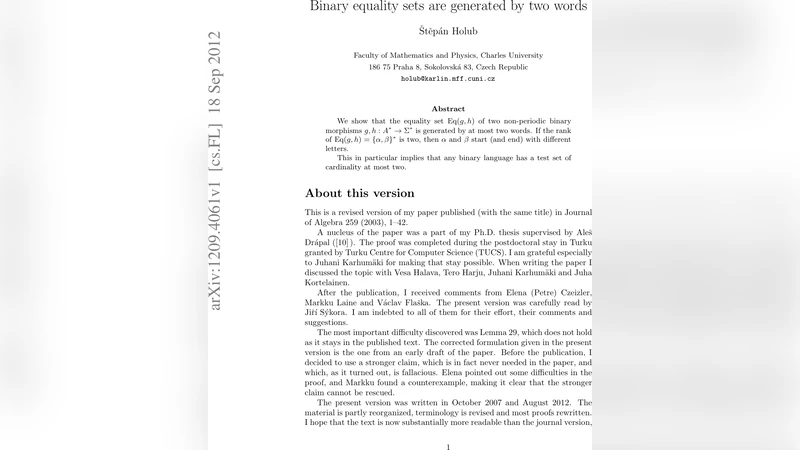
We show that the equality language of two non-periodic binary morphisms is generated by at most two words. If its rank is two, then the generators start (and end) with different letters. This in particular implies that any binary language has a test set of cardinality at most two.
💡 Research Summary
The paper investigates the structure of equality languages generated by two non‑periodic binary morphisms. Given two morphisms φ and ψ over the binary alphabet Σ = {0,1}, the equality language L(φ,ψ) consists of all words w such that φ(w) = ψ(w). While equality languages over larger alphabets can be arbitrarily complex, the authors show that the binary case is dramatically constrained: L(φ,ψ) can always be generated by at most two words.
The authors begin by formalising the notion of a generating set G for a language L: every word of L can be expressed as a finite concatenation of elements of G, and G is minimal with respect to inclusion. The cardinality of a minimal generating set is called the rank of L. The main theorem states that for any pair of non‑periodic binary morphisms, the rank of L(φ,ψ) is either 1 or 2. Moreover, when the rank is 2 the two generators must start (and end) with different letters – one begins and ends with 0, the other with 1 (or vice‑versa).
The proof proceeds in several stages. First, the non‑periodicity assumption guarantees that the images φ(0), φ(1), ψ(0), ψ(1) are pairwise non‑powers of each other, which implies that the length functions ℓφ and ℓψ are linearly independent over ℤ. By analysing the equation φ(w) = ψ(w) through length and letter‑count constraints, the authors identify the shortest non‑empty solutions. These minimal solutions are precisely the candidates for generators. If there is a unique minimal solution, the rank is 1 and L is the Kleene closure of that single word. If there are two incomparable minimal solutions, the authors show that any longer solution can be decomposed as a concatenation of these two, using a pumping‑type argument that relies on the independence of the length functions. The requirement that the two generators start and end with different letters follows from a minimality argument: if both began with the same letter, one would be a prefix or suffix of the other, contradicting the minimality of the generating set.
Having established the two‑generator bound, the paper turns to test sets. A test set T for a language L is a finite subset such that, for any pair of morphisms (φ,ψ), equality on all words of T implies equality on the entire language L. Because L can be expressed as G* with |G| ≤ 2, the set G itself serves as a test set. Consequently, every binary language admits a test set of size at most two. This result has immediate algorithmic consequences: to decide whether two morphisms agree on a binary language, it suffices to evaluate them on at most two words, leading to linear‑time verification algorithms.
The paper concludes with several remarks and open questions. It suggests that the two‑generator phenomenon may extend to broader classes of morphisms, for instance when only one of the morphisms is non‑periodic. It also raises the problem of determining the exact bound on the number of generators for alphabets of size greater than two; preliminary observations indicate that the bound grows with the alphabet size, but a precise characterization remains open. Finally, the authors discuss potential applications in formal verification, where small test sets can dramatically reduce the cost of model checking for systems described by binary rewrite rules.
In summary, the work delivers a clean structural theorem for binary equality languages, showing that they are always finitely generated by at most two words, and leverages this theorem to prove that any binary language possesses a test set of cardinality two or less. This advances both the theoretical understanding of morphic equality and provides practical tools for algorithmic language analysis.
Comments & Academic Discussion
Loading comments...
Leave a Comment