Content Management in Ruby on Rails
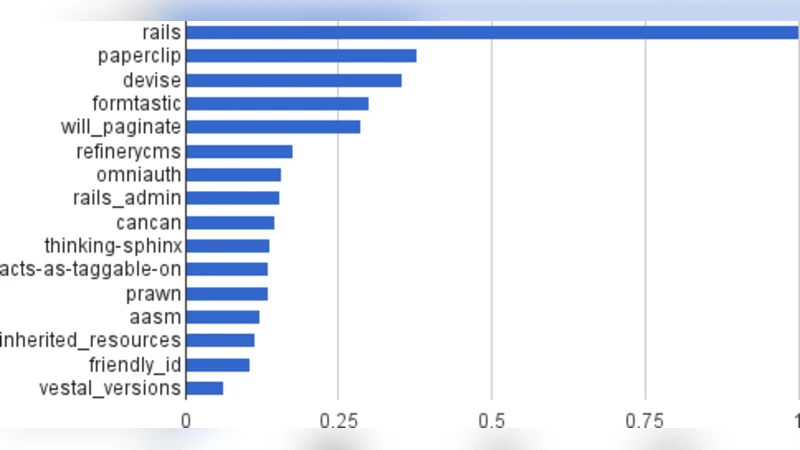
Web development is currently driven by model-view-controller (MVC) frameworks. How has content management adapted to this scenario? This paper reviews content management features in Ruby on Rails framework and its most popular plug-ins. These features are distributed among the different layers of the MVC architecture.
💡 Research Summary
The paper examines how content management (CM) has evolved within the dominant model‑view‑controller (MVC) paradigm of modern web development, focusing specifically on the Ruby on Rails (Rails) framework and its most widely adopted plug‑ins. It begins by outlining the intrinsic CM capabilities that Rails provides across its three core layers. In the model layer, ActiveRecord serves as an object‑relational mapper that automatically maps database schemas to domain objects, enabling developers to define content structures with minimal boilerplate. The paper highlights how auxiliary gems such as paper_trail (for versioning), globalize (for multilingual fields), and state‑machine libraries (e.g., aasm) can be mixed into models to handle version control, localization, and workflow states without violating the MVC separation of concerns.
The view layer is built on ActionView and supports multiple templating engines (ERB, Haml, Slim). Layouts, partials, and helper methods allow for reusable presentation components, while the asset pipeline (or modern equivalents like jsbundling‑rails and cssbundling‑rails) streamlines the management of CSS, JavaScript, and media assets. Integration with WYSIWYG editors (TinyMCE, CKEditor) is straightforward, giving content editors a rich editing experience directly within Rails applications.
In the controller layer, Rails’ RESTful routing and filter chain (before_action, after_action) provide a declarative way to expose CRUD endpoints for any content type. The resources macro automatically generates routes, while strong parameters enforce mass‑assignment protection. Controllers can also respond to multiple formats (HTML, JSON, XML) via respond_to, supporting API‑first strategies alongside traditional page rendering.
The core contribution of the paper is its analysis of the most popular Rails‑based CM plug‑ins—RefineryCMS, Radiant, Comfortable Mexican Sofa, and AlchemyCMS—and how they leverage Rails engines (mountable engines). An engine encapsulates its own routes, models, migrations, views, and controllers, yet can be mounted into a host application with a single mount statement. This architecture preserves namespace isolation, prevents migration conflicts, and enables developers to add or remove a complete CM subsystem without touching the main codebase.
Each plug‑in is described in detail. RefineryCMS offers an intuitive admin UI, built‑in page, image, and file management, and a modular gem architecture that lets developers include only the needed components. Radiant is lightweight, emphasizes a template‑driven page hierarchy, and provides an “extension” system for custom functionality. Comfortable Mexican Sofa focuses on a tree‑structured page model, slug‑based routing, and drag‑and‑drop layout editing with a built‑in WYSIWYG editor. AlchemyCMS distinguishes itself with strong multilingual support, SEO‑focused metadata handling, and an admin interface reminiscent of ActiveAdmin.
All these plug‑ins make extensive use of Rails concerns and modules to avoid code duplication, and they benefit from Rails’ built‑in caching mechanisms (fragment caching, low‑level caching) and background‑job infrastructure (ActiveJob, Sidekiq). The paper shows how fragment caching can store rendered snippets of content, while heavy media processing (image resizing, PDF generation) can be off‑loaded to background workers, thereby preserving request latency even under high traffic.
Security considerations are also addressed. Rails’ default protection against CSRF attacks and its strong‑parameters system apply uniformly across engines. Most CM plug‑ins integrate authentication solutions such as Devise or OmniAuth, and they employ authorization libraries like Cancancan or Pundit to implement role‑based access control (RBAC). This unified security model mitigates the fragmentation and privilege‑escalation risks that often plague traditional monolithic CMS platforms.
In conclusion, the paper argues that Rails provides a cohesive, layered foundation for content management: the model layer handles data integrity and versioning, the view layer delivers reusable presentation, and the controller layer orchestrates RESTful interactions. The engine/plug‑in ecosystem extends these capabilities, offering modular, reusable, and secure CM solutions that can be seamlessly integrated into any Rails application. The authors suggest future research directions, including deeper integration with Rails 7 features such as import‑maps, Hotwire (Turbo + Stimulus), and real‑time collaboration tools, to push the boundaries of interactive, live‑updating content management within the Rails ecosystem.
Comments & Academic Discussion
Loading comments...
Leave a Comment