Distributed Multi-objective Multidisciplinary Design Optimization Algorithms
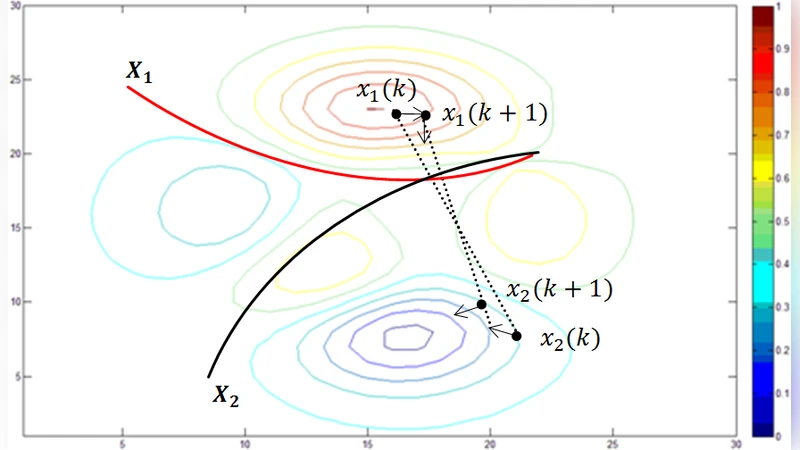
This work proposes multi-agent systems setting for concurrent engineering system design optimization and gradually paves the way towards examining graph theoretic constructs in the context of multidisciplinary design optimization problem. The flow of the algorithm can be described as follow; generated estimates of the optimal (shared design) variables are exchanged locally with neighbor subspaces and then updated by computing a weighted sum of the local and received estimates. To comply with the consistency requirement, the resultant values are projected to local constraint sets. By employing the existing rules and results of the field, it has shown that the dual task of reaching consensus and asymptotic convergence of the algorithms to locally and globally optimal and consistent designs can be achieved. Finally, simulations are provided to illustrate the effectiveness and capability of the presented framework.
💡 Research Summary
The paper tackles the growing need for scalable multidisciplinary design optimization (MDO) by casting the problem as a distributed multi‑agent system. Traditional centralized MDO gathers all design variables, objectives, and constraints into a single optimizer, which quickly becomes infeasible for large‑scale aerospace, automotive, or energy systems where each discipline operates semi‑independently and communication bandwidth is limited. The authors therefore propose a graph‑theoretic framework in which each subsystem is represented by an agent that holds a local estimate of the shared design variables and updates this estimate through local interactions with neighboring agents.
The algorithm proceeds in four steps at each iteration k. First, each agent i collects the current estimates (\mathbf{x}_j(k)) from its neighbors (\mathcal{N}_i) according to a communication graph (\mathcal{G}=(\mathcal{V},\mathcal{E})). Second, a weighted average is computed: \
Comments & Academic Discussion
Loading comments...
Leave a Comment