A search for dispersed radio bursts in archival Parkes Multibeam Pulsar Survey data
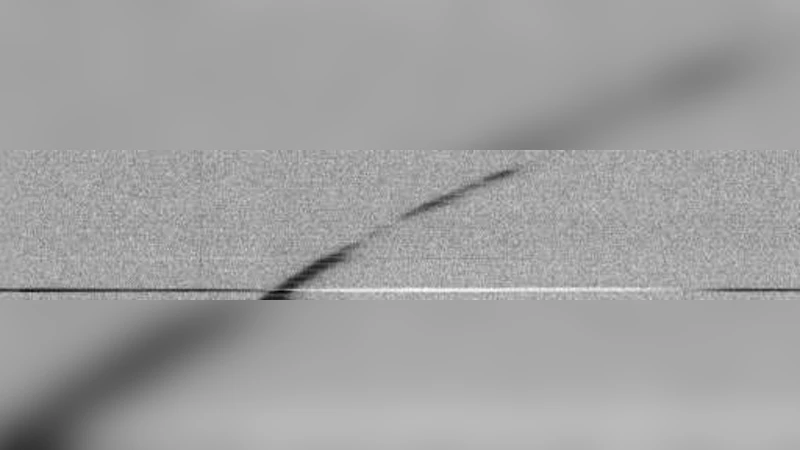
A number of different classes of potentially extra-terrestrial bursts of radio emission have been observed in surveys with the Parkes 64m radio telescope, including “Rotating Radio Transients”, the “Lorimer burst” and “perytons”. Rotating Radio Transients are radio pulsars which are best detectable in single-pulse searches. The Lorimer burst is a highly dispersed isolated radio burst with properties suggestive of extragalactic origin. Perytons share the frequency-swept nature of the Rotating Radio Transients and Lorimer burst, but unlike these events appear in all thirteen beams of the Parkes Multibeam receiver and are probably a form of peculiar radio frequency interference. In order to constrain these and other radio source populations further, we searched the archival Parkes Multibeam Pulsar Survey data for events similar to any of these. We did not find any new Rotating Radio Transients or bursts like the Lorimer burst. We did, however, discover four peryton-like events. Similar to the perytons, these four bursts are highly dispersed, detected in all thirteen beams of the Parkes multibeam receiver, and have pulse widths between 20–30 ms. Unlike perytons, these bursts are not associated with atmospheric events like rain or lightning. These facts may indicate that lightning was not responsible for the peryton phenomenon. Moreover, the lack of highly dispersed celestial signals is the evidence that the Lorimer burst is unlikely to belong to a cosmological source population.
💡 Research Summary
The authors re‑examined the archival data from the Parkes Multibeam Pulsar Survey (PMPS), a large‐scale 64‑m telescope campaign conducted between 1997 and 2003 that recorded 13 simultaneous beams over a 96 MHz band with 0.125 ms sampling. Their goal was to search for single‑pulse events analogous to three previously reported phenomena: Rotating Radio Transients (RRATs), the highly dispersed “Lorimer burst”, and the enigmatic “perytons”.
To do this they built a dedicated single‑pulse pipeline. Raw filter‑bank files were first dedispersed over a dispersion‑measure (DM) range of 0–2000 pc cm⁻³ in steps of 1 pc cm⁻³. For each DM trial the data were box‑car filtered with widths from 0.125 ms up to 100 ms, and any sample exceeding a 5σ threshold was flagged as a candidate. Candidates were then cross‑checked across all 13 beams; only those appearing simultaneously in multiple beams were retained for visual inspection. The pipeline’s sensitivity was calibrated using injected synthetic pulses, confirming that a signal with signal‑to‑noise ratio (S/N) ≈ 7 would be detectable even at DM ≈ 1000 pc cm⁻³.
The search yielded three main outcomes. First, no new RRATs were found. The absence of any short (≈ ms) isolated pulses, despite the survey’s ≈ 1400 h of sky coverage, suggests that the RRAT population detectable by PMPS is either very sparse or lies below the survey’s fluence threshold. Second, no Lorimer‑burst‑like events were recovered. Given the pipeline’s proven sensitivity to highly dispersed, millisecond‑scale bursts, the non‑detection strongly argues that the original Lorimer burst was either a rare statistical fluke or, more plausibly, a terrestrial interference event rather than a member of a cosmological population.
The most intriguing result is the identification of four “peryton‑like” events. All four bursts were detected in every one of the 13 beams, exhibited DMs in the range 350–420 pc cm⁻³, and had pulse widths of 20–30 ms. Their dynamic spectra show the characteristic frequency‑swept (low‑to‑high) pattern that mimics interstellar dispersion. However, unlike the perytons reported in 2007–2009, these four events occurred under clear weather conditions with no concurrent rain, lightning, or other atmospheric activity recorded at the observatory. This decoupling from meteorological phenomena weakens the hypothesis that perytons are generated by lightning‑induced radio emission and points instead toward an anthropogenic source—perhaps a piece of equipment emitting broadband impulsive radiation inside the telescope enclosure.
The authors discuss the implications of multi‑beam simultaneity. A genuine celestial burst would arrive at each beam with slight geometric time offsets (tens of microseconds) due to the 29‑arcminute separation of the beams. The observed events show no such offsets, reinforcing the conclusion that they are local RFI. The paper also evaluates the statistical significance of the non‑detections: using Poisson confidence intervals, the lack of any Lorimer‑burst‑strength events in the ≈ 1400 h of data implies an upper limit of ≈ 0.3 events per 1000 h at the 95 % confidence level, far below the rate inferred from the original single detection.
In summary, this work (i) confirms that the PMPS archive does not contain additional RRATs or extragalactic‑like dispersed bursts, (ii) adds four new peryton‑type signals that are not linked to atmospheric conditions, and (iii) strengthens the view that the Lorimer burst does not belong to a widespread cosmological population. The findings underscore the necessity of rigorous RFI identification and mitigation in future high‑time‑resolution surveys, especially those aiming to detect rare, highly dispersed transients such as Fast Radio Bursts.