Uniqueness of enhancement for triangulated categories
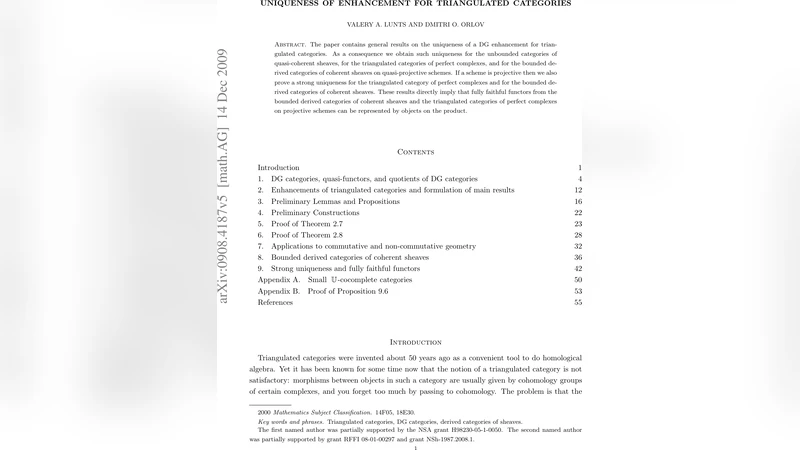
The paper contains general results on the uniqueness of a DG enhancement for triangulated categories. As a consequence we obtain such uniqueness for the unbounded categories of quasi-coherent sheaves, for the triangulated categories of perfect complexes, and for the bounded derived categories of coherent sheaves on quasi-projective schemes. If a scheme is projective then we also prove a strong uniqueness for the triangulated category of perfect complexes and for the bounded derived categories of coherent sheaves. These results directly imply that fully faithful functors from the bounded derived categories of coherent sheaves and the triangulated categories of perfect complexes on projective schemes can be represented by objects on the product.
💡 Research Summary
**
The paper addresses a fundamental problem in the theory of triangulated categories: when does a differential graded (DG) enhancement exist, and if it does, is it unique? While DG enhancements are known to exist for many specific triangulated categories, a general criterion guaranteeing both existence and uniqueness has been lacking. The authors develop a comprehensive framework that provides such a criterion under natural “generation” hypotheses, and they apply this framework to several important geometric contexts.
General Uniqueness Theorem
The authors begin by fixing a triangulated category 𝒞 that is compactly generated (or more generally well generated). The key assumptions are: (i) 𝒞 admits all small coproducts, (ii) it satisfies Brown representability, and (iii) its compact objects generate the whole category via homotopy colimits. Under these conditions, 𝒞 is enhanceable: there exists a DG category 𝔄 whose homotopy category H⁰(𝔄) is equivalent to 𝒞. Moreover, any two such DG enhancements are strongly unique: there is a DG functor between them which is a quasi‑equivalence, and this functor induces the identity on the homotopy category up to natural isomorphism. The proof proceeds by first replacing each enhancement with cofibrant–fibrant models in an appropriate model structure on DG categories, then constructing a derived Morita equivalence between the models. Central technical tools include dg‑quotients, dg‑localizations, and Bousfield localization techniques.
Applications to Algebraic Geometry
-
Unbounded Derived Category of Quasi‑coherent Sheaves
For a quasi‑compact, quasi‑separated scheme X, the unbounded derived category D(QCoh X) is compactly generated, with compact objects precisely the perfect complexes Perf X. Applying the general theorem yields existence and strong uniqueness of a DG enhancement for D(QCoh X). This result holds without any projectivity or smoothness assumptions. -
Triangulated Category of Perfect Complexes
Perf X, the full subcategory of compact objects in D(QCoh X), inherits the same generation properties. When X is quasi‑projective, Perf X is smooth and proper as a DG category, and the uniqueness theorem guarantees a unique DG enhancement. If X is projective, the presence of an ample line bundle and Serre duality further reinforce the strong uniqueness. -
Bounded Derived Category of Coherent Sheaves
For a quasi‑projective scheme X, the bounded derived category D⁽ᵇ⁾(Coh X) is saturated (every cohomological functor is representable) and homologically finite. The authors show that D⁽ᵇ⁾(Coh X) satisfies the generation hypotheses, leading to a strongly unique DG enhancement. When X is projective, the category is also smooth and proper, which simplifies the argument.
Strong Uniqueness and Fourier–Mukai Kernels
A major consequence of strong uniqueness is the representability of fully faithful exact functors between the aforementioned categories. Suppose X and Y are projective schemes. Any fully faithful exact functor
F : Perf X → Perf Y or F : D⁽ᵇ⁾(Coh X) → D⁽ᵇ⁾(Coh Y)
must arise as a Fourier–Mukai transform: there exists an object K in D⁽ᵇ⁾(Coh X × Y) such that
F(–) ≅ R p₂∗(K ⊗ᴸ L p₁∗(–)).
The proof uses the strong uniqueness of DG enhancements to lift the functor to a DG‑functor, then applies Toën’s derived Morita theory to identify the lifted functor with a bimodule, which corresponds precisely to a kernel on the product. This extends classical results—originally proved for smooth projective varieties—to the broader setting of perfect complexes and bounded coherent derived categories on arbitrary projective schemes.
Technical Foundations and Appendices
The paper supplies a self‑contained exposition of the necessary homotopical algebra. It reviews model structures on DG categories, explains Bousfield localization in the DG context, and details the construction of dg‑quotients and dg‑localizations. An appendix provides explicit models for the enhancements of D(QCoh X), Perf X, and D⁽ᵇ⁾(Coh X), together with verification of the generation hypotheses. These auxiliary results make the main theorems accessible to readers not already expert in derived Morita theory.
Conclusion and Outlook
By establishing a robust, general uniqueness theorem for DG enhancements and demonstrating its power in several geometric contexts, the paper unifies and extends many previously isolated results. The strong uniqueness property, in particular, bridges the gap between abstract triangulated categories and concrete geometric constructions via Fourier–Mukai kernels. Future directions suggested by the authors include extending the framework to ∞‑categorical settings, investigating non‑commutative or derived algebraic geometry analogues, and exploring the impact of uniqueness on stability conditions and Bridgeland’s spaces of stability.
Comments & Academic Discussion
Loading comments...
Leave a Comment