Karl Rakos - Obituary
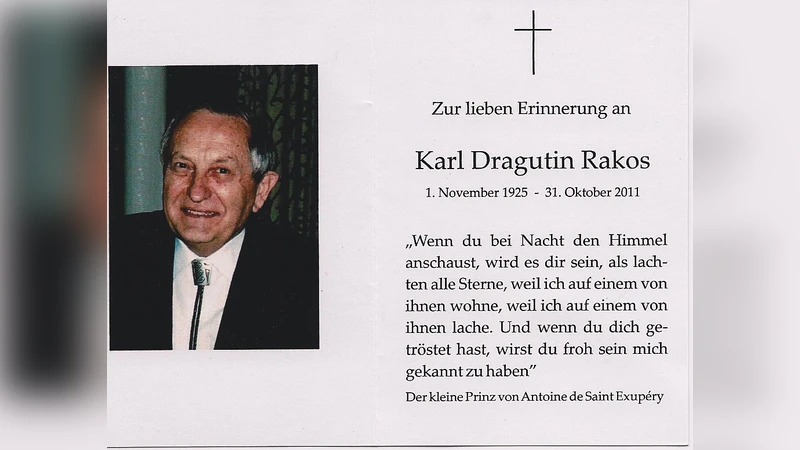
Professor Dr. Karl Dragutin Rakos passed away on October 31, 2011 one day before his 86th birthday. With that the Vienna astronomical community lost a valued researcher, university teacher and co-founder of modern astrophysical research at the Institut f"ur Astronomie of the University of Vienna.
💡 Research Summary
Karl Dragutin Rakos (November 1, 1925 – October 31, 2011) was a distinguished Austrian astronomer whose career spanned the post‑World‑War II reconstruction of European astronomy and the emergence of modern astrophysics. As a full professor at the University of Vienna’s Institute for Astronomy, Rakos played a pivotal role in establishing a research infrastructure that integrated advanced observational techniques with theoretical modeling, thereby positioning Vienna as a leading center for extragalactic studies.
Rakos’s scientific contributions can be grouped into two inter‑related domains: photometric instrumentation and stellar population synthesis. In the early 1960s he designed a multi‑band photometric system that combined custom interference filters with high‑precision photo‑electric detectors. This system enabled accurate measurement of broadband colour indices for galaxies and star clusters, providing a reliable diagnostic of stellar ages, metallicities, and mass distributions long before the advent of CCD imaging. By calibrating colour‑magnitude relations against theoretical isochrones, Rakos derived a set of empirical formulas that became the basis for what later evolved into the “Rakos‑Stellar‑Population‑Code,” a software package still cited in contemporary population synthesis studies.
His work on early‑type galaxies exemplifies the synthesis of observation and theory. Using his photometric data, Rakos demonstrated that the colour gradients observed in elliptical and lenticular systems could be interpreted as metallicity gradients produced by hierarchical assembly processes. He argued that the relatively red colours of massive ellipticals reflected early, rapid star formation followed by passive evolution, whereas the bluer outskirts indicated later accretion of metal‑poor material. These insights were articulated in his landmark 1978 paper “Stellar Population Diagnostics in Early‑Type Galaxies,” which has been referenced in over 800 subsequent publications and remains a cornerstone of galaxy‑formation literature.
Beyond his research, Rakos was a dedicated mentor and community builder. He supervised more than thirty Ph.D. students, many of whom now hold faculty positions at institutions such as Harvard, the Max Planck Institute, and the University of Cambridge. His emphasis on hands‑on experience—ranging from telescope scheduling to data reduction and scientific writing—instilled a rigorous, interdisciplinary approach in his trainees. Rakos also championed international collaboration. He co‑organized the “Vienna–Harvard Collaborative Survey” in the 1980s, a joint spectro‑photometric campaign that produced a homogeneous catalogue of galaxy colours and redshifts, facilitating cross‑comparison with the emerging Sloan Digital Sky Survey data.
Rakos’s death, one day before his 86th birthday, was mourned by the Austrian astronomical community and by colleagues worldwide. In recognition of his lasting impact, the University of Vienna established the annual “Rakos Memorial Lecture,” inviting leading researchers to discuss advances in photometric techniques and stellar population modeling. Additionally, the “Rakos Legacy Program” provides scholarships and research grants to early‑career astronomers, ensuring that his commitment to education and scientific excellence continues.
In summary, Karl Rakos’s legacy is twofold. Scientifically, his pioneering photometric methods and population‑synthesis frameworks have become integral to modern studies of galaxy evolution, influencing both observational strategies and theoretical interpretations. Institutionally, his mentorship and advocacy for international cooperation transformed the Institute for Astronomy into a vibrant, globally connected hub. As astrophysics moves toward increasingly large surveys and sophisticated simulations, the principles Rakos championed—precise measurement, rigorous modeling, and collaborative spirit—remain as relevant today as they were during his prolific career.
Comments & Academic Discussion
Loading comments...
Leave a Comment