Database Semantics
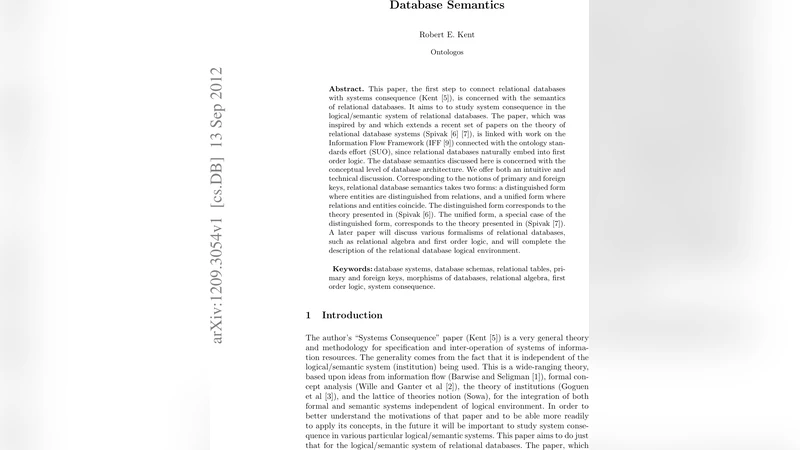
This paper, the first step to connect relational databases with systems consequence (Kent: “System Consequence” 2009), is concerned with the semantics of relational databases. It aims to to study system consequence in the logical/semantic system of relational databases. The paper, which was inspired by and which extends a recent set of papers on the theory of relational database systems (Spivak: “Functorial Data Migration” 2012), is linked with work on the Information Flow Framework (IFF) [http://suo.ieee.org/IFF/] connected with the ontology standards effort (SUO), since relational databases naturally embed into first order logic. The database semantics discussed here is concerned with the conceptual level of database architecture. We offer both an intuitive and technical discussion. Corresponding to the notions of primary and foreign keys, relational database semantics takes two forms: a distinguished form where entities are distinguished from relations, and a unified form where relations and entities coincide. The distinguished form corresponds to the theory presented in (Spivak: “Simplicial databases” 2009)[arXiv:0904.2012]. The unified form, a special case of the distinguished form, corresponds to the theory presented in (Spivak: “Functorial Data Migration” 2012). A later paper will discuss various formalisms of relational databases, such as relational algebra and first order logic, and will complete the description of the relational database logical environment.
💡 Research Summary
This paper initiates a bridge between relational database theory and the meta‑logical notion of system consequence, originally formulated by Kent (2009). The authors argue that relational databases, being naturally embeddable in first‑order logic, provide a fertile ground for applying system consequence to study how logical entailments are preserved across schema transformations, data migrations, and multi‑database integrations.
Two semantic models are presented. The “distinguished form” treats entities and relations as separate categorical objects: entities are objects equipped with primary‑key identifiers, while relations are morphisms linking entity objects. Foreign‑key constraints become functorial mappings between these morphisms, and schema morphisms are expressed as functors together with natural transformations that capture data migration. This approach aligns with Spivak’s “Simplicial databases” (2009), which emphasizes a clear separation between data items and the relationships that bind them.
The “unified form” collapses the distinction, representing both entities and relations as instances of a single categorical type—essentially treating every table as a relation object. Primary keys and foreign keys are then merely attributes of that object. This model is a special case of the distinguished form and corresponds directly to the framework developed in Spivak’s “Functorial Data Migration” (2012), where a database schema is a small category and a database instance is a functor (a presentation) on that category. The unified view yields a more compact categorical representation while preserving the expressive power needed for system consequence analysis.
The paper further connects these categorical models to the Information Flow Framework (IFF), the meta‑framework underpinning the Standards for Ontology (SUO) initiative. By mapping database schemas to IFF classes and properties, and instances to IFF individuals, the authors show how system consequence can be interpreted as a flow of logical information across ontological boundaries. This linkage demonstrates that the preservation of constraints during data migration is not merely a technical requirement but a logical invariant that can be captured within a broader semantic infrastructure.
Technical contributions include: (1) a rigorous categorical formalization of primary‑key and foreign‑key constraints, enabling the use of functors and natural transformations to model schema evolution and data migration; (2) a clear exposition of the relationship between the distinguished and unified semantic forms, providing a conceptual bridge between traditional relational design principles (normalization, key constraints) and modern functorial data migration theory; and (3) an articulation of how system consequence can serve as a meta‑logical guarantee of semantic consistency in heterogeneous database environments.
The authors outline a future research agenda that will flesh out the correspondence between relational algebra, first‑order logic, and the categorical semantics introduced here. They plan to develop concrete case studies where system consequence is instantiated in ETL pipelines and data‑warehouse integration scenarios, thereby moving the theory from abstract category theory toward practical data‑engineering tools. In doing so, the paper sets the stage for a unified logical environment for relational databases that can support both rigorous theoretical analysis and real‑world data integration challenges.
Comments & Academic Discussion
Loading comments...
Leave a Comment