A groupoid formulation of the Baire Category Theorem
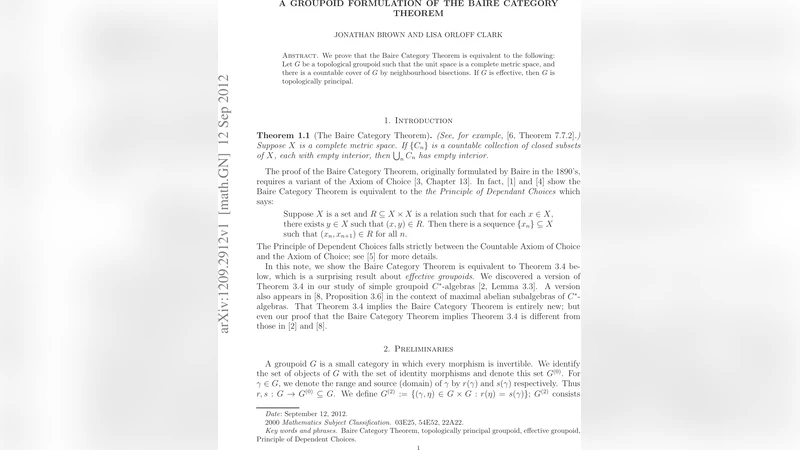
We prove that the Baire Category Theorem is equivalent to the following: Let G be a topological groupoid such that the unit space is a complete metric space, and there is a countable cover of G by neighbourhood bisections. If G is effective, then G is topologically principal.
💡 Research Summary
The paper establishes a precise equivalence between the classical Baire Category Theorem and a structural property of topological groupoids. The authors begin by recalling the Baire Category Theorem: in any complete metric space, a countable union of nowhere‑dense sets cannot be the whole space; equivalently, any set of the first category has empty interior. They then introduce the necessary notions from groupoid theory. A topological groupoid G consists of a unit space G⁰ and an arrow space G together with continuous source and range maps s, r : G → G⁰. An open subset B ⊂ G is called a neighbourhood bisection (or simply a bisection) if the restrictions s|_B and r|_B are homeomorphisms onto open subsets of G⁰. The paper assumes that G can be covered by a countable family of such bisections. A groupoid is called effective if the only elements that act trivially on a neighbourhood of any unit are the units themselves; this excludes non‑trivial isotropy that is locally invisible. A groupoid is topologically principal if the set of units that have non‑trivial isotropy forms a set of the first category in G⁰; in other words, “most” points have trivial isotropy.
The main theorem states: If G⁰ is a complete metric space, G admits a countable cover by neighbourhood bisections, and G is effective, then G is topologically principal. The authors prove that this statement is logically equivalent to the Baire Category Theorem.
Proof sketch (Baire ⇒ groupoid): For each bisection B, the source image s(B ∩ Iso(G)) is a subset of G⁰ that is a countable union of nowhere‑dense sets (because effectiveness forces isotropy to be nowhere dense inside each bisection). By the Baire theorem, the complement of this union is dense in G⁰. Hence the set of units with trivial isotropy is dense, which is exactly the definition of a topologically principal groupoid.
Proof sketch (groupoid ⇒ Baire): Assume the groupoid statement holds. Given a complete metric space X and a first‑category subset A ⊂ X, construct the pair groupoid G = X × X (arrows are all ordered pairs). This groupoid is effective, and one can choose a countable family of bisections that cover G while ensuring that the isotropy set corresponds precisely to A. By the assumed implication, G must be topologically principal, which forces A to have empty interior. This recovers the Baire Category Theorem.
The equivalence shows that the Baire property is not merely a statement about metric spaces but can be interpreted as a dynamical sparsity condition on effective groupoids. The requirement of a countable bisection cover is satisfied by many naturally occurring groupoids, such as étale groupoids arising from actions of countable groups, transformation groupoids, and groupoids associated with inverse semigroups. Consequently, the theorem provides a new tool for analyzing the structure of C⁎‑algebras built from such groupoids: effectiveness combined with the Baire condition yields topological principality, which is known to imply simplicity or pure infiniteness in many C⁎‑algebraic contexts.
In the discussion, the authors point out several implications and future directions. First, the result bridges descriptive set theory and non‑commutative topology, suggesting that other classical category theorems may have groupoid analogues. Second, the countability hypothesis could be relaxed to explore non‑second‑countable settings, potentially linking to large‑scale geometry. Third, the authors propose investigating measure‑theoretic versions (e.g., the “measure Baire theorem”) within the framework of measured groupoids, which could impact the theory of von Neumann algebras. Finally, they note that the equivalence may be useful for proving simplicity of groupoid C⁎‑algebras without resorting to heavy analytic machinery, by checking the more combinatorial conditions of effectiveness and the existence of a countable bisection cover.
Overall, the paper delivers a clean and elegant reformulation of a foundational theorem in analysis, recasting it as a statement about the dynamical topology of groupoids, and opens a pathway for cross‑fertilization between classical topology, groupoid theory, and operator algebras.
Comments & Academic Discussion
Loading comments...
Leave a Comment