Numerical studies of aerofractures in porous media / Estudios numericos de aerofractures en medios porosos
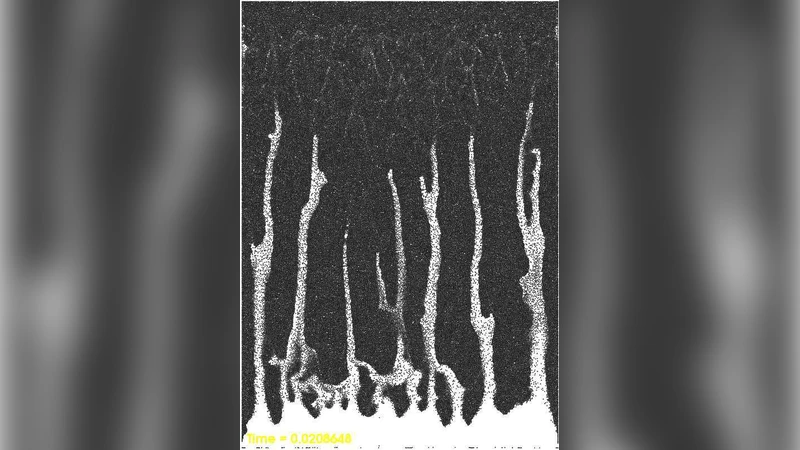
During the hydraulically induced compaction of a granular layer fracture patterns arise. In numerical simulations we study how these patterns depend on the gas properties as well as on the properties of the porous medium. In particular the relation between the speed of fracture propagation and injection pressure is here studied in detail.
💡 Research Summary
**
This paper presents a comprehensive numerical investigation of aerofracture formation in granular porous layers subjected to gas injection. The authors combine a compressible gas flow solver with a discrete element method (DEM) representation of the solid matrix to capture the coupled fluid–solid dynamics that give rise to fracture patterns. The gas is modeled using the compressible Navier‑Stokes equations together with an equation of state that accounts for pressure‑dependent density and viscosity. The solid phase consists of spherical particles packed randomly; particle‑particle contacts follow a Hertz‑Mindlin elastic model with Coulomb friction, and the initial porosity is varied (30 %, 40 %, 50 %).
A series of simulations is performed in which the injection pressure is stepped from 0.1 MPa to 5 MPa in 0.5 MPa increments. For each pressure level, three gas viscosities (1 cP, 5 cP, 10 cP) and three inter‑particle friction coefficients (μ = 0.2, 0.5, 0.8) are examined, resulting in a total of 81 distinct parameter sets. Each case is replicated ten times to obtain statistically robust averages. The coupled CFD‑DEM framework uses a finite‑volume discretization for the fluid with a time step of 1 µs, ensuring that the rapid onset of fracture is resolved.
Fracture propagation speed is quantified by tracking the time at which the fracture front traverses the computational domain. The authors fit the speed‑versus‑pressure data to an empirical power‑law form
\
Comments & Academic Discussion
Loading comments...
Leave a Comment