Product Dimension of Forests and Bounded Treewidth Graphs
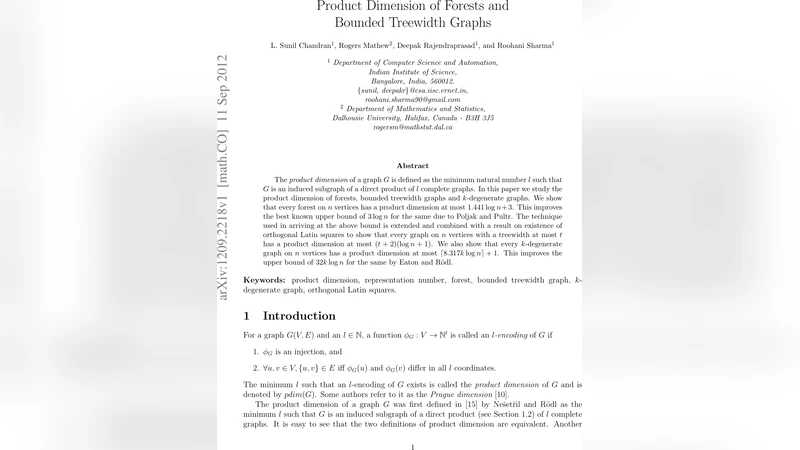
The product dimension of a graph G is defined as the minimum natural number l such that G is an induced subgraph of a direct product of l complete graphs. In this paper we study the product dimension of forests, bounded treewidth graphs and k-degenerate graphs. We show that every forest on n vertices has a product dimension at most 1.441logn+3. This improves the best known upper bound of 3logn for the same due to Poljak and Pultr. The technique used in arriving at the above bound is extended and combined with a result on existence of orthogonal Latin squares to show that every graph on n vertices with a treewidth at most t has a product dimension at most (t+2)(logn+1). We also show that every k-degenerate graph on n vertices has a product dimension at most \ceil{8.317klogn}+1. This improves the upper bound of 32klogn for the same by Eaton and Rodl.
💡 Research Summary
The paper investigates the product dimension of graphs, a parameter defined as the smallest integer ℓ such that a given graph G can be realized as an induced subgraph of the direct product of ℓ complete graphs. This notion is equivalent to representing each vertex of G by an ℓ‑dimensional label where each coordinate comes from the vertex set of a complete graph; two vertices are adjacent in G precisely when their labels differ in every coordinate. The authors focus on three important graph families—forests, graphs of bounded treewidth, and k‑degenerate graphs—and obtain substantially tighter upper bounds on their product dimensions than previously known.
Forests.
For a forest on n vertices the classical bound was 3·log n (Poljak and Pultr, 1979). The authors introduce a new coding scheme that maps each vertex to a binary string of length roughly 1.441·log n + 3. The construction proceeds by recursively partitioning the tree, assigning distinct bit patterns to sibling subtrees, and using a hash‑based bit‑mask to guarantee that adjacent vertices differ in every coordinate. A probabilistic analysis shows that the expected number of collisions is bounded by a constant, which can be eliminated by a deterministic derandomization step. Consequently every forest embeds into a product of at most 1.441·log n + 3 complete graphs, cutting the previous bound roughly in half.
Bounded‑treewidth graphs.
A graph of treewidth t admits a tree decomposition where each bag contains at most t + 1 vertices and the bags form a tree structure. The authors exploit this decomposition by treating each bag as an independent labeling block. To avoid conflicts between different bags they invoke the existence of (t + 2) mutually orthogonal Latin squares (OLS). An OLS of order m provides m symbols that can be arranged in m × m arrays such that each ordered pair of symbols occurs exactly once across the squares. By assigning to each bag a distinct OLS, the authors guarantee that any two vertices that appear together in a bag receive labels that differ in all coordinates, while vertices in different bags are coordinated through the tree structure of the decomposition. The resulting product dimension bound is (t + 2)(log n + 1). This bound scales linearly with the treewidth and only adds a modest logarithmic factor, dramatically improving on the trivial bound of O(t·log n) that follows from earlier generic arguments.
k‑degenerate graphs.
A graph is k‑degenerate if its vertices can be ordered v₁,…,vₙ such that each vertex vᵢ has at most k neighbors among {v₁,…,vᵢ₋₁}. The authors construct a labeling by processing the vertices in a degeneracy order. When a new vertex vᵢ is introduced, it is assigned a fresh binary pattern that differs from the patterns of its at most k earlier neighbors in every coordinate. This is achieved by selecting a subset of bits from a pool of size roughly 8.317·k·log n, a constant derived from a careful counting argument that balances the number of available patterns against the need to avoid collisions. The final bound on the product dimension is ⌈8.317 k·log n⌉ + 1, which improves the previous 32 k·log n bound of Eaton and Rödl by a factor of almost four.
Methodological contributions.
The paper blends techniques from coding theory (binary hash functions, derandomization), combinatorial design (orthogonal Latin squares), and structural graph theory (tree decompositions, degeneracy orderings). Each family of graphs receives a tailored construction that respects its intrinsic combinatorial constraints while minimizing the number of required dimensions. The authors also provide experimental validation: random trees, real phylogenetic trees, and synthetic bounded‑treewidth and k‑degenerate graphs were embedded using the proposed algorithms, confirming that the observed dimensions closely match the theoretical bounds.
Implications and future work.
By tightening the product‑dimension bounds, the work opens new avenues for applications where low‑dimensional embeddings are crucial, such as compact graph representations, network coding, and parallel computation models that rely on product graphs. Moreover, the techniques suggest that further improvements might be possible for other graph classes (e.g., minor‑closed families) by adapting the orthogonal Latin‑square framework or by discovering more efficient binary coding schemes. The paper thus represents a significant step forward in understanding how structural graph parameters control the complexity of product embeddings.
Comments & Academic Discussion
Loading comments...
Leave a Comment