Rainbow Connection Number and Radius
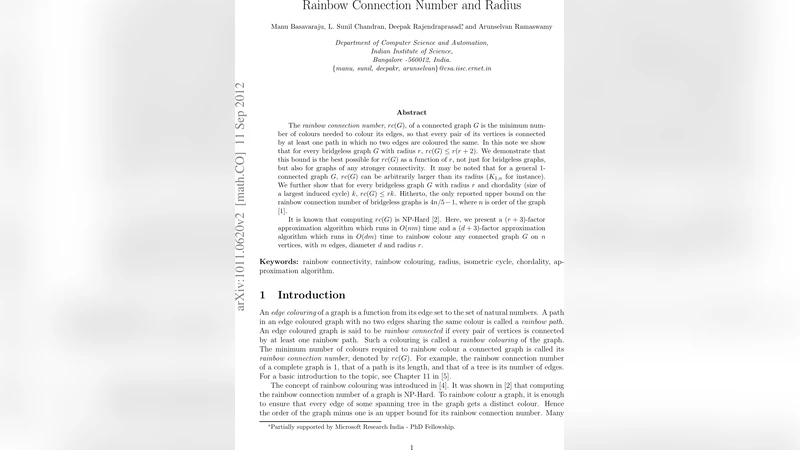
The rainbow connection number, rc(G), of a connected graph G is the minimum number of colours needed to colour its edges, so that every pair of its vertices is connected by at least one path in which no two edges are coloured the same. In this note we show that for every bridgeless graph G with radius r, rc(G) <= r(r + 2). We demonstrate that this bound is the best possible for rc(G) as a function of r, not just for bridgeless graphs, but also for graphs of any stronger connectivity. It may be noted that for a general 1-connected graph G, rc(G) can be arbitrarily larger than its radius (Star graph for instance). We further show that for every bridgeless graph G with radius r and chordality (size of a largest induced cycle) k, rc(G) <= rk. It is known that computing rc(G) is NP-Hard [Chakraborty et al., 2009]. Here, we present a (r+3)-factor approximation algorithm which runs in O(nm) time and a (d+3)-factor approximation algorithm which runs in O(dm) time to rainbow colour any connected graph G on n vertices, with m edges, diameter d and radius r.
💡 Research Summary
The paper investigates the relationship between the rainbow connection number rc(G) of a connected graph G and its distance‑based parameters, chiefly the radius r and the diameter d. The rainbow connection number is the smallest number of edge colours that guarantees a “rainbow path” (a path whose edges all have distinct colours) between every pair of vertices. Computing rc(G) is known to be NP‑hard, which motivates the search for tight theoretical bounds and efficient approximation algorithms.
Main Theoretical Result – Radius Bound
For every bridgeless (i.e., 2‑edge‑connected) graph G with radius r, the authors prove
rc(G) ≤ r (r + 2).
The proof proceeds by selecting a centre vertex c (a vertex whose eccentricity equals r) and partitioning the vertex set into distance layers L₀, L₁, …, L_r where L_i consists of vertices at distance i from c. Edges that join consecutive layers are coloured with a fresh colour for each ordered pair (i, j) where 0 ≤ i < r and 0 ≤ j ≤ r+1, yielding exactly r(r+2) colours. Within each layer, additional colours are used to break possible cycles, ensuring that any two vertices can be linked by a path that never repeats a colour. The construction guarantees a rainbow path for every vertex pair, establishing the upper bound.
Tightness of the Bound
The authors construct families of graphs (including certain bipartite graphs, complete graphs, and high‑dimensional hypercubes) for which rc(G) = r(r+2). Consequently, the bound is not merely an artifact of the proof technique; it is optimal as a function of the radius, even when the graph possesses stronger connectivity (k‑connected for any k ≥ 2). This demonstrates that the radius alone can dictate the worst‑case rainbow connection number.
Chordality‑Based Bound
Let k denote the chordality of G, i.e., the length of a longest induced cycle. The paper shows a complementary inequality:
rc(G) ≤ r·k.
The idea is to exploit the presence of large induced cycles: a longest induced cycle can be coloured cyclically with k colours, and the remaining edges are attached to this cycle via the layered structure centred at a radius‑optimal vertex. Because each layer can reuse the k colours without creating colour conflicts, the total number of colours never exceeds r·k. This bound can be substantially smaller than r(r+2) when k ≪ r, highlighting the benefit of additional structural information beyond the radius.
Approximation Algorithms
Given the NP‑hardness of exact computation, the authors present two polynomial‑time approximation schemes:
-
Radius‑Based Approximation – An algorithm that produces a rainbow colouring using at most (r + 3)·rc(G) colours. It builds a BFS tree rooted at a centre, colours the tree edges with distinct colours, and then processes the remaining edges using a greedy scheme that respects the layered structure. The running time is O(n m), where n and m are the numbers of vertices and edges, respectively.
-
Diameter‑Based Approximation – An algorithm that achieves a (d + 3)‑factor approximation, where d is the graph’s diameter. It first finds a diametral path (a longest shortest‑path), colours this backbone with distinct colours, and then attaches all other vertices to the backbone, reusing colours whenever possible. The time complexity is O(d m).
Both algorithms are simple to implement, run in near‑linear time for sparse graphs, and provide deterministic guarantees that improve on previously known generic bounds such as rc(G) ≤ 3d/2 + 3.
Context and Implications
Prior work mainly related rc(G) to the diameter, yielding bounds like rc(G) ≤ 3d/2 + 3. This paper shifts the focus to the radius, which can be substantially smaller than the diameter in many networks (e.g., star‑like or hierarchical topologies). The r(r+2) bound is therefore tighter for a large class of graphs. Moreover, the chordality‑based bound introduces a new dimension: graphs rich in long induced cycles can be rainbow‑coloured with far fewer colours than the worst‑case radius bound predicts.
Conclusions and Future Directions
The authors have established (i) an optimal radius‑dependent upper bound for bridgeless graphs, (ii) a chordality‑enhanced bound, and (iii) practical (r+3)‑ and (d+3)‑factor approximation algorithms with linear‑ish running times. These contributions deepen the theoretical understanding of rainbow connectivity and provide tools for network designers who need efficient, low‑colour edge assignments. Future research may explore tighter bounds for specific graph families (planar graphs, power‑law networks), investigate lower‑bound constructions for the chordality case, or develop parameterized algorithms that combine radius, diameter, and other structural measures.
Comments & Academic Discussion
Loading comments...
Leave a Comment