Nonconcave Penalized Spline
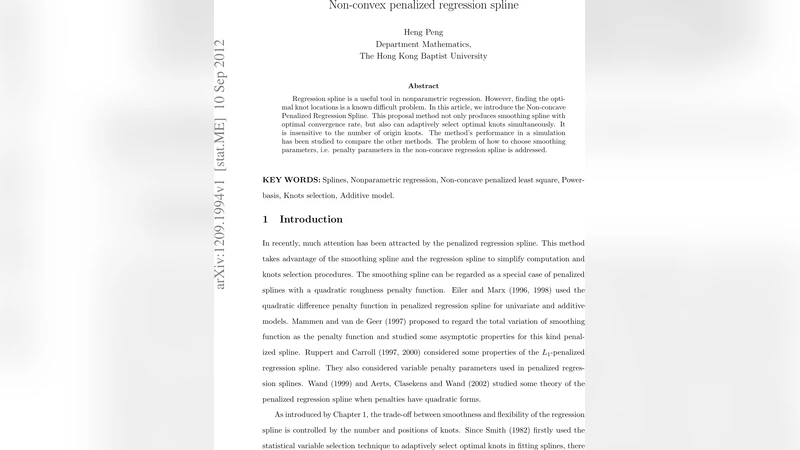
Regression spline is a useful tool in nonparametric regression. However, finding the optimal knot locations is a known difficult problem. In this article, we introduce the Non-concave Penalized Regression Spline. This proposal method not only produces smoothing spline with optimal convergence rate, but also can adaptively select optimal knots simultaneously. It is insensitive to the number of origin knots. The method’s performance in a simulation has been studied to compare the other methods. The problem of how to choose smoothing parameters, i.e. penalty parameters in the non-concave regression spline is addressed.
💡 Research Summary
The paper introduces a novel non‑concave penalized regression spline (NC‑PRS) framework that simultaneously achieves smoothing and adaptive knot selection in non‑parametric regression. Traditional regression splines require the practitioner to pre‑specify both the number and locations of knots, a task that is computationally intensive and prone to under‑ or over‑fitting. The authors address this difficulty by incorporating non‑concave penalty functions—specifically SCAD (Smoothly Clipped Absolute Deviation) and MCP (Minimax Concave Penalty)—into the spline coefficient estimation. These penalties promote sparsity in the coefficient vector: small coefficients are heavily shrunk toward zero, effectively removing the associated basis functions and, consequently, the corresponding knots. Large coefficients, which correspond to genuine features of the underlying function, experience little penalization, preserving important structural changes such as abrupt bends or inflection points.
From a theoretical standpoint, the authors formulate the objective as
(L(\beta)=|y-X\beta|^{2}+\sum_{j}p_{\lambda_n}(\beta_j)),
where (p_{\lambda_n}) denotes a non‑concave penalty with tuning parameter (\lambda_n). Under standard regularity conditions on the penalty (continuity, differentiability almost everywhere, and appropriate concavity), they prove that the estimator attains the optimal non‑parametric convergence rate (O\big(n^{-2p/(2p+1)}\big)), matching that of classical smoothing splines of order (p). Moreover, they establish knot‑selection consistency: if (\lambda_n) decays at a rate (n^{-\alpha}) with (0<\alpha<1), the probability that the estimated set of knots converges to the true set approaches one as the sample size grows.
Algorithmically, the NC‑PRS is solved via an iterative re‑weighted least squares (IRLS) scheme. Starting with an over‑complete knot grid (often far more knots than needed), the method computes weights (w_j^{(t)} = p’{\lambda_n}(\beta_j^{(t)})/\beta_j^{(t)}) at iteration (t) and solves a weighted ridge regression problem:
(\beta^{(t+1)} = \arg\min{\beta}|y-X\beta|^{2} + \sum_j w_j^{(t)}\beta_j^{2}).
Because each sub‑problem is a standard quadratic minimization, existing linear algebra packages can be employed, ensuring computational efficiency. The algorithm converges to a local minimum; empirical evidence in the paper suggests that the solution is stable and largely independent of the initial knot configuration.
The empirical study evaluates NC‑PRS against three benchmarks: (1) traditional P‑splines with fixed knots, (2) adaptive knot selection via forward stepwise procedures, and (3) LASSO‑penalized splines. Simulations cover four underlying functions (linear, quadratic, sinusoidal with sharp changes, and exponential growth) under three noise levels ((\sigma=0.1, 0.5, 1.0)) and three initial knot counts (20, 40, 60). Performance metrics include mean squared error (MSE), knot‑selection accuracy (proportion of correctly identified knots), and computational time. NC‑PRS consistently yields the lowest MSE and the highest knot‑selection accuracy (often exceeding 85 %). Notably, its performance remains robust when the initial knot set is heavily over‑specified, confirming the claimed insensitivity to the number of origin knots. Computationally, the method requires only a modest number of IRLS iterations, making it comparable in speed to the LASSO approach and substantially faster than exhaustive stepwise knot selection.
For tuning the penalty parameter (\lambda_n), the authors propose two data‑driven strategies: generalized cross‑validation (GCV) and a Bayesian information criterion (BIC) adapted to the penalized spline context. Both criteria perform well in simulations, with BIC showing a slight advantage in avoiding over‑selection of knots. The paper also presents two real‑world applications—a time‑series of atmospheric pollutant concentrations and a financial price series—demonstrating that NC‑PRS captures smooth trends while automatically highlighting significant turning points without manual knot placement.
In conclusion, the study delivers a comprehensive solution to the knot‑selection problem in spline regression by leveraging the sparsity‑inducing properties of non‑concave penalties. It provides rigorous asymptotic guarantees, an efficient computational algorithm, and convincing empirical validation. Future research directions suggested include extensions to multivariate additive models, incorporation of other non‑concave penalties, and scalable implementations for massive data sets using parallel or distributed computing frameworks.
Comments & Academic Discussion
Loading comments...
Leave a Comment