Operation of a Brain-Computer Interface Walking Simulator by Users with Spinal Cord Injury
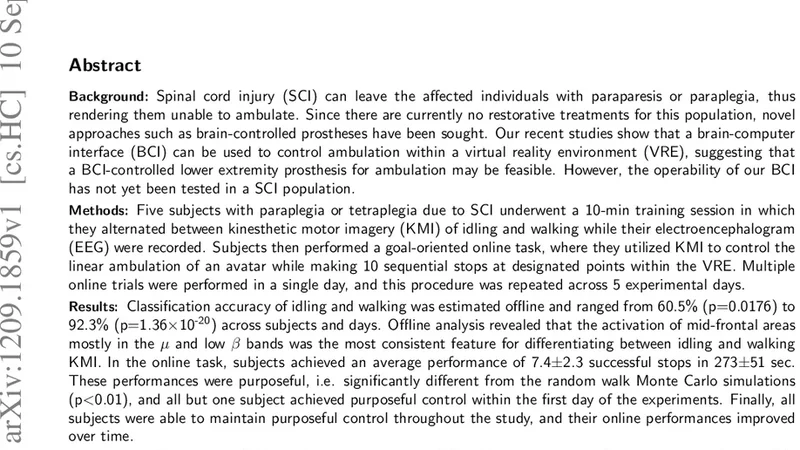
Background: Spinal cord injury (SCI) can leave the affected individuals unable to ambulate. Since there are no restorative treatments for SCI, novel approaches such as brain-controlled prostheses have been sought. Our recent studies show that a brain-computer interface (BCI) can be used to control ambulation within a virtual reality environment (VRE), suggesting that a BCI-controlled lower extremity prosthesis for ambulation may be feasible. However, the operability of our BCI has not been tested in a SCI population. Methods: Five subjects with paraplegia or tetraplegia due to SCI underwent a 10-min training session in which they alternated between kinesthetic motor imagery (KMI) of idling and walking while their electroencephalogram (EEG) were recorded. Subjects then performed a goal-oriented online task, where they utilized KMI to control the linear ambulation of an avatar and make 10 sequential stops at designated points within the VRE. Multiple online trials were performed over 5 experimental days. Results: Classification accuracy of idling and walking was estimated offline and ranged from 60.5% (p=0.0176) to 92.3% (p=1.36*10^-20) across subjects and days. In the online task, all subjects achieved purposeful control with an average performance of 7.4 +/- 2.3 successful stops in 273 +/- 51 sec (p<0.01). All subjects maintained purposeful control throughout the study, and their online performances improved over time. Conclusions: The results demonstrate that SCI subjects can purposefully operate a self-paced BCI walking simulator to complete a goal-oriented ambulation task. The operation of this BCI system requires short training, is intuitive, and robust against subject-to-subject and day-to-day neurophysiological variations. These findings indicate that BCI-controlled lower extremity prostheses for gait rehabilitation or restoration after SCI may be feasible in the future.
💡 Research Summary
Background: Spinal cord injury (SCI) often results in permanent loss of ambulation, and restorative therapies remain limited. Brain‑computer interfaces (BCIs) have emerged as a potential means to bypass damaged spinal pathways by translating cortical activity directly into control signals for assistive devices. Prior work demonstrated that healthy participants could use a BCI to steer an avatar in a virtual‑reality walking simulator, suggesting feasibility for lower‑extremity prostheses. However, the operability of such a system in the target population—individuals with SCI—had not been empirically tested.
Objective: This study aimed to determine whether people with paraplegia or tetraplegia could quickly learn to modulate their electroencephalogram (EEG) through kinesthetic motor imagery (KMI) of “idling” versus “walking,” and subsequently use those signals to control a self‑paced, goal‑directed walking task in a virtual environment.
Methods: Five SCI participants (three paraplegic, two tetraplegic) attended five experimental days. Each day began with a 10‑minute training session in which subjects alternated between imagining standing still (idle) and walking while a 64‑channel EEG was recorded. Standard preprocessing (band‑pass filtering, artifact removal via ICA) was applied. A common spatial pattern (CSP) algorithm extracted spatial filters that maximally discriminated the two imagined states; the resulting features fed a linear discriminant analysis (LDA) classifier. Offline classification accuracy was assessed via five‑fold cross‑validation for each subject and day.
For the online task, participants entered a virtual reality corridor where an avatar moved linearly forward. Using KMI, they toggled the avatar between moving and stopping to reach ten sequentially placed “stop points.” A successful stop required maintaining the idle state for at least two seconds. Multiple trials were performed each day, and performance metrics included the number of successful stops and total trial duration.
Results: Offline classification accuracies ranged from 60.5 % to 92.3 % across subjects and days, all achieving statistical significance (p < 0.05, with the strongest result p = 1.36 × 10⁻²⁰). In the online navigation task, the group averaged 7.4 ± 2.3 successful stops per trial, completing the sequence in 273 ± 51 seconds on average (p < 0.01 versus chance). Performance improved over the five days, indicating a learning effect; later sessions showed higher stop counts and reduced completion times. Importantly, all participants maintained purposeful control throughout the study, demonstrating robustness to day‑to‑day neurophysiological variability.
Discussion: The findings confirm that SCI individuals can generate distinguishable EEG patterns for idle versus walking KMI, despite the loss of peripheral feedback and altered sensorimotor integration. The CSP‑LDA pipeline proved effective at compensating for inter‑subject and intra‑subject variability, enabling reliable real‑time decoding after only ten minutes of training. The self‑paced nature of the interface—where users decide when to initiate or cease movement—mirrors natural gait initiation and may reduce cognitive load compared with cue‑driven paradigms.
Limitations include the exclusive use of a virtual environment; translation to physical exoskeletons or robotic gait orthoses remains to be demonstrated. The sample size (n = 5) and short experimental horizon limit generalizability and preclude assessment of long‑term fatigue, adaptation, or neuroplastic changes. Additionally, the binary control scheme restricts the richness of possible commands (e.g., turning, speed modulation).
Future Directions: Subsequent work should integrate the BCI with actual lower‑extremity prosthetic hardware, evaluate long‑term usage over weeks or months, and explore adaptive machine‑learning strategies that update spatial filters in real time. Expanding the command set to include directional intent or variable speed could yield more functional gait assistance. Larger, multicenter trials encompassing a broader range of injury levels and durations will be essential to establish clinical efficacy and safety.
Conclusion: This pilot investigation demonstrates that individuals with spinal cord injury can quickly learn to operate a self‑paced BCI walking simulator, achieving purposeful, goal‑directed control in a virtual setting. The system’s short training requirement, intuitive operation, and resilience to neurophysiological fluctuations suggest that BCI‑driven lower‑extremity prostheses for gait rehabilitation or restoration are a realistic prospect for future development.
Comments & Academic Discussion
Loading comments...
Leave a Comment