A doublet of cosmic-ray events with primary energies >10^20 eV
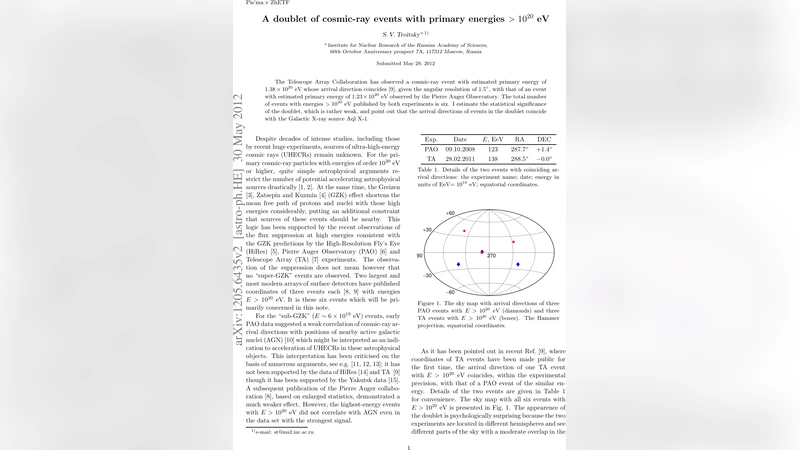
The Telescope Array Collaboration has observed a cosmic-ray event with estimated primary energy of 1.3810^20 eV whose arrival direction coincides (see arxiv:1205.5984), given the angular resolution of 1.5 deg, with that of an event with estimated primary energy of 1.2310^20 eV observed by the Pierre Auger Observatory. The total number of events with energies >10^20 eV published by both experiments is six. I estimate the statistical significance of the doublet, which is rather weak, and point out that the arrival directions of events in the doublet coincide with the Galactic X-ray source Aql X-1.
💡 Research Summary
**
The paper reports a rare coincidence between two ultra‑high‑energy cosmic‑ray (UHECR) events recorded by the Telescope Array (TA) and the Pierre Auger Observatory (Auger). TA observed a shower with an estimated primary energy of 1.38 × 10²⁰ eV, while Auger recorded another with 1.23 × 10²⁰ eV. The reconstructed arrival directions of the two events differ by less than the angular resolution of the instruments (≈1.5°), effectively forming a “doublet”. The total number of published events with energies above 10²⁰ eV from both experiments is six (three from each), making this doublet an especially noteworthy feature in a very small data set.
The author evaluates the statistical significance of the doublet. Assuming an isotropic distribution of six events over the full sky, the probability that any pair falls within a 1.5° circle is roughly 2 × 10⁻⁴. With 15 possible pairs (6 choose 2), the chance of at least one such close pair is about 3 × 10⁻³, i.e., roughly 0.3 %. When the uncertainties in direction and energy are folded in, the probability rises to a few percent, corresponding to a significance well below the conventional 3σ threshold. In other words, the doublet is statistically weak and could easily be a random fluctuation.
Beyond the pure statistics, the paper points out that the common arrival direction lies close to the Galactic X‑ray binary Aql X‑1, a low‑mass system located at ~5 kpc from the Sun. Aql X‑1 is a well‑studied neutron‑star system that exhibits frequent X‑ray outbursts, but no known mechanism can accelerate particles to 10²⁰ eV. Conventional acceleration sites (e.g., supernova remnants, active galactic nuclei, gamma‑ray bursts) are far more energetic, and the magnetic fields in Aql X‑1 are orders of magnitude too weak to provide the required voltage. Therefore, the positional coincidence is intriguing but not compelling evidence of a physical connection.
The paper also discusses magnetic deflection. If the primaries are protons, Galactic and extragalactic magnetic fields would bend their trajectories by tens of degrees at 10²⁰ eV, making a direct line‑of‑sight association with a Galactic source unlikely. Heavy nuclei (e.g., iron) could experience larger deflections, but the degree of bending depends sensitively on the poorly known magnetic field structure. Without composition information—something that current surface detector data cannot robustly provide—the interpretation of the doublet’s direction remains ambiguous.
Given these limitations, the author emphasizes the need for larger statistics and better composition diagnostics. Future upgrades such as AugerPrime, TA×4, and space‑based missions like POEMMA will increase exposure and improve the ability to separate proton‑like from heavy‑nucleus showers. Complementary multi‑messenger observations (high‑energy gamma rays, neutrinos, gravitational waves) could help identify genuine source candidates and test whether any clustering of UHECR arrival directions is physically meaningful.
In summary, the paper documents an observationally interesting pair of >10²⁰ eV events that happen to point toward the same region of the sky, evaluates the modest statistical significance of this coincidence, and highlights a speculative spatial association with the X‑ray binary Aql X‑1. While the doublet does not constitute strong evidence for a new UHECR source, it serves as a reminder that rare clustering may emerge in the sparse high‑energy data set, and that future, higher‑statistics experiments will be essential to confirm or refute such hints.