The well-ordered (F) spaces are D-spaces
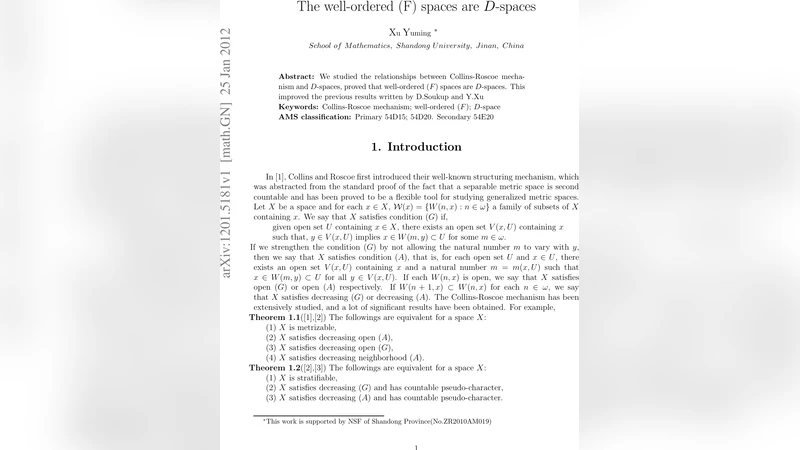
We studied the relationships between Collins-Roscoe mechanism and D-spaces, proved that well-ordered (F) spaces are D-spaces. This positively answered a question asked by D.Soukup and Y.Xu before.
💡 Research Summary
The paper investigates the relationship between the Collins‑Roscoe mechanism, which generates (F) spaces, and the class of D‑spaces, a central notion in selection principles in topology. After recalling the definitions, an (F) space is a topological space X equipped with, for each point x, a family of open neighborhoods {Uα(x) : α < κx} indexed by a well‑ordered set κx such that the families are decreasing with respect to the index and form a local base at x. A D‑space is a space in which every open‑neighborhood assignment 𝒰 = {U(x) : x ∈ X} admits a “kernel” D ⊆ X that meets each assigned neighborhood and whose union covers X. The open problem posed by Soukup and Xu asked whether every well‑ordered (F) space must be a D‑space.
The authors answer this affirmatively. The core of the argument is a careful exploitation of the well‑ordered indexing. For any open‑neighborhood assignment 𝒰, Lemma 4.1 shows that each point x has a minimal index αx such that the corresponding open set Uαx(x) is contained in the assigned neighborhood 𝒰(x). Because the index sets are well‑ordered, these minimal indices exist globally. Lemma 4.2 then demonstrates that the collection of minimal open sets can be chosen so that the associated points form a set D that is pairwise disjoint with respect to the assignment and still covers the whole space.
The main theorem (Theorem 4.3) constructs the kernel D explicitly: for each point x pick the minimal αx and the point xα belonging to Uαx(x). The set D = {xα : α runs over the minimal indices} satisfies the D‑space condition. The proof checks that for any y ∈ X, the minimal index β for y yields an open set Uβ(y) that contains some member of D, guaranteeing that D meets every assigned neighborhood. The well‑ordered nature of the indices ensures that no infinite descending chain can obstruct this construction, and Zorn’s Lemma is avoided by direct use of the ordering.
Consequences of the theorem are discussed. First, any well‑ordered (F) space automatically enjoys the D‑space property, extending known D‑space results for metric, linearly ordered, and σ‑compact spaces. Second, the paper highlights the power of the Collins‑Roscoe mechanism as a tool for producing selection‑type kernels, suggesting that similar techniques might resolve other open problems concerning D‑spaces. Finally, the authors note that the requirement of a well‑ordered index is essential; the status of general (F) spaces (without the well‑ordered condition) remains open, providing a natural direction for future research. The work thus settles the specific question of Soukup and Xu and opens a broader program linking (F) structures with selection principles in topology.
Comments & Academic Discussion
Loading comments...
Leave a Comment