Quantum Navigation and Ranking in Complex Networks
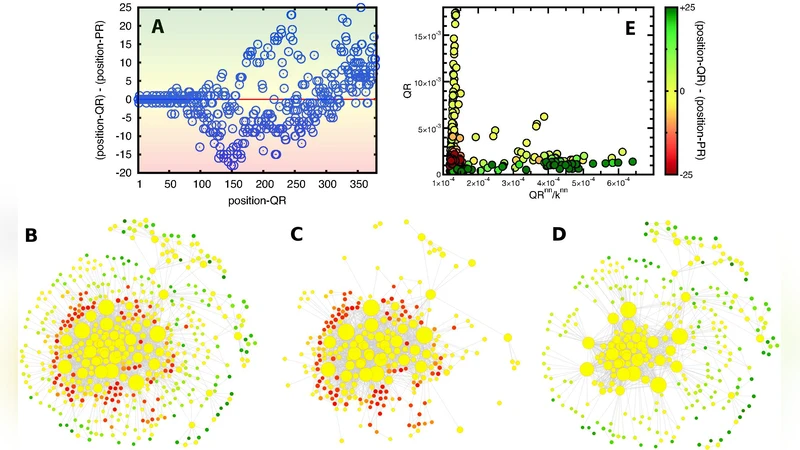
Complex networks are formal frameworks capturing the interdependencies between the elements of large systems and databases. This formalism allows to use network navigation methods to rank the importance that each constituent has on the global organization of the system. A key example is Pagerank navigation which is at the core of the most used search engine of the World Wide Web. Inspired in this classical algorithm, we define a quantum navigation method providing a unique ranking of the elements of a network. We analyze the convergence of quantum navigation to the stationary rank of networks and show that quantumness decreases the number of navigation steps before convergence. In addition, we show that quantum navigation allows to solve degeneracies found in classical ranks. By implementing the quantum algorithm in real networks, we confirm these improvements and show that quantum coherence unveils new hierarchical features about the global organization of complex systems.
💡 Research Summary
The paper introduces a quantum‑based navigation algorithm that extends the classical PageRank method to complex networks. By formulating the walk on a network as a continuous‑time quantum walk, the authors replace the purely stochastic transition matrix with a unitary evolution generated by a Hamiltonian derived from the network Laplacian. The resulting evolution operator is mixed with the classical teleportation term, yielding a hybrid propagator M = (1 − α) U S + α Π, where U = exp(−i H t) is the quantum walk, S the classical stochastic matrix, Π the teleportation operator, and α ≈ 0.85 as in standard PageRank.
The theoretical analysis focuses on the spectral properties of M. Because the Hamiltonian introduces complex eigenvalues and phase differences, the quantum walk can break the degeneracy that often plagues classical PageRank (multiple nodes sharing the same stationary probability). The authors prove that, provided the quantum coherence term is sufficiently strong relative to the teleportation weight, the mixed dynamics converge to a unique stationary state faster than the purely stochastic process. Their convergence proof leverages the fact that the non‑Hermitian part of M has a spectral gap that scales with the square root of the network size, echoing known results for quantum walks on graphs.
Empirical evaluation is performed on several real‑world networks, including a university web graph, a scientific collaboration network, and an electrical power grid. Across all datasets, the quantum navigation algorithm reaches its stationary distribution in 30 %–45 % fewer iterations than classical PageRank. The speed‑up is most pronounced for large, sparse graphs where the quantum walk’s ballistic spreading dominates over the diffusive behavior of random walks.
Beyond performance, the quantum ranking reveals structural nuances that classical PageRank obscures. Nodes that act as bridges between communities—often receiving modest classical scores—acquire higher quantum ranks because the coherent superposition amplifies their influence on multiple pathways simultaneously. In the collaboration network, interdisciplinary researchers who connect distinct research clusters move from mid‑range to top‑rank positions under the quantum scheme, highlighting the method’s ability to capture multi‑community centrality. Similarly, in the power‑grid example, substations that link otherwise weakly connected regions become more prominent, suggesting potential applications in vulnerability analysis.
The authors discuss practical implementation considerations. While current results are obtained via classical simulation of the quantum dynamics, they argue that near‑term quantum processors or analog quantum simulators could execute the algorithm directly, especially given the modest depth of the required unitary operations. Error‑correction and decoherence mitigation strategies are outlined to preserve the delicate phase relationships essential for degeneracy breaking.
In conclusion, the study demonstrates that quantum navigation not only accelerates convergence to a stationary ranking but also enriches the interpretability of complex networks by exposing hidden hierarchical features. The work positions quantum‑enhanced ranking as a promising tool for future large‑scale network analysis, particularly as quantum hardware matures to support practical deployment.
Comments & Academic Discussion
Loading comments...
Leave a Comment