Bragg solitons in nonlinear PT-symmetric periodic potentials
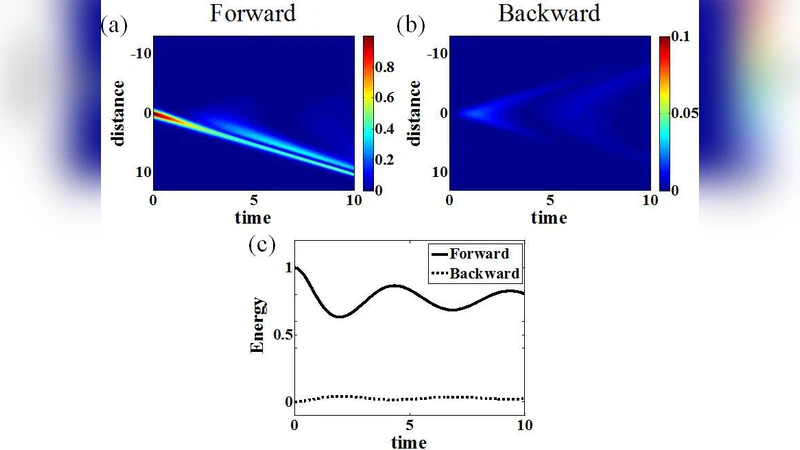
It is shown that slow Bragg soliton solutions are possible in nonlinear complex parity-time (PT) symmetric periodic structures. Analysis indicates that the PT-symmetric component of the periodic optical refractive index can modify the grating band structure and hence the effective coupling between the forward and backward waves. Starting from a classical modified massive Thirring model, solitary wave solutions are obtained in closed form. The basic properties of these slow solitary waves and their dependence on their respective PT-symmetric gain/loss profile are then explored via numerical simulations.
💡 Research Summary
The paper investigates the existence and properties of slow Bragg solitons in nonlinear optical media whose refractive index is modulated periodically with a complex, parity‑time (PT)‑symmetric profile. In a conventional Bragg grating the refractive index modulation is purely real; forward‑propagating and backward‑propagating waves are coupled by a real coupling coefficient κ, which opens a photonic band gap. By introducing a PT‑symmetric component—i.e., a balanced gain and loss distribution that is odd in space—the coupling coefficient becomes complex (κ → κ + iγ). This complex coupling modifies the band structure: the real part of κ still determines the width of the stop‑band, while the imaginary part γ shifts the effective phase matching and can reduce the group velocity of modes near the band edge.
To describe the nonlinear dynamics the authors start from a modified massive Thirring model (MTM), a well‑known integrable system that captures the interaction of two counter‑propagating fields with Kerr nonlinearity. The governing equations for the forward envelope A(z,t) and backward envelope B(z,t) read
∂_z A + (1/v_g)∂_t A = i κ B + i γ A + i χ|A|²A,
∂_z B – (1/v_g)∂_t B = i κ* A – i γ B + i χ|B|²B,
where v_g is the group velocity in the unperturbed medium, χ is the Kerr coefficient, and κ* denotes the complex conjugate of κ. The term iγA (and its counterpart –iγB) embodies the PT‑symmetric gain/loss distribution.
By applying a traveling‑wave ansatz and exploiting the conserved quantities of the MTM (energy, momentum, and a phase invariant), the authors obtain an exact solitary‑wave solution. The solution is characterized by a constant amplitude ratio R = |A|/|B| and a fixed phase difference Δφ, both of which depend on the dimensionless parameter α = γ/|κ|. The soliton’s velocity v_s relative to the background group velocity v_g is given by
v_s = v_g √(1 – α²).
When α = 0 (no gain/loss) the expression reduces to the familiar Bragg soliton with v_s = v_g, i.e., a standing wave inside the band gap. As α approaches unity, the velocity drops dramatically, producing a “slow” soliton whose envelope propagates at a fraction of v_g. At the PT‑symmetry breaking threshold (|γ| = |κ|) the soliton ceases to exist, and the system becomes unstable.
The analytical results are corroborated by numerical simulations performed with a fourth‑order Runge‑Kutta scheme. Starting from a localized forward pulse, the evolution of A and B follows the predicted solitary‑wave shape, confirming the amplitude ratio and phase locking. For moderate γ the backward component is strongly suppressed, leading to an asymmetric soliton that carries most of its energy in the forward direction while still satisfying the PT‑symmetry balance. When γ exceeds the critical value, the soliton either blows up (gain‑dominated) or decays (loss‑dominated), illustrating the delicate stability dictated by the PT‑symmetric gain/loss balance.
The paper discusses several implications. First, the ability to generate slow, robust solitons without requiring external dispersion engineering opens new avenues for optical buffering and low‑latency signal processing. Second, the PT‑symmetric control of κ and γ provides a tunable knob for dynamically adjusting soliton speed, amplitude, and directionality, which could be exploited in reconfigurable photonic circuits or non‑reciprocal devices. Third, the analytical closed‑form solution offers a valuable benchmark for future experimental work on PT‑symmetric gratings fabricated in semiconductor waveguides, fiber Bragg gratings with doped gain regions, or metamaterial platforms that support balanced gain and loss.
In summary, the authors demonstrate that PT‑symmetric periodic potentials fundamentally alter the coupling between forward and backward waves, enabling the formation of slow Bragg solitons whose properties are analytically tractable. The work bridges integrable field‑theory models with practical photonic structures, highlighting the rich interplay between non‑Hermitian physics and nonlinear wave dynamics, and pointing toward novel applications in slow‑light technologies and PT‑engineered photonic devices.