Channel Assignment in Dense MC-MR Wireless Networks: Scaling Laws and Algorithms
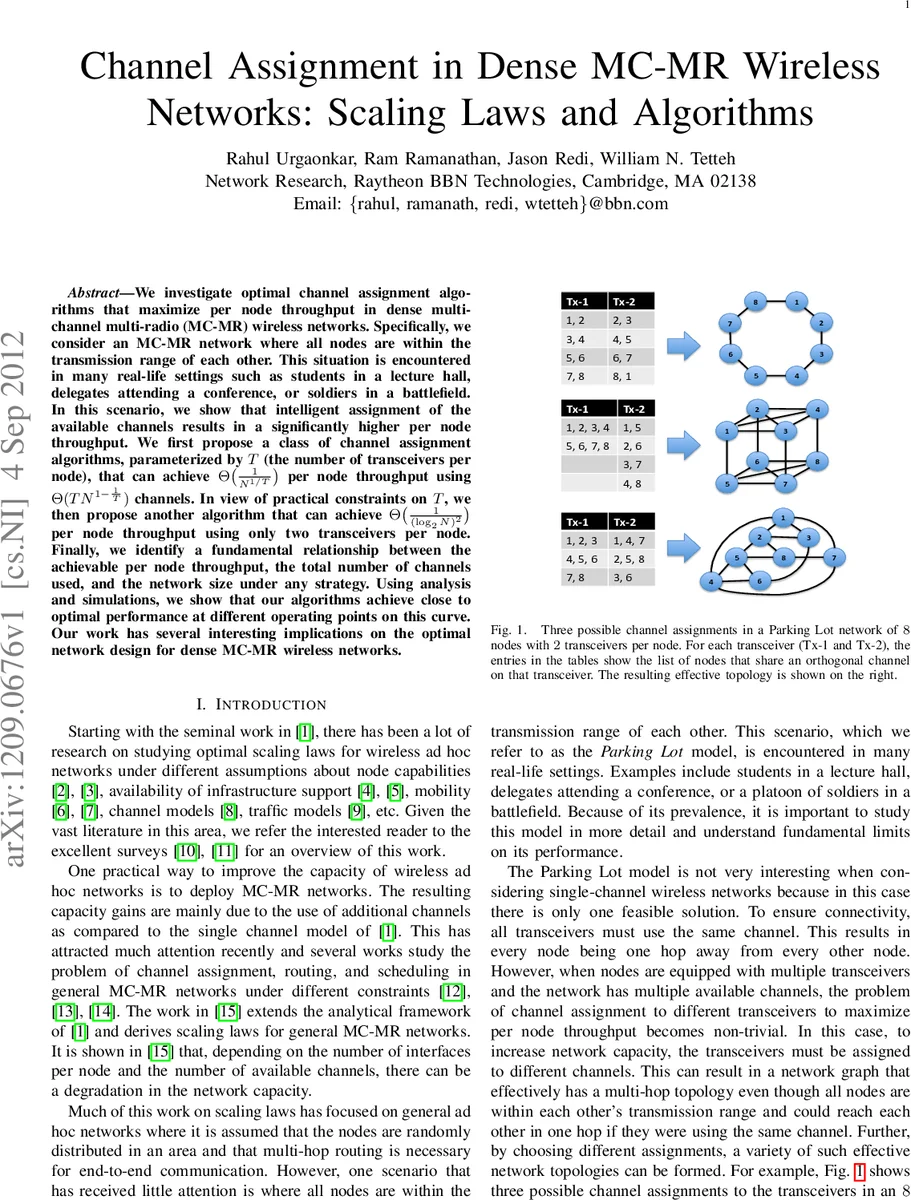
We investigate optimal channel assignment algorithms that maximize per node throughput in dense multichannel multi-radio (MC-MR) wireless networks. Specifically, we consider an MC-MR network where all nodes are within the transmission range of each other. This situation is encountered in many real-life settings such as students in a lecture hall, delegates attending a conference, or soldiers in a battlefield. In this scenario, we show that intelligent assignment of the available channels results in a significantly higher per node throughput. We first propose a class of channel assignment algorithms, parameterized by T (the number of transceivers per node), that can achieve $\Theta(1/N^{1/T})$ per node throughput using $\Theta(TN^{1-1/T})$ channels. In view of practical constraints on $T$, we then propose another algorithm that can achieve $\Theta(1/(\log_2 N)^2)$ per node throughput using only two transceivers per node. Finally, we identify a fundamental relationship between the achievable per node throughput, the total number of channels used, and the network size under any strategy. Using analysis and simulations, we show that our algorithms achieve close to optimal performance at different operating points on this curve. Our work has several interesting implications on the optimal network design for dense MC-MR wireless networks.
💡 Research Summary
The paper studies optimal static channel‑assignment, routing, and scheduling for dense multichannel‑multiradio (MC‑MR) wireless networks in which every node lies within the transmission range of every other node—a scenario the authors call the “Parking Lot” model. In such a setting, a naïve single‑channel solution yields trivial connectivity but poor throughput because only one transmission can occur at a time. By equipping each node with T ≥ 2 radios and exploiting F orthogonal frequency channels, the authors show that intelligent channel assignment can dramatically increase the uniform per‑node throughput.
The core contribution is a family of hierarchical interleaved channel‑assignment algorithms, denoted HINT‑T (Hierarchical Interleaved Channel Assignment with T transceivers). For a network of N nodes, let M = N^{1/T}. The algorithm creates M^{T‑1} groups for each radio index k (1 ≤ k ≤ T). Each group contains exactly M nodes and is assigned a distinct orthogonal channel. The assignment is performed by interleaving nodes across groups so that any node can reach any other node in at most T hops: a source first uses its k‑th radio to reach a node that shares the same (k‑1)‑level group as the destination, then that intermediate node uses its (k‑1)‑th radio, and so on until the destination is reached.
Because each channel is shared by M transceivers, a simple time‑division schedule gives each transceiver a 1/M fraction of the channel capacity. Under the collision model (only one transmission per channel at any instant) and assuming one packet per channel use, the load on each transceiver can be shown to be balanced, yielding a uniform per‑node throughput of Θ(1/M) = Θ(1/N^{1/T}). The total number of channels required is Θ(T·M^{T‑1}) = Θ(T·N^{1‑1/T}). Consequently, if T grows as Θ(log₂N), the per‑node throughput becomes Θ(1), i.e., constant regardless of network size, while the number of channels grows only polylogarithmically.
Recognizing that hardware often limits T to a small constant, the authors also propose a two‑radio algorithm that attains Θ(1/(log₂N)²) per‑node throughput using only O(N) channels. This scheme partitions the channel set hierarchically in logarithmic layers and routes traffic through a multi‑level tree, preserving the “at most two hops” property while keeping the number of channels modest.
Beyond specific constructions, the paper derives a fundamental trade‑off that any static MC‑MR scheme must satisfy:
λ · F · N ≤ C · T · N^{1‑1/T}
where λ is the achievable uniform per‑node throughput, F the total number of channels employed, and C a constant independent of N, T, and F. This inequality captures the tension between increasing concurrent transmissions (larger F) and limiting path length (larger T). The HINT‑T algorithm lies near the upper envelope of this bound for large T, while the two‑radio algorithm approaches the bound in the regime where T is fixed and F scales linearly with N.
Simulation results, performed with realistic packet sizes, link rates, and scheduling overhead, confirm the analytical scaling laws. For networks ranging from a few dozen to several thousand nodes, HINT‑T achieves throughput close to the theoretical prediction, and the two‑radio scheme maintains the Θ(1/(log₂N)²) scaling while using far fewer channels than a naïve full‑mesh assignment. The simulations also show low end‑to‑end delay and balanced channel utilization, indicating that the proposed static assignments are practical for real deployments.
The authors conclude with design implications: (1) when the number of radios per node can be made logarithmic in network size, dense MC‑MR networks can sustain constant per‑node throughput without requiring a prohibitive number of frequency channels; (2) when radios are limited, a carefully structured two‑radio assignment still yields polylogarithmic throughput, far exceeding the single‑channel baseline; (3) static channel assignment, despite being less flexible than dynamic schemes, can approach the optimal performance frontier when designed according to the hierarchical interleaving principle. These insights are directly applicable to environments such as lecture halls, conference venues, or battlefield platoons where many devices are co‑located and high aggregate throughput is desired.
Comments & Academic Discussion
Loading comments...
Leave a Comment