Impact of solar activity on climate changes in Athens region, Greece
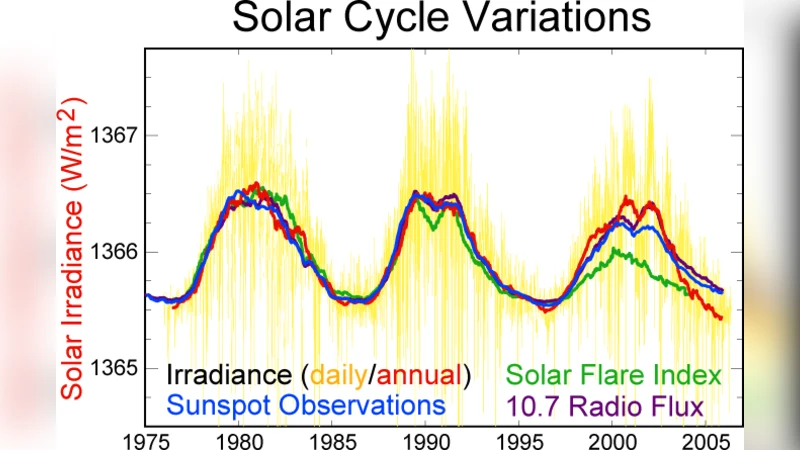
The scope of this work is to study the role that the solar weather plays in terrestrial weather. For this reason we study the effect of the solar activity on the climate changes in Greece. In the current work we look for possible correlation between the solar activity data spanning the years from 1975 to 2000 and the meteorological data from two weather stations based inside the city of Athens, Greece (New Philadelphia) and in greater Athens in the north of Attica (Tatoi area). We examine the annual variations of the average values of six meteorological parameters: temperature, atmospheric pressure, direction and intensity of wind, rainfall and relative air humidity. The solar data include decade variations, within the above period, of the solar irradiance, mean sunspot number between two solar cycles, magnetic cycle influence, and solar UV driving of climate (radio flux).
💡 Research Summary
The paper investigates whether variations in solar activity influence local climate in the Athens region of Greece. Using data from two meteorological stations—Nea Filadelfeia (within the city) and Tatoi (north of the city)—the authors examined six atmospheric variables (temperature, atmospheric pressure, wind direction, wind speed, relative humidity, and precipitation) recorded at three‑hour intervals (precipitation averaged over 12 hours) for the period 1975–2000. Solar activity was represented by four proxies: total solar irradiance (TSI), the 10.7 cm radio flux (F10.7, a proxy for UV/EUV output), the mean sunspot number, and a magnetic flux index. All four solar proxies display the classic ~11‑year solar cycle with peaks around 1980, 1991 and 2002 and minima near 1975, 1986 and 1997.
For each year, the authors calculated the annual mean, standard deviation, skewness, and kurtosis of each meteorological variable. These statistical descriptors were then plotted alongside the solar proxies to look for visual or statistical correlations. The analysis, described as “simple” and “preliminary,” found no obvious relationship between any of the solar indices and the annual means of the six weather parameters at either station. Likewise, the higher‑order moments (standard deviation, skewness, kurtosis) showed no consistent pattern that could be linked to solar variability.
The introduction provides a thorough overview of the three primary mechanisms by which solar variability could affect climate: (i) direct changes in total solar irradiance, (ii) UV‑driven alterations of stratospheric chemistry, and (iii) modulation of galactic cosmic rays influencing low‑cloud cover. The authors cite a wide range of literature, noting both studies that claim a significant solar contribution to recent warming and those (including IPCC assessments) that deem the solar effect negligible. They also discuss the challenges of reconstructing historical solar data and the inconsistencies among satellite composites.
Methodologically, the study relies on data from the Hellenic National Meteorological Service and limits the analysis to the post‑1975 period to match the availability of solar measurements. However, the paper does not describe any preprocessing steps such as detrending, seasonal adjustment, or handling of missing values. Moreover, the statistical approach is limited to visual inspection of time‑series plots; no formal correlation coefficients, regression models, cross‑correlation functions, or significance testing are presented. The four solar proxies are themselves highly correlated, yet the analysis treats them independently, potentially inflating the chance of spurious findings.
The discussion acknowledges that the lack of observed correlation may stem from the limited temporal span (only two solar cycles) and the modest spatial coverage (two stations). The authors suggest that more sophisticated statistical techniques and longer, higher‑resolution datasets would be needed to detect subtle solar signals amid the natural variability of the Mediterranean climate.
In conclusion, the paper reports a null result: within the examined 26‑year window, the selected solar activity indices do not exhibit a measurable impact on the average values or statistical distributions of temperature, pressure, humidity, precipitation, wind direction, or wind speed in the Athens area. While this finding contributes to the ongoing debate about natural versus anthropogenic drivers of climate change, the study’s methodological constraints limit the strength of its inference. Future work should incorporate longer records, a larger network of stations, multivariate time‑series modeling, and explicit testing for lagged or non‑linear relationships to more robustly assess the potential solar influence on regional climate.
Comments & Academic Discussion
Loading comments...
Leave a Comment