A spectral sequence for the Hochschild cohomology of a coconnective dga
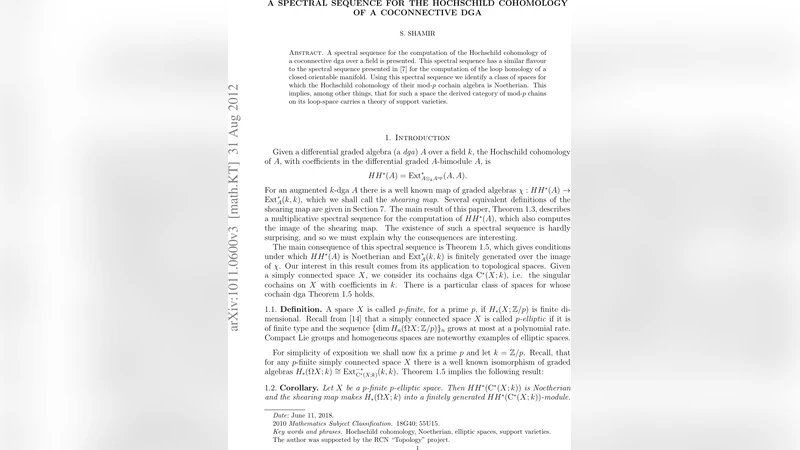
A spectral sequence for the computation of the Hochschild cohomology of a coconnective dga over a field is presented. This spectral sequence has a similar flavour to the spectral sequence constructed by Cohen, Jones and Yan for the computation of the loop homology of a closed orientable manifold. Using this spectral sequence we identify a class of spaces for which the Hochschild cohomology of their mod-p cochain algebra is Noetherian. This implies, among other things, that for such a space the derived category of mod-p chains on its loop-space carries a theory of support varieties.
💡 Research Summary
The paper introduces a new spectral sequence designed to compute the Hochschild cohomology HH⁎(A) of a coconnective differential graded algebra (dga) A over a field k. A coconnective dga is one whose cohomology is concentrated in non‑positive degrees, a condition that guarantees a finite filtration on the Hochschild complex. The construction mirrors the Cohen‑Jones‑Yan (CJY) spectral sequence for the homology of free loop spaces of closed orientable manifolds, but it operates entirely in the algebraic setting of dgas.
The authors begin by recalling the classical Hochschild complex C⁎(A,A) and the Bar construction. By choosing a minimal model for A, they rewrite C⁎(A,A) as a tensor product of a Bar complex and a co‑Bar complex. The key idea is to filter this tensor product by the “outer degree’’ (the total degree coming from the Bar part). Because A is coconnective, the Bar complex is non‑zero only in finitely many outer degrees, which yields a bounded, exhaustive, and complete filtration. Applying the standard machinery of filtered complexes produces a first‑quadrant spectral sequence
E₁^{s,t}=F^{s}C^{s+t}(A,A)/F^{s+1}C^{s+t}(A,A) ⇒ HH^{s+t}(A).
A careful analysis shows that the E₂‑page can be identified with an Ext‑group over the enveloping algebra H⁎(A)⊗H⁎(A)^{op}:
E₂^{s,t}=Ext_{H⁎(A)⊗H⁎(A)^{op}}^{s}(H⁎(A),H⁎(A))^{t}.
Thus the spectral sequence translates the problem of computing Hochschild cohomology into a purely algebraic Ext calculation on the ordinary cohomology ring of A. The authors prove strong convergence: under the coconnective hypothesis the filtration is bounded below, so the spectral sequence collapses at a finite stage and converges to the graded object associated to HH⁎(A). Moreover, when the differentials beyond d₂ vanish (which happens in many geometric examples), the E∞‑page coincides with HH⁎(A) as a graded algebra, preserving products and the Gerstenhaber bracket.
A substantial portion of the paper is devoted to comparing this construction with the CJY spectral sequence. The CJY sequence arises from a filtration of the free loop space LM by the length of loops, and its E₂‑page is the Hochschild homology of the cochains C⁎(M). By dualizing and using the coconnective hypothesis, the authors exhibit a natural isomorphism between the two spectral sequences when A=C⁎(M) for a simply‑connected manifold M. This comparison not only validates the new algebraic approach but also clarifies the relationship between loop homology and Hochschild cohomology.
The authors then apply the spectral sequence to a class of spaces X whose mod‑p cochain algebra C⁎(X;𝔽ₚ) is coconnective. Typical examples include finite CW complexes, classifying spaces of finite groups, p‑compact groups, and more generally any space whose cohomology H⁎(X;𝔽ₚ) is a finitely generated graded algebra. For such X, the Ext‑groups on the E₂‑page are modules over a Noetherian ring (the cohomology algebra), and the spectral sequence shows that HH⁎(C⁎(X;𝔽ₚ)) itself is Noetherian. This is a non‑trivial result: Hochschild cohomology is often infinite‑dimensional and non‑Noetherian, but the coconnective hypothesis forces enough finiteness to prevent pathological growth.
The Noetherian property has powerful consequences for the derived category D(C₍₎(ΩX;𝔽ₚ)) of chains on the based loop space ΩX. Since HH⁎(C⁎(X)) acts centrally on this derived category, one can define support varieties for objects M∈D(C₍₎(ΩX)) by
Supp(M)= { 𝔭∈Spec HH⁎(C⁎(X)) | Mₚ≠0 }.
These support varieties inherit many of the desirable features known from representation theory of finite groups (e.g., detection of nilpotence, stratification, and tensor product theorems). The paper demonstrates that for the aforementioned class of spaces, the support theory is well‑behaved: Spec HH⁎ is a finite type affine scheme, and every thick tensor ideal in D(C₍*₎(ΩX)) corresponds to a specialization‑closed subset of Spec HH⁎. Thus the authors provide a bridge between algebraic topology (loop space homology), homological algebra (Hochschild cohomology), and modular representation theory (support varieties).
The final sections present explicit calculations illustrating the machinery. For X=ℂP^∞, the mod‑p cohomology is a polynomial algebra 𝔽ₚ
Comments & Academic Discussion
Loading comments...
Leave a Comment