Ensuring Stability in Networked Systems with Nonlinear MPC for Continuous Time Systems
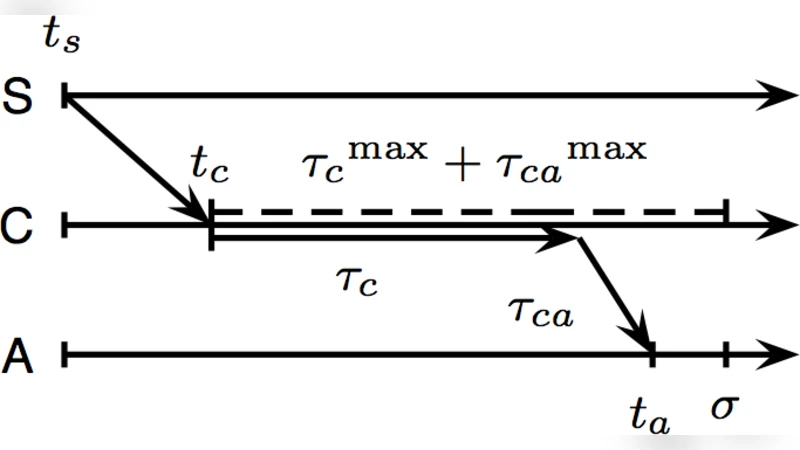
For networked systems, the control law is typically subject to network flaws such as delays and packet dropouts. Hence, the time in between updates of the control law varies unexpectedly. Here, we present a stability theorem for nonlinear model predictive control with varying control horizon in a continuous time setting without stabilizing terminal constraints or costs. It turns out that stability can be concluded under the same conditions as for a (short) fixed control horizon.
💡 Research Summary
This paper addresses the challenge of ensuring stability in networked systems where control law updates are subject to irregularities due to network flaws such as delays and packet dropouts. The authors propose a nonlinear model predictive control (NMPC) approach for continuous-time settings with varying control horizons, without relying on stabilizing terminal constraints or costs. A key contribution is the presentation of a stability theorem that demonstrates stability can be achieved under conditions similar to those required for a short fixed control horizon.
The paper highlights the importance of addressing network-induced irregularities in control law updates, which are common issues in networked systems. By leveraging NMPC techniques, the authors aim to provide a robust solution that maintains system stability despite these challenges. The proposed method does not require additional stabilizing constraints or costs, making it more flexible and applicable to a wider range of scenarios.
The analysis includes rigorous mathematical proofs and theoretical derivations that support the validity of the stability theorem. Through simulations and case studies, the paper also demonstrates practical applications of the NMPC approach in real-world networked systems. The results show promising potential for maintaining system stability under varying control horizons and network conditions, thus offering a valuable contribution to the field of control theory and its application in networked environments.
Overall, this research provides a comprehensive framework for ensuring stability in networked systems using advanced NMPC techniques, highlighting the effectiveness and adaptability of these methods in handling complex real-world challenges.
Comments & Academic Discussion
Loading comments...
Leave a Comment