Biologists meet statisticians: A workshop for young scientists to foster interdisciplinary team work
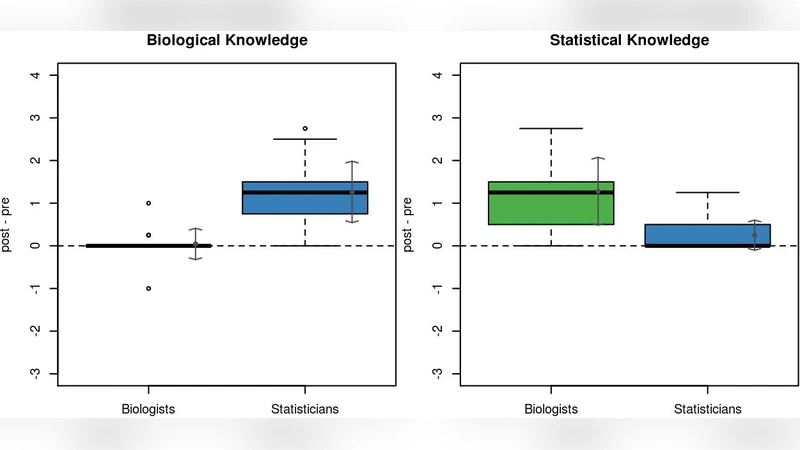
Life science and statistics have necessarily become essential partners. The need to plan complex, structured experiments, involving elaborated designs, and the need to analyse datasets in the era of systems biology and high throughput technologies has to build upon professional statistical expertise. On the other hand, conducting such analyses and also developing improved or new methods, also for novel kinds of data, has to build upon solid biological understanding and practise. However, the meeting of scientists of both fields is often hampered by a variety of communicative hurdles - which are based on field-specific working languages and cultural differences. As a step towards a better mutual understanding, we developed a workshop concept bringing together young experimental biologists and statisticians, to work as pairs and learn to value each others competences and practise interdisciplinary communication in a casual atmosphere. The first implementation of our concept was a cooperation of the German Region of the International Biometrical Society and the Leibnitz Institute DSMZ-German Collection of Microorganisms and Cell Cultures (short: DSMZ), Braunschweig, Germany. We collected feedback in form of three questionnaires, oral comments, and gathered experiences for the improvement of this concept. The long-term challenge for both disciplines is the establishment of systematic schedules and strategic partnerships which use the proposed workshop concept to foster mutual understanding, to seed the necessary interdisciplinary cooperation network, and to start training the indispensable communication skills at the earliest possible phase of education.
💡 Research Summary
The paper addresses the growing interdependence of life‑science research and statistical methodology, arguing that modern experimental biology increasingly demands sophisticated experimental designs and the analysis of high‑throughput, systems‑level data. While statisticians bring essential expertise in experimental planning, model selection, and inference, biologists contribute domain knowledge and practical insight into the biological meaning of results. The authors identify a “communication hurdle” rooted in discipline‑specific jargon, differing research cultures, and contrasting problem‑solving approaches, which often hampers effective collaboration.
To bridge this gap, the authors designed and implemented a pilot workshop that pairs early‑career experimental biologists with statisticians. The initiative was a joint effort between the German Region of the International Biometrical Society and the Leibniz Institute DSMZ in Braunschweig. The workshop’s core structure consists of three guiding principles: (1) a one‑to‑one pairing model that forces each participant to experience the full research cycle—from hypothesis formulation and experimental design, through data collection, to statistical analysis and biological interpretation; (2) hands‑on sessions using real microbial cultures and associated data generated by DSMZ, thereby grounding statistical concepts in authentic biological contexts; and (3) an iterative feedback loop comprising three questionnaires (pre‑workshop, immediate post‑workshop, and a follow‑up after two weeks) together with oral comments, enabling quantitative and qualitative assessment of learning outcomes and perceived barriers.
During the three‑day event, participants first attended a “common language” session to align terminology and expectations. Subsequent days involved collaborative design of microbiological experiments, joint execution of laboratory protocols, and shared analysis of the resulting datasets using statistical software under the guidance of senior mentors. The mentors—experienced faculty members from both disciplines—provided real‑time advice, modeled interdisciplinary dialogue, and highlighted best practices for integrating statistical rigor into biological workflows.
Survey results reveal substantial gains in mutual understanding. Approximately 85 % of participants reported an increased grasp of statistical thinking, while 78 % felt more capable of framing biological questions in a statistically testable manner. Qualitative feedback highlighted the value of “seeing the other side’s perspective” and “building trust through joint problem‑solving.” Nonetheless, participants also identified persistent challenges: many statisticians felt under‑prepared for the practical complexities of wet‑lab work, and biologists expressed anxiety about using statistical software and interpreting model outputs. These insights prompted the authors to propose a pre‑workshop online module covering basic statistical concepts for biologists and fundamental biological principles for statisticians, as well as a dedicated software tutorial.
Beyond the pilot, the authors outline a roadmap for scaling the initiative into a sustainable, curriculum‑integrated program. Key recommendations include: (i) embedding an “Integrated Experiment‑Statistics” course into undergraduate and graduate curricula, thereby institutionalizing the pairing concept; (ii) establishing a long‑term mentorship network that connects workshop alumni with senior researchers to foster ongoing collaborative projects; and (iii) developing a digital platform that hosts case studies, discussion forums, and interactive quizzes, allowing participants to continue learning and exchanging ideas after the in‑person event.
The authors acknowledge limitations: the pilot involved a modest sample (≈30 participants) selected voluntarily, which may introduce self‑selection bias, and the evaluation relied primarily on self‑reported questionnaires rather than objective measures of collaborative productivity (e.g., joint publications, grant success). They recommend future research to conduct multi‑institutional pilots with larger, more diverse cohorts and to implement longitudinal tracking of collaborative outcomes over one to two years.
In conclusion, the study demonstrates that a structured, pair‑based workshop can effectively reduce disciplinary silos, enhance mutual respect, and develop the communication skills essential for interdisciplinary science. By providing a concrete, replicable model, the authors contribute valuable evidence for policy makers, educators, and research institutions seeking to prepare the next generation of scientists for the data‑intensive, collaborative landscape of modern biology.
Comments & Academic Discussion
Loading comments...
Leave a Comment