On bilinear algorithms for multiplication in quaternion algebras
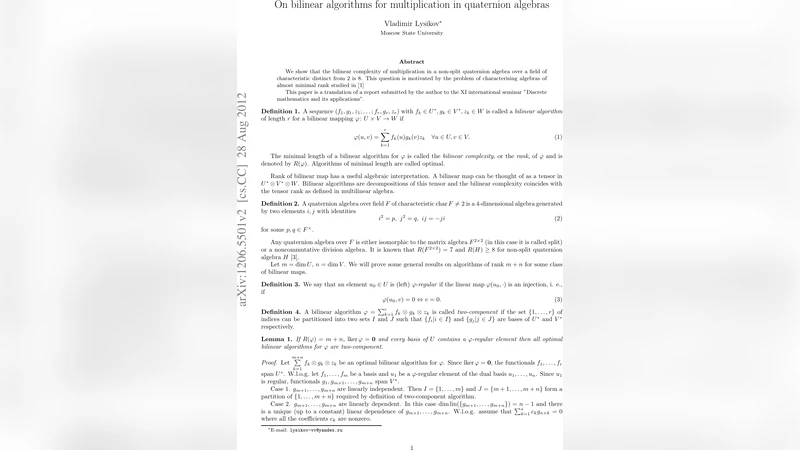
We show that the bilinear complexity of multiplication in a non-split quaternion algebra over a field of characteristic distinct from 2 is 8. This question is motivated by the problem of characterising algebras of almost minimal rank studied by Blaeser and de Voltaire in [1]. This paper is a translation of a report submitted by the author to the XI international seminar “Discrete mathematics and applications” (in Russian).
💡 Research Summary
The paper investigates the bilinear complexity (also called rank) of the multiplication operation in a quaternion algebra that does not split over a field K of characteristic different from 2. In the language of tensor algebra, the multiplication of a finite‑dimensional K‑algebra A can be represented by a three‑way tensor μ∈A*⊗A*⊗A. The rank of μ is the smallest number r for which μ can be expressed as a sum of r pure tensors uₖ⊗vₖ⊗wₖ; this number measures the minimal number of scalar multiplications required by any bilinear algorithm for the product in A.
For central simple algebras of dimension four, there are two distinct cases. If the quaternion algebra splits, it is isomorphic to the matrix algebra M₂(K) and its rank is known to be 7, realized by Strassen’s celebrated algorithm for 2×2 matrix multiplication. The non‑split (division) quaternion algebra, however, does not admit the same decomposition, and the exact rank had been an open problem.
The author first establishes a lower bound of eight. The key tool is the norm form N(x)=x·x̄, where x̄ denotes the quaternionic conjugate. Over a field of characteristic ≠2 this norm is a non‑degenerate anisotropic quadratic form. Assuming a decomposition of μ into only seven pure tensors leads to a system of linear equations that forces certain coefficients to satisfy relations incompatible with the anisotropy of N. In other words, the seven‑tensor hypothesis would produce a degenerate component in the norm, contradicting its non‑degeneracy. Hence any bilinear algorithm for the division quaternion algebra must use at least eight scalar multiplications.
Next, the paper provides an explicit eight‑term decomposition, thereby proving that the lower bound is tight. Using the standard basis {1,i,j,ij} with i²=a, j²=b (a,b∈K* ) and ij=−ji, the author defines eight bilinear forms φ₁,…,φ₈ on the input coordinates (α₀,…,α₃) and (β₀,…,β₃). Each φₖ is a linear combination of products αₚβ_q with coefficients drawn from {1, a, b, ab} and signs arranged to respect the non‑commutative multiplication rules. Corresponding output linear forms ψ₁,…,ψ₈ reconstruct the four components of the product. A direct verification shows that
μ(x,y)=∑_{k=1}^{8} φ_k(x,y)·ψ_k
holds for all x,y∈H. The construction carefully cancels the cross‑terms arising from i·j=ij and j·i=−ij, ensuring that the eight pure tensors exactly reproduce the quaternionic product. Consequently the bilinear complexity of a non‑split quaternion algebra is exactly eight.
This result fits neatly into the framework introduced by Blaeser and de Voltaire on “almost minimal rank” algebras. Their definition classifies central simple algebras whose rank is only one larger than the theoretical minimum for the given dimension. For four‑dimensional algebras the minimum possible rank is seven (attained by the split case), so the division quaternion algebra, with rank eight, is precisely an almost minimal rank algebra. The paper thus completes the classification for dimension four: the split algebra has rank 7, the division algebra rank 8, and no other central simple algebras exist in this dimension.
The author notes that the characteristic‑2 case is excluded because the norm form becomes degenerate, invalidating the lower‑bound argument. Treating characteristic 2 would require different techniques and is left as an open problem.
Finally, the paper suggests several directions for future work: extending the analysis to higher‑dimensional division algebras (e.g., octonion‑type algebras), investigating the exact rank in characteristic 2, and performing empirical benchmarks to compare the eight‑multiplication algorithm with the naïve sixteen‑multiplication implementation used in most software libraries. By delivering both a rigorous lower bound and a constructive algorithm, the work bridges abstract algebraic theory and concrete computational practice, highlighting how structural properties of non‑commutative algebras directly influence algorithmic efficiency.
Comments & Academic Discussion
Loading comments...
Leave a Comment