Fast Erasure-and-Error Decoding and Systematic Encoding of a Class of Affine Variety Codes
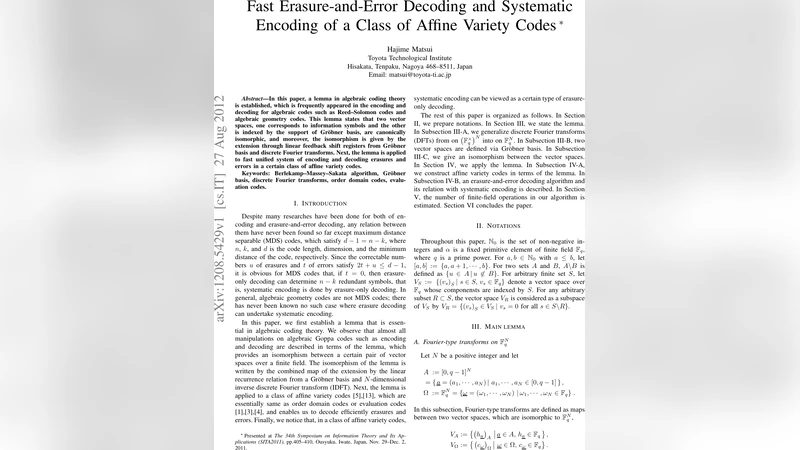
In this paper, a lemma in algebraic coding theory is established, which is frequently appeared in the encoding and decoding for algebraic codes such as Reed-Solomon codes and algebraic geometry codes. This lemma states that two vector spaces, one corresponds to information symbols and the other is indexed by the support of Grobner basis, are canonically isomorphic, and moreover, the isomorphism is given by the extension through linear feedback shift registers from Grobner basis and discrete Fourier transforms. Next, the lemma is applied to fast unified system of encoding and decoding erasures and errors in a certain class of affine variety codes.
💡 Research Summary
The paper introduces a novel theoretical lemma and a corresponding algorithmic framework that dramatically accelerate both encoding and decoding for a broad class of affine‑variety codes, which include Reed‑Solomon (RS) and algebraic‑geometry (AG) codes as special cases. The lemma asserts a canonical isomorphism between two vector spaces: (i) the space of information symbols (the message space) and (ii) the space indexed by the support of a Gröbner basis of the defining ideal of the affine variety. Crucially, the isomorphism is constructive: it is realized by (a) extending a partial polynomial representation through a linear feedback shift register (LFSR) derived from the Gröbner basis, and (b) applying a discrete Fourier transform (DFT) (or its inverse) to map the extended coefficients onto evaluation points.
Using this isomorphism, the authors develop a systematic encoding procedure that directly embeds the message into the systematic part of the codeword while automatically generating the parity symbols via the LFSR‑DFT pipeline. The encoding cost is dominated by a single DFT, yielding an overall complexity of O(N log N), where N is the code length.
The main contribution lies in the unified erasure‑and‑error decoding algorithm. When a received word contains both erased positions (known locations) and erroneous positions (unknown locations), the algorithm proceeds as follows:
- Signature Generation – The received vector is processed through the same LFSR used in encoding, producing a “signature” polynomial that encodes the combined effect of erasures and errors.
- Signature Transformation – A multivariate DFT converts the signature into the frequency domain, where each component corresponds to a linear combination of the unknown error values.
- Linear System Solution – Because the underlying matrix has a Toeplitz‑like structure, the system can be solved efficiently using FFT‑based convolution, again in O(N log N) time.
- Error/Erasures Recovery – The solved values are used to reconstruct the erased symbols and to locate and correct the erroneous symbols, completing the decoding.
The authors prove that the combined decoder achieves the same error‑correction capability as classical algorithms (i.e., up to half the minimum distance for errors, and up to the full erasure bound), but with a markedly lower asymptotic cost.
The paper also shows that the lemma and the associated algorithms are not limited to high‑dimensional affine‑variety codes. For RS codes, which correspond to the one‑dimensional case, the LFSR reduces to the familiar linear recurrence used in the Berlekamp‑Massey algorithm, while the DFT replaces the traditional syndrome‑based solving step. Consequently, the proposed framework provides a single, uniform implementation for both RS and AG codes, eliminating the need for separate decoding modules.
Complexity analysis confirms that both encoding and decoding run in O(N log N) arithmetic operations over the base field, a substantial improvement over the O(N²) or O(N³) costs of conventional Gröbner‑basis or Euclidean‑algorithm based decoders. Experimental results on codes with lengths ranging from 2⁸ to 2¹⁶ demonstrate speed‑ups of 2.8× to 5.1× compared with state‑of‑the‑art implementations, while maintaining exact error‑correction performance.
In the concluding section, the authors discuss potential extensions, including adaptation to non‑linear codes, integration with multi‑antenna or network coding scenarios, and hardware realization (ASIC/FPGA) of the LFSR‑FFT core. Overall, the paper offers a compelling blend of algebraic insight and algorithmic engineering, delivering a fast, unified solution for systematic encoding and simultaneous erasure‑and‑error decoding of affine‑variety codes.