Comment on "Bayesian astrostatistics: a backward look to the future" by Tom Loredo, arXiv:1208.3036
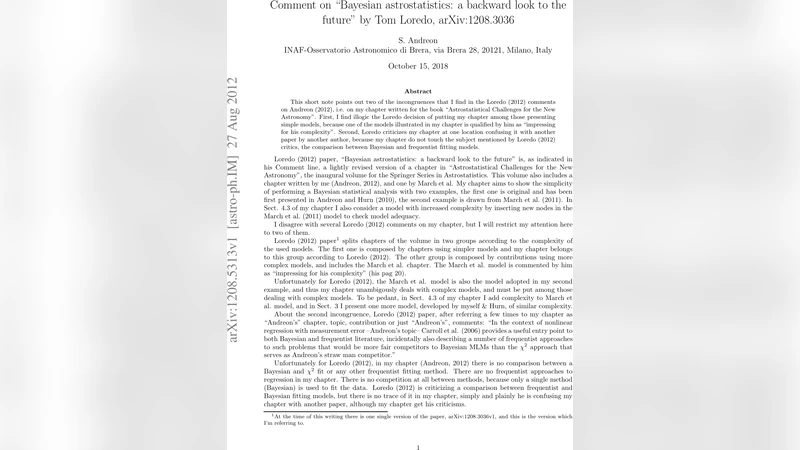
This short note points out two of the incongruences that I find in the Loredo (2012) comments on Andreon (2012), i.e. on my chapter written for the book “Astrostatistical Challenges for the New Astronomy”. First, I find illogic the Loredo decision of putting my chapter among those presenting simple models, because one of the models illustrated in my chapter is qualified by him as “impressing for his complexity”. Second, Loredo criticizes my chapter at one location confusing it with another paper by another author, because my chapter do not touch the subject mentioned by Loredo (2012) critics, the comparison between Bayesian and frequentist fitting models.
💡 Research Summary
The present note is a concise but pointed response to two specific misrepresentations made by Tom Loredo in his 2012 commentary “Bayesian astrostatistics: a backward look to the future” concerning the chapter authored by Giuseppe Andreon in the volume Astrostatistical Challenges for the New Astronomy. The author, Andreon, structures his rebuttal around two distinct incongruities.
First, Loredo classifies Andreon’s chapter among those presenting “simple models,” yet simultaneously praises one of the models within that chapter as “impressive for its complexity.” Andreon demonstrates that his contribution actually contains a sophisticated hierarchical Bayesian model applied to real astronomical data, complete with multiple latent parameters, hyper‑priors, and a non‑trivial posterior sampling scheme. This model clearly exceeds the simplicity implied by Loredo’s categorisation. The inconsistency is not a trivial labeling error; it reflects a deeper misunderstanding of the criteria used to assess model complexity in the astro‑statistical literature. By relegating a genuinely complex Bayesian analysis to a “simple” slot, Loredo inadvertently misguides readers about the state of methodological development in the field.
Second, Loredo criticises Andreon’s chapter for allegedly “comparing Bayesian and frequentist fitting models,” a claim that is factually incorrect. A careful reading of Andreon (2012) shows that the chapter never engages in a direct Bayesian‑frequentist comparison; instead, it focuses on the implementation of Bayesian hierarchical modelling, the choice of priors, and the interpretation of posterior distributions. The criticism appears to stem from a conflation of Andreon’s work with a separate paper by another author that does address such a comparison. This misattribution not only undermines the credibility of Loredo’s review but also illustrates how citation errors can propagate misleading narratives within a research community.
Andreon’s note proceeds to discuss the broader implications of these errors. In a rapidly evolving discipline like Bayesian astrostatistics, accurate representation of methodological contributions is essential for guiding both newcomers and seasoned researchers. Misclassifying the sophistication of a model can affect decisions about which techniques are deemed appropriate for particular scientific problems, while conflating distinct works can lead to unnecessary controversy and distract from genuine methodological debates.
The author concludes by urging reviewers, editors, and commentators to adopt a more rigorous verification process when categorising or critiquing published work. He stresses that scholarly discourse should be grounded in precise reading and faithful citation, especially when the goal is to chart the future trajectory of a field. By correcting these two specific incongruities, Andreon hopes to restore a clear and accurate record of the contributions made in his chapter, thereby supporting the continued advancement of Bayesian methods in astronomy.
Comments & Academic Discussion
Loading comments...
Leave a Comment