General Managers Role in Balancing Subsidiary Between Internal Competition and Knowledge Sharing
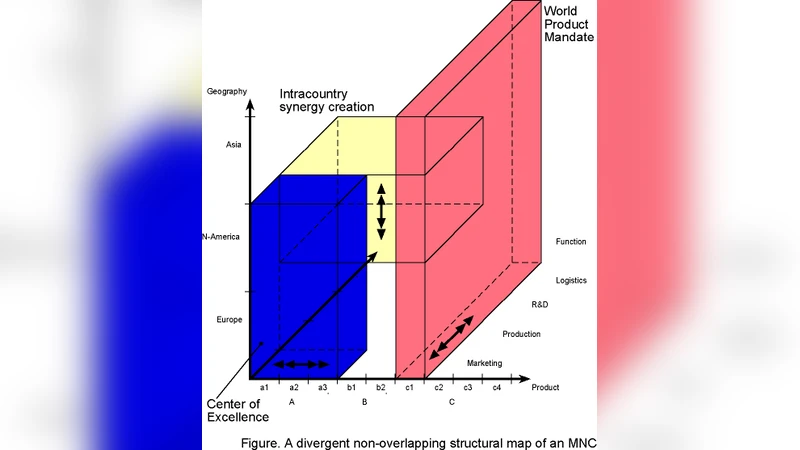
In our work we saw that during the last decades the environment that the MNCs operate in has changed becoming more volatile and less pacedly growing. In this environment the MNCs themselves have become more complex and also flexible. We found that MNCs are essentially three dimensional, that is, they organize around product, functional and geographical dimensions and exhibit characteristics that having a common origin can be applied along any one dimension. Therefore we depicted MNCs as having a divergent, partially overlapping structural map. On that map there can, for instance, be functionally oriented Centers Of Excellence, product dimension World Product Mandates, and for capturing synergy of a big set of operations country dimension based arrangements. Analyzing the development of organizational aspects of MNC theories we saw different bodies of work pointing to a similar direction. We followed developments of concepts Heterarchy, Transnational (and the related Individualized Corporation), works of interorganizational theories school (the multicentered MNC), works considering autonomous strategic decisions, and works originating from subsidiary (host) country research. In addition to the structural developments mentioned earlier these works also point to a need to empower the frontline units. Outlining our research problem the conceptualization of MNCs as operating (competitive) internal markets was shown to rely on entrepreneurial, initiative taking behavior and result in the development of the subsidiary. We classified the subsidiaries first selecting operations substantial enough and then differentiating them based on the autonomy level, as it has implications for the types of initiatives taken.
💡 Research Summary
The paper investigates how multinational corporations (MNCs) have adapted their internal organization in response to a volatile, slower‑growing global environment over recent decades. The authors argue that modern MNCs are best understood as three‑dimensional entities organized simultaneously along product, functional, and geographic axes. This “divergent, partially overlapping structural map” produces distinct but intersecting units: function‑oriented Centers of Excellence, product‑focused World Product Mandates, and country‑based arrangements that capture synergies across large operational clusters.
Building on a review of organizational theory, the authors trace the evolution from traditional hierarchical models to heterarchical and transnational frameworks, including the multicentered MNC and the individualized corporation concepts. These theories converge on a common insight: subsidiaries must be empowered to act as autonomous strategic actors rather than passive implementers of headquarters’ directives. To operationalize this insight, the study classifies subsidiaries first by the substantive size and impact of their operations (core subsidiaries) and then by their level of autonomy—high, medium, or low. Autonomy level determines the type and intensity of initiatives a subsidiary undertakes.
High‑autonomy subsidiaries are expected to behave like internal entrepreneurs: they compete with sister units for resources, market share, and innovation outcomes, while simultaneously sharing knowledge, best practices, and technology with the broader MNC network. This dual mandate creates an “internal market” where competition spurs efficiency and innovation, and knowledge sharing spreads the resulting gains across the corporation.
The central contribution of the paper is a nuanced description of the General Manager’s (GM) role in balancing these opposing forces. The GM must act as a bridge between the subsidiary’s entrepreneurial drive and the corporation’s collective learning objectives. On the entrepreneurial side, the GM cultivates a risk‑taking culture, designs performance‑based incentives, and protects the subsidiary’s ability to launch new products or processes without excessive bureaucratic delay. On the knowledge‑sharing side, the GM establishes network‑based communication channels, integrates knowledge‑contribution metrics into performance evaluations, and orchestrates “co‑opetition” mechanisms that prevent destructive rivalry while preserving healthy competition.
The authors synthesize insights from heterarchy, transnational, multicentered, and subsidiary‑driven strategy literature to propose a management framework that aligns internal competition with collaborative learning. They argue that when GMs deliberately calibrate incentives, information flows, and governance structures to the subsidiary’s autonomy level, the MNC as a whole becomes more agile, innovative, and capable of sustaining competitive advantage in a turbulent global market.
In conclusion, the paper posits that the future success of multinational enterprises hinges on a dual‑track governance model: granting subsidiaries sufficient autonomy to act as internal entrepreneurs, while simultaneously embedding robust knowledge‑sharing mechanisms overseen by proactive General Managers. This balance enables MNCs to harness the creative potential of internal competition without sacrificing the synergistic benefits of collective learning, thereby delivering sustained growth and resilience in an increasingly uncertain business landscape.
Comments & Academic Discussion
Loading comments...
Leave a Comment