Initiality for Typed Syntax and Semantics
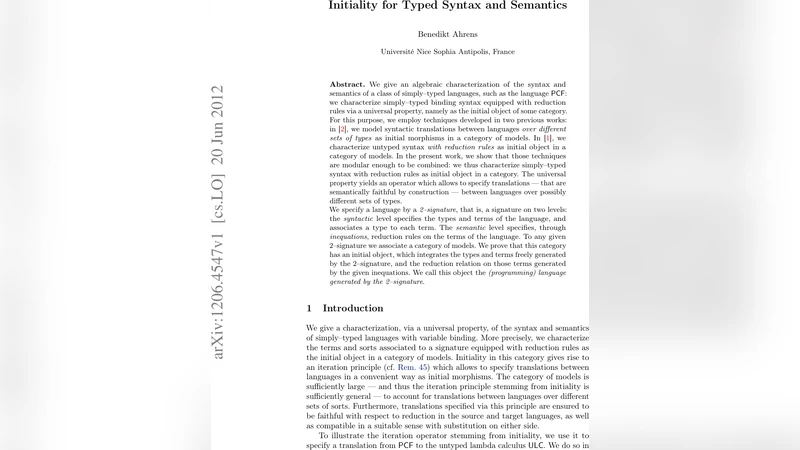
We give an algebraic characterization of the syntax and semantics of a class of simply-typed languages, such as the language PCF: we characterize simply-typed binding syntax equipped with reduction rules via a universal property, namely as the initial object of some category. For this purpose, we employ techniques developed in two previous works: in [2], we model syntactic translations between languages over different sets of types as initial morphisms in a category of models. In [1], we characterize untyped syntax with reduction rules as initial object in a category of models. In the present work, we show that those techniques are modular enough to be combined: we thus characterize simply-typed syntax with reduction rules as initial object in a category. The universal property yields an operator which allows to specify translations - that are semantically faithful by construction - between languages over possibly different sets of types. We specify a language by a 2-signature, that is, a signature on two levels: the syntactic level specifies the types and terms of the language, and associates a type to each term. The semantic level specifies, through inequations, reduction rules on the terms of the language. To any given 2-signature we associate a category of models. We prove that this category has an initial object, which integrates the types and terms freely generated by the 2-signature, and the reduction relation on those terms generated by the given inequations. We call this object the (programming) language generated by the 2-signature. [1] Ahrens, B.: Modules over relative monads for syntax and semantics (2011), arXiv:1107.5252, to be published in Math. Struct. in Comp. Science [2] Ahrens, B.: Extended Initiality for Typed Abstract Syntax. Logical Methods in Computer Science 8(2), 1-35 (2012)
💡 Research Summary
The paper presents a categorical characterisation of the syntax and semantics of simply‑typed languages such as PCF by means of an initial‑object theorem. The authors introduce the notion of a 2‑signature, which consists of two layers: a syntactic layer that declares the set of types and the formation rules for terms together with a typing assignment, and a semantic layer that specifies reduction rules as inequations between terms. For any given 2‑signature they define a category of models. A model comprises (i) an interpretation of the type symbols, (ii) an interpretation of the term symbols over those types, and (iii) a reduction relation that satisfies the inequations. Morphisms in this category are strong monad morphisms that preserve both typing and reduction.
The central technical contribution is the proof that this category possesses an initial object. The construction builds on two earlier works by the same author. The first work (Ahrens 2011) treats untyped syntax with reduction rules using relative monads and shows that such syntax is initial in a suitable category of models. The second work (Ahrens 2012) treats translations between languages with different type sets as initial morphisms in a category of typed abstract syntax. In the present paper the authors combine these ideas modularly: they encode a 2‑signature as a relative monad equipped with a preorder of reductions, then construct the free model that freely generates the types and terms while simultaneously generating the smallest reduction relation closed under the given inequations. This free model is shown to be initial, i.e., for any other model there exists a unique morphism from the initial model preserving typing and reduction.
The existence of an initial model yields an operator for language translation that is automatically semantically faithful. Because the translation is a morphism from the initial model to a target model, it necessarily respects the typing discipline and the reduction semantics encoded by the 2‑signature. Consequently, two languages that may have different underlying type sets but share a common 2‑signature can be related by a canonical, correctness‑by‑construction translation. This property is highly valuable for language designers: one can specify the static (type) and dynamic (reduction) aspects of a language independently, and later instantiate concrete implementations, optimisations, or target languages without re‑proving soundness of the translation.
Furthermore, the framework is modular. Adding new type constructors, term formers, or reduction rules simply extends the 2‑signature; the corresponding initial model is obtained by the same construction without having to redesign the whole semantics. This makes the approach suitable for incremental language development, meta‑programming, and the formal verification of compilers or interpreters.
In summary, the paper establishes that simply‑typed binding syntax equipped with reduction rules can be captured as the initial object of a well‑defined category of models derived from a 2‑signature. This initiality theorem provides a principled, algebraic foundation for defining languages, proving properties about them, and constructing semantically faithful translations between disparate typed languages.
Comments & Academic Discussion
Loading comments...
Leave a Comment