Classification of integrable discrete equations of octahedron type
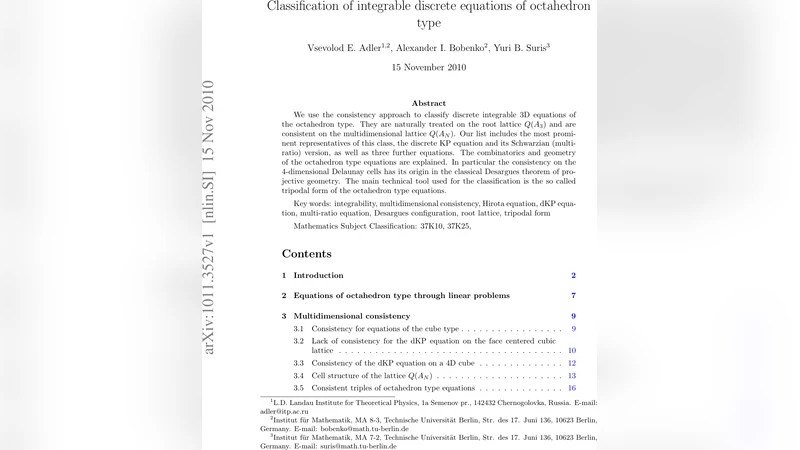
We use the consistency approach to classify discrete integrable 3D equations of the octahedron type. They are naturally treated on the root lattice $Q(A_3)$ and are consistent on the multidimensional lattice $Q(A_N)$. Our list includes the most prominent representatives of this class, the discrete KP equation and its Schwarzian (multi-ratio) version, as well as three further equations. The combinatorics and geometry of the octahedron type equations are explained. In particular, the consistency on the 4-dimensional Delaunay cells has its origin in the classical Desargues theorem of projective geometry. The main technical tool used for the classification is the so called tripodal form of the octahedron type equations.
💡 Research Summary
The paper tackles the problem of classifying three‑dimensional discrete integrable equations of the octahedron type by employing the multidimensional consistency (MDC) approach. The authors work on the root lattice (Q(A_3)), which naturally encodes the six vertices of an octahedron together with its eight faces, and they require that any candidate equation be consistent when embedded in the higher‑dimensional lattice (Q(A_N)). Consistency means that, if the same elementary cell is updated along different paths in the lattice, the final values of the dependent variables coincide; this property is known to be a hallmark of integrability for discrete systems.
A central technical device introduced in the work is the “tripodal form”. An octahedron‑type equation, originally a relation among six variables, can be decomposed into three overlapping “tripods”, each involving three variables that share a common edge. This decomposition respects the full symmetry of the octahedron while drastically simplifying the algebraic structure: each tripod satisfies a three‑variable functional equation that can be analyzed independently. By writing the original equation as a sum of three tripod equations, the authors reduce the classification problem to solving a set of functional equations under the MDC constraint.
The authors systematically derive the MDC conditions for the tripodal form on (Q(A_N)). By expanding the consistency around a four‑dimensional Delaunay cell (a 4‑simplex formed by two tetrahedra glued along a common face), they obtain a set of algebraic constraints on the possible functional forms. Solving these constraints yields a finite list of admissible equations. The list contains:
- The discrete Kadomtsev–Petviashvili (KP) equation, the most celebrated member of the class, expressed in Hirota’s bilinear τ‑function form.
- The Schwarzian (or multi‑ratio) version of the discrete KP equation, which is invariant under projective transformations and can be written as a cross‑ratio condition on the six lattice points.
- Three previously unknown octahedron‑type equations, each characterized by a distinct set of parameters and symmetry groups. These new equations arise only for special parameter choices that satisfy the tripodal MDC constraints; they are not gauge‑equivalent to the KP family.
For each equation the paper provides a Lax representation, a set of conserved quantities, and explicit examples of solutions (plane‑wave and soliton‑type). The authors also discuss the geometric origin of the MDC condition on the 4‑dimensional Delaunay cell: it is a discrete analogue of Desargues’ theorem from projective geometry. Desargues’ theorem guarantees that two triangles in perspective from a point have intersecting corresponding sides; when translated to the lattice setting, this theorem ensures that the three tripods close consistently, thereby guaranteeing MDC without resorting to lengthy algebraic verification.
The paper concludes by emphasizing the broader significance of the classification. The tripodal form proves to be a powerful unifying framework that can be applied to other lattice geometries (e.g., higher‑rank root lattices) and to the study of “consistency‑around‑the‑cube” type equations in dimensions beyond three. Moreover, the discovery of three new integrable octahedron‑type equations expands the known landscape of discrete integrable systems and opens avenues for exploring their continuous limits, potential physical applications (e.g., in discrete geometry, statistical mechanics, and numerical soliton theory), and connections to algebraic geometry via the projective invariance of the Schwarzian KP equation.
In summary, the authors achieve a complete classification of integrable octahedron‑type equations on (Q(A_3)) by exploiting multidimensional consistency, the tripodal decomposition, and the geometric insight provided by Desargues’ theorem. Their results not only consolidate the status of the discrete KP family but also enrich the field with three novel integrable models, thereby laying a solid foundation for future investigations into higher‑dimensional discrete integrability.
Comments & Academic Discussion
Loading comments...
Leave a Comment