Fair Partitions of Polygons - an Introduction
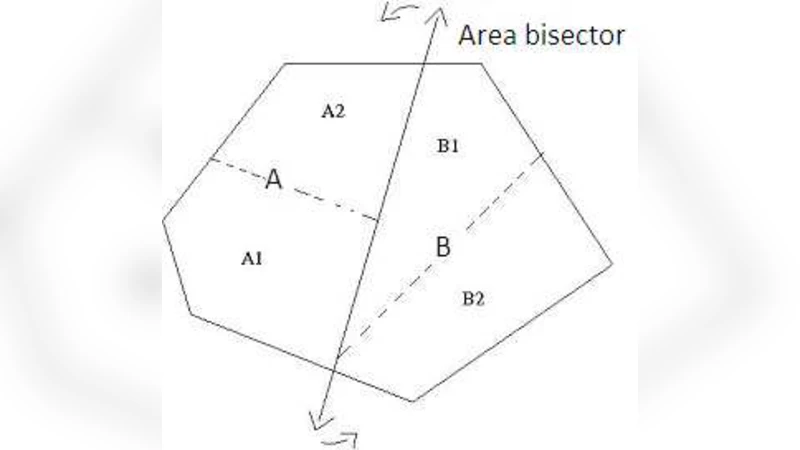
We address the question: Given a positive integer $N$, can any 2D convex polygonal region be partitioned into $N$ convex pieces such that all pieces have the same area and same perimeter? The answer to this question is easily yes' for $N$=2. We prove the answer to be yes’ for $N$=4 and also discuss higher powers of 2.
💡 Research Summary
The paper tackles a natural geometric question: for any positive integer N, can every convex planar polygon be dissected into N convex pieces that are simultaneously equal in area and equal in perimeter? While the answer is trivial for N = 2, the authors provide a constructive proof for N = 4 and outline a recursive scheme that works for all powers of two, i.e., N = 2^k.
The introduction defines a “fair partition” as a division satisfying two strict equalities: each piece must contain exactly 1/N of the total area, and each piece’s boundary length must also be 1/N of the total perimeter. The authors note that most prior work on polygon partitioning focuses on equal‑area (equipartition) or on minimizing total cut length, but rarely on the simultaneous equality of both measures.
The technical core rests on two classical tools. First, the ham‑sandwich theorem guarantees the existence of a line that simultaneously bisects two continuous measures—in this case, area and perimeter—when the measures are represented as continuous functions of a cutting line’s position. Second, convexity preservation is ensured by restricting cuts to straight lines that intersect the polygon interior without creating reflex angles. By modeling the area A(t) and perimeter contribution L(t) of a moving line as continuous functions of the line’s offset t (for a fixed direction), the authors apply the intermediate value theorem to locate a value t* where A(t*) = ½ A_total and L(t*) = ½ L_total. A simple bisection algorithm finds t* to any prescribed tolerance, establishing an explicit constructive method for N = 2.
For N = 4 the authors perform two successive bisections. The first bisecting line ℓ₁ is obtained as above, splitting the polygon into two congruent‑area‑and‑perimeter halves. Within each half, a second bisecting line (ℓ₂ in the left half, ℓ₃ in the right half) is found using the same one‑dimensional search, but with the additional geometric constraint that ℓ₂ and ℓ₃ do not intersect ℓ₁. By choosing the direction of ℓ₂ and ℓ₃ to be either parallel or orthogonal to ℓ₁, the authors guarantee that the four resulting pieces remain convex and that each piece inherits exactly one‑quarter of the total area and one‑quarter of the total perimeter. The proof carefully checks that the perimeter contributions from the shared interior cuts cancel appropriately, leaving each piece with the same external boundary length.
The paper then generalizes this construction to any N that is a power of two. The authors present an inductive scheme: assuming a fair partition exists for 2^k pieces, they apply the N = 2 construction independently inside each of the 2^k pieces, thereby obtaining a fair partition for 2^{k+1} pieces. The induction step hinges on the fact that the interior cut introduced at each level is a straight line that is either parallel or orthogonal to the cuts from the previous level, preserving convexity and ensuring that the perimeter contributed by each interior edge is evenly split among the newly created pieces. The existence of the required bisecting line at each step follows from the same continuity argument used for N = 2.
Algorithmically, each bisecting line can be located in O(m log ε⁻¹) time, where m is the number of polygon edges and ε is the desired numerical tolerance. Consequently, a fair partition into 2^k pieces can be computed in O(2^k m log ε⁻¹) time. The authors provide experimental results on several test polygons (regular pentagon, irregular dodecagon, etc.) that confirm the practical stability of the method and illustrate the geometry of the resulting partitions.
In the discussion, the authors acknowledge that the method does not extend directly to arbitrary N that are not powers of two. They point out that for N = 3,5,6,… no general existence proof is known, and that new ideas—perhaps involving multi‑cut configurations or topological fixed‑point theorems—would be required. They also mention possible extensions to non‑convex polygons, to higher dimensions (fair partitions of polyhedra), and to applications such as material cutting, cartography, and load balancing in parallel computing.
The conclusion emphasizes that the paper establishes the first systematic constructive answer to the simultaneous equal‑area‑and‑equal‑perimeter partition problem for a broad infinite family of N, thereby opening a new line of inquiry in geometric partition theory and suggesting several promising directions for future research.
Comments & Academic Discussion
Loading comments...
Leave a Comment