📝 Original Info
- Title: ARGO-YBJ constraints on very high energy emission from GRBs
- ArXiv ID: 0903.0119
- Date: 2012-08-27
- Authors: Researchers from original ArXiv paper
📝 Abstract
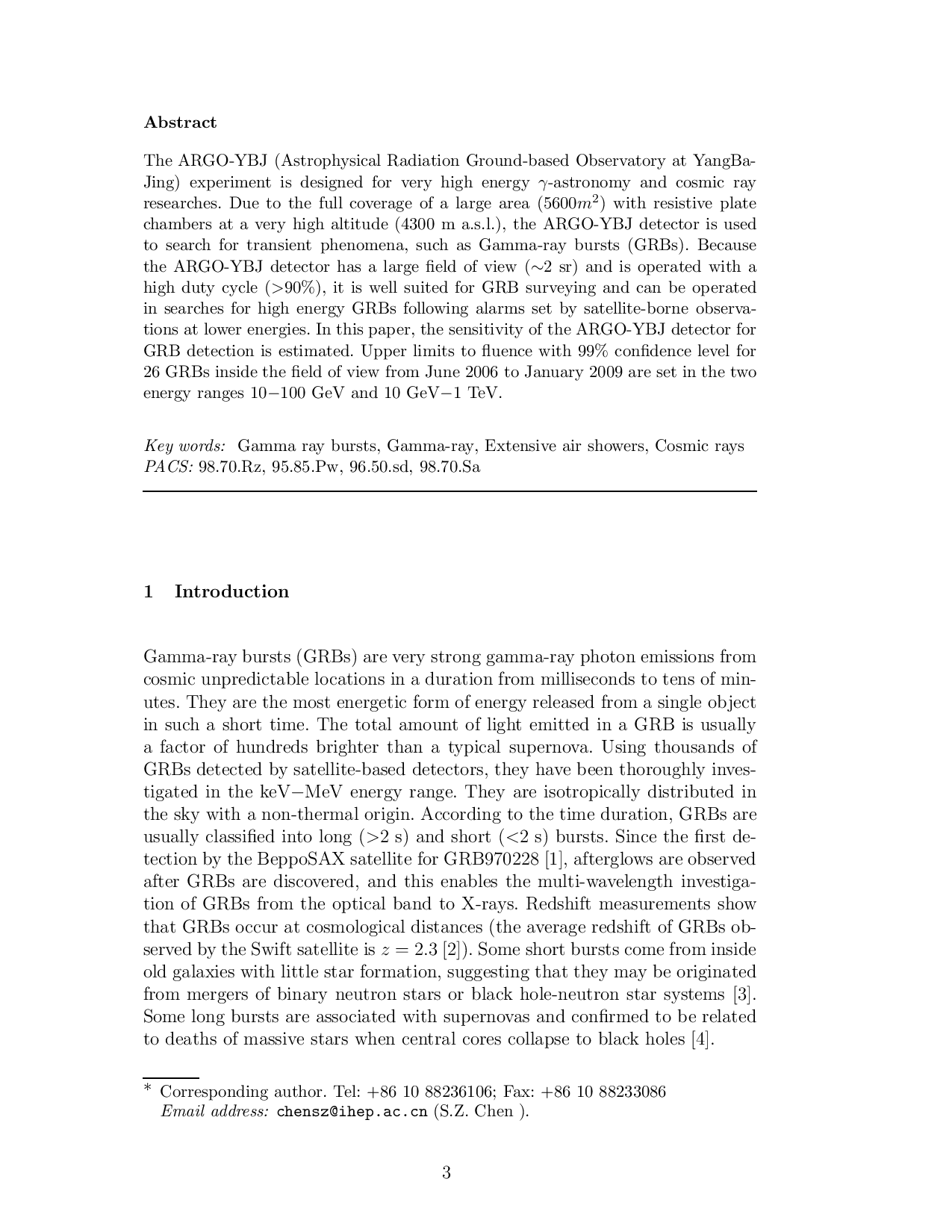
The ARGO-YBJ (Astrophysical Radiation Ground-based Observatory at YangBaJing) experiment is designed for very high energy $\gamma$-astronomy and cosmic ray researches. Due to the full coverage of a large area ($5600 m^2$) with resistive plate chambers at a very high altitude (4300 m a.s.l.), the ARGO-YBJ detector is used to search for transient phenomena, such as Gamma-ray bursts (GRBs). Because the ARGO-YBJ detector has a large field of view ($\sim$2 sr) and is operated with a high duty cycle ($>$90%), it is well suited for GRB surveying and can be operated in searches for high energy GRBs following alarms set by satellite-borne observations at lower energies. In this paper, the sensitivity of the ARGO-YBJ detector for GRB detection is estimated. Upper limits to fluence with 99% confidence level for 26 GRBs inside the field of view from June 2006 to January 2009 are set in the two energy ranges 10$-$100 GeV and 10 GeV$-$1 TeV.
💡 Deep Analysis
Deep Dive into ARGO-YBJ constraints on very high energy emission from GRBs.
The ARGO-YBJ (Astrophysical Radiation Ground-based Observatory at YangBaJing) experiment is designed for very high energy $\gamma$-astronomy and cosmic ray researches. Due to the full coverage of a large area ($5600 m^2$) with resistive plate chambers at a very high altitude (4300 m a.s.l.), the ARGO-YBJ detector is used to search for transient phenomena, such as Gamma-ray bursts (GRBs). Because the ARGO-YBJ detector has a large field of view ($\sim$2 sr) and is operated with a high duty cycle ($>$90%), it is well suited for GRB surveying and can be operated in searches for high energy GRBs following alarms set by satellite-borne observations at lower energies. In this paper, the sensitivity of the ARGO-YBJ detector for GRB detection is estimated. Upper limits to fluence with 99% confidence level for 26 GRBs inside the field of view from June 2006 to January 2009 are set in the two energy ranges 10$-$100 GeV and 10 GeV$-$1 TeV.
📄 Full Content
Gamma-ray bursts (GRBs) are very strong gamma-ray photon emissions from cosmic unpredictable locations in a duration from milliseconds to tens of minutes. They are the most energetic form of energy released from a single object in such a short time. The total amount of light emitted in a GRB is usually a factor of hundreds brighter than a typical supernova. Using thousands of GRBs detected by satellite-based detectors, they have been thoroughly investigated in the keV-MeV energy range. They are isotropically distributed in the sky with a non-thermal origin. According to the time duration, GRBs are usually classified into long (>2 s) and short (<2 s) bursts. Since the first detection by the BeppoSAX satellite for GRB970228 [1], afterglows are observed after GRBs are discovered, and this enables the multi-wavelength investigation of GRBs from the optical band to X-rays. Redshift measurements show that GRBs occur at cosmological distances (the average redshift of GRBs observed by the Swift satellite is z = 2.3 [2]). Some short bursts come from inside old galaxies with little star formation, suggesting that they may be originated from mergers of binary neutron stars or black hole-neutron star systems [3]. Some long bursts are associated with supernovas and confirmed to be related to deaths of massive stars when central cores collapse to black holes [4].
High energy (HE) gamma-ray emissions from GRBs is also observed in several satellite-born experiments. Energetic Gamma-Ray Experiment Telescope (EGRET) detected several GRBs with photon energies ranging from 100 MeV to 18 GeV [5]. Both prompt and delayed emissions were detected and no high energy cutoff was found in the spectra. Most importantly, a distinct HE spectral component was evidently detected in GRB941017 [6]. Recently, Fermi Large Area Telescope (LAT) also detected GeV emissions from GRB080916C [7] and 081024B [8]. These observations at high energies can place important constraints on models of emission processes and on parameters of the environment surrounding the sources of bursts. Very high energy (VHE) emission up to ∼TeV is predicted by several models in both prompt and afterglow phases [9]. Emission at such high energies could result from electron Self-Synchrotron Compton (SSC) scattering in either internal or external, forward or reverse shocks. In such cases, a spectrum with double-peak shape extending into the VHE band is expected. Some models [10] also predict VHE emission due to decays of secondary π 0 mesons in neutron-rich outflows. Observations of VHE emission could play a role in discriminating between these models. The difficulty is that the absorption of the VHE photons by the Extragalactic Background Light (EBL), due to the pair production γ + γ EBL → e + + e -, causes a substantial reduction of the VHE photon flux. This sets a high upper limit on the sensitivity of a detector used for GRB search in this energy range. The gamma-ray fluxes from these GRBs become too small to be detected from current satellite-based experiments due to their small sensitive areas, so only ground-based experiments have areas large enough for the detection.
Search for VHE emission from GRBs has been done by many ground-based experiments including extensive air shower arrays and Cherenkov telescopes. No conclusive detection has been made up to now, while some positive indications were reported. The Tibet ASγ experiment found an indication of 10 TeV emission in a stacked analysis of 57 bursts [11]. The Milagrito experiment reported evidence of emission above 650 GeV from GRB970417A with a chance probability of 1.5 × 10 -3 [12]. Evidence of emission above 20 TeV from GRB920915C was reported about 1 min earlier than the GRB trigger time at 2.7σ level by the HEGRA AIROBICC array, but the position deviated of about 9 • [13]. The muon detector GRAND found an excess during GRB971110 with a chance probability of 3 × 10 -3 [14]. Due to limited field of view (FOV), Cherenkov telescopes, like MAGIC and HESS, can only be operated in follow-up mode and at least 40 s (usually minutes) are needed to sway the telescopes to point to the GRB. However, this sets very low upper limits to the photon fluences at energies around hundreds of GeV during the afterglow phase [15,16].
With a large FOV (∼2 sr) and high duty cycle (>90%), the ARGO-YBJ experiment, using a full coverage detector of Resistive Plate Chambers (RPCs) with area 5600m 2 , is well suited for GRB surveying. Following alarms by satellite-borne observations of GRBs, the ARGO-YBJ detector is used to look for emission from them with a threshold of a few hundreds of GeV. No significant excess has been observed yet. In this paper, we place upper limits on the VHE emission fluences for the GRBs inside the FOV of the ARGO-YBJ detector. Two models with very different high energy cutoff are used. The detector performance is investigated using MC simulation. Based on this, the sensitivity of the ARGO-YBJ detector for GRB
…(Full text truncated)…
📸 Image Gallery
Reference
This content is AI-processed based on ArXiv data.