The IceCube Neutrino Observatory V: Future Developments
Proposed enhancements of the IceCube observatory. Submitted papers to the 32nd International Cosmic Ray Conference, Beijing 2011.
💡 Research Summary
The IceCube Neutrino Observatory, originally built as a cubic‑kilometer optical Cherenkov detector at the South Pole, is now pursuing a multi‑modal expansion to reach an effective volume of order 100 km³ for the detection of ultra‑high‑energy (UHE) neutrinos (10¹⁷–10²⁰ eV). This paper reviews four complementary development streams that together constitute “IceCube V”: (1) the South Pole Acoustic Test Setup (SPATS), (2) the Radio Air Shower Test Array (RASTA), (3) an In‑Ice Radio Frequency (RF) extension, and (4) a conceptual proton‑decay experiment embedded in the ice.
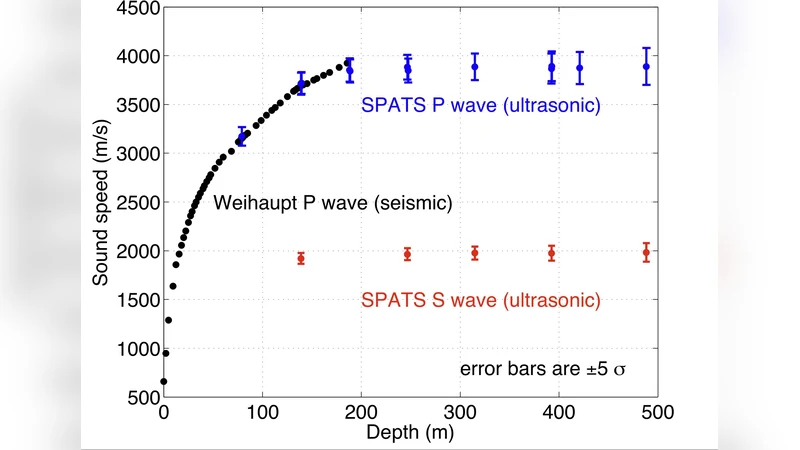
SPATS, operational since 2007, consists of four vertical strings each holding seven acoustic stages (sensor + transmitter) forming a trapezoidal array with inter‑string distances of 125–543 m. Measurements in the 10–100 kHz band have yielded a pressure‑wave speed of 3878 ± 12 m s⁻¹ and a shear‑wave speed of 1975.8 ± 8.0 m s⁻¹, with negligible vertical gradient below 200 m. This near‑absence of refraction implies that acoustic signals from neutrino‑induced cascades propagate essentially on straight lines, simplifying direction reconstruction and background discrimination. The ambient acoustic noise, monitored over two years down to 500 m depth, is Gaussian and stable, with an effective pressure‑noise level of ~20 mPa above 200 m and ~14 mPa below 500 m after subtraction of the 7 mPa electronic self‑noise. These low noise levels suggest that an acoustic trigger threshold could be set well below the 10¹⁸ eV scale, making acoustic detection a viable complement to optical methods.
RASTA aims to characterize the radio component of extensive air showers by deploying a “pinger” in 13 IceCube drill holes. The pinger emits narrow‑band pulses at 30, 45, and 60 kHz and has been used to probe attenuation lengths and frequency‑dependent propagation up to 1 km depth. Early results confirm that radio‑frequency signals can travel kilometer‑scale distances in the ice, but detailed modeling of ice conductivity, temperature gradients, and possible birefringence effects remains necessary to predict the performance of a full‑scale radio array.
The In‑Ice RF extension adds high‑voltage pulse generators and broadband antennas to existing IceCube strings, targeting the 200 MHz–1 GHz band where the Askaryan effect produces coherent radio emission from UHE neutrino interactions. Prototype modules have demonstrated signal‑to‑noise ratios above 3 dB, and simulations indicate that a denser deployment (≈10 × the current antenna density) could achieve an effective volume of order 10 km³ for GZK neutrinos.
Finally, the paper outlines a long‑term vision for a proton‑decay experiment embedded in the Antarctic ice. The ultra‑cold, low‑background environment, combined with the existing drilling infrastructure, could host large‑mass detectors (e.g., high‑purity silicon or low‑temperature superconducting sensors) at a fraction of the cost of underground facilities. Preliminary studies of material performance at –50 °C and high pressure suggest feasibility, though detailed engineering and background studies are required.
Collectively, these four initiatives illustrate a coherent strategy: acoustic detection provides precise directional information with low noise; radio detection offers long attenuation lengths and cost‑effective sparse instrumentation; the optical array continues to deliver calibrated low‑energy measurements; and a future proton‑decay module would exploit the same ice volume for rare‑process searches. By integrating these modalities, IceCube V seeks to open a new observational window on the highest‑energy neutrino sky and to pursue fundamental particle‑physics goals within a single, scalable Antarctic platform.
Comments & Academic Discussion
Loading comments...
Leave a Comment