Curved String Topology and Tangential Fukaya Categories
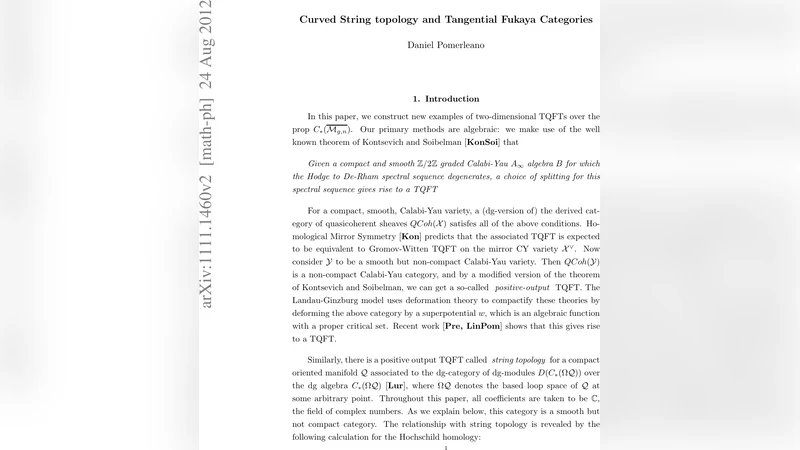
Given a simply connected manifold M such that its cochain algebra, C^\star(M), is a pure Sullivan dga, this paper considers curved deformations of the algebra C_\star({\Omega}M) and consider when the category of curved modules over these algebras becomes fully dualizable. For simple manifolds, like products of spheres, we are able to give an explicit criterion for when the resulting category of curved modules is smooth, proper and CY and thus gives rise to a TQFT. We give Floer theoretic interpretations of these theories for projective spaces and their products, which involve defining a Fukaya category which counts holomorphic disks with prescribed tangencies to a divisor.
💡 Research Summary
The paper develops a systematic framework for constructing two‑dimensional topological quantum field theories (TQFTs) from curved deformations of the chain algebra of the based loop space of a simply‑connected manifold. The starting point is a manifold (M) whose cochain algebra (C^{}(M)) is a pure Sullivan differential graded algebra (dga). Such a hypothesis guarantees that the rational homotopy type of (M) is encoded by a finite‑dimensional minimal model, and that the Hochschild cohomology of (C^{}(M)) can be identified with polyvector fields via the Hochschild‑Kostant‑Rosenberg (HKR) theorem.
Using the classical Adams–Hilton construction, the authors identify the chain algebra (C_{}(\Omega M)) of the based loop space with a non‑compact Calabi–Yau (A_{\infty})-algebra (A). They then introduce a curvature element (potential) (w\in Z(C_{}(\Omega M))) of even degree and form a curved (A_{\infty})-algebra ((A,w)). The central object of study is the category of curved modules, denoted (\operatorname{MF}(A,w)), which is a non‑commutative analogue of matrix factorizations. By adjoining an auxiliary variable of odd degree they obtain a curved dg‑algebra (A_{0}) and define (\operatorname{Pre}(\operatorname{MF}(A,w))) as the full subcategory of perfect (A_{0})-modules. This category carries a natural (\mathbb{C}
Comments & Academic Discussion
Loading comments...
Leave a Comment