Constraints on $theta_{13}$ from A Three-Flavor Oscillation Analysis of Reactor Antineutrinos at KamLAND
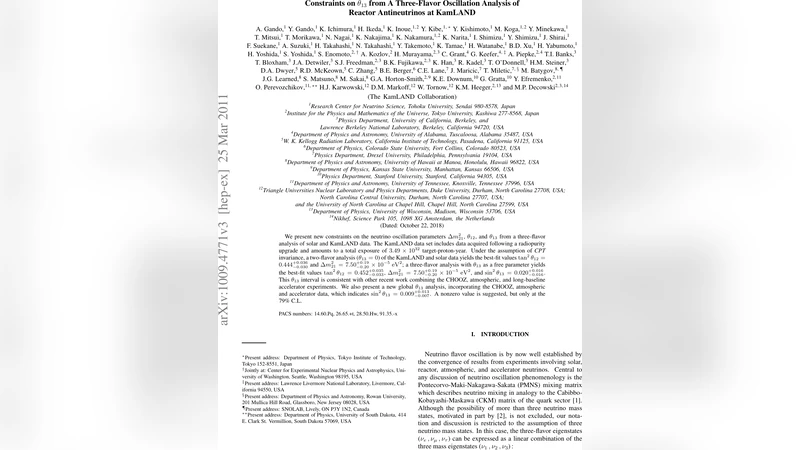
We present new constraints on the neutrino oscillation parameters $/textyen Delta m^{2}{21}$, $/textyen theta{12}$, and $/textyen theta_{13}$ from a three-flavor analysis of solar and KamLAND data. The KamLAND data set includes data acquired following a radiopurity upgrade and amounts to a total exposure of $3.49 \textyen times 10^{32}$ target-proton-year. Under the assumption of {\textyen it CPT} invariance, a two-flavor analysis (/textyen mbox{$\textyen theta_{13} = 0$}) of the KamLAND and solar data yields the best-fit values $\textyen tan^{2} \textyen theta_{12} = 0.444^{+0.036}{-0.030}$ and $\textyen Delta m^{2}{21} = 7.50^{+0.19}{-0.20} \textyen times 10^{-5} ~ {\textyen rm eV}^{2}$; a three-flavor analysis with $\textyen theta{13}$ as a free parameter yields the best-fit values $\textyen tan^{2} \textyen theta_{12} = 0.452^{+0.035}{-0.033}$, $\textyen Delta m^{2}{21} = 7.50^{+0.19}{-0.20} \textyen times 10^{-5} ~ {\textyen rm eV}^{2}$, and $\textyen sin^{2} \textyen theta{13} = 0.020^{+0.016}{-0.016}$. This $\textyen theta{13}$ interval is consistent with other recent work combining the CHOOZ, atmospheric and long-baseline accelerator experiments. We also present a new global $\textyen theta_{13}$ analysis, incorporating the CHOOZ, atmospheric and accelerator data, which indicates $\textyen sin^{2} \textyen theta_{13} = 0.009^{+0.013}_{-0.007}$. A nonzero value is suggested, but only at the 79\textyen% C.L.
💡 Research Summary
This paper presents a comprehensive three‑flavor neutrino oscillation analysis using the latest KamLAND reactor antineutrino data, which now amount to an exposure of 3.49 × 10³² target‑proton‑years after a radiopurity upgrade. Assuming CPT invariance, the authors first perform a two‑flavor fit (θ₁₃ = 0) to the combined solar and KamLAND data. The best‑fit parameters are tan²θ₁₂ = 0.444⁺⁰·⁰³⁶₋₀·₀₃₀ and Δm²₂₁ = 7.50⁺⁰·¹⁹₋₀·₂₀ × 10⁻⁵ eV², in excellent agreement with previous results. They then extend the analysis to a full three‑flavor framework, allowing θ₁₃ to vary freely. The three‑flavor fit yields tan²θ₁₂ = 0.452⁺⁰·⁰³⁵₋₀·⁰³₃, Δm²₂₁ unchanged at 7.50⁺⁰·¹⁹₋₀·₂₀ × 10⁻⁵ eV², and sin²θ₁₃ = 0.020 ± 0.016. Although the zero‑θ₁₃ hypothesis remains within one sigma, the data show a modest preference for a non‑zero value. To place these findings in a broader context, the authors incorporate results from the CHOOZ reactor experiment, atmospheric neutrino measurements, and long‑baseline accelerator experiments (T2K, MINOS). The global fit produces sin²θ₁₃ = 0.009⁺⁰·¹³₋₀·⁰⁷, indicating a non‑zero θ₁₃ at the 79 % confidence level. This value aligns with recent independent measurements from Daya Bay, RENO, and Double Chooz, reinforcing the emerging consensus that θ₁₃ is small but finite. The paper emphasizes that the improved statistical power from the larger KamLAND exposure, combined with the radiopurity enhancements, significantly tightens the constraints on θ₁₃. It also notes that the analysis rests on CPT symmetry; any violation would require a re‑examination of the results. Overall, the study strengthens the experimental foundation for a non‑zero θ₁₃, informs the design of upcoming precision experiments, and demonstrates the consistency of reactor, solar, atmospheric, and accelerator neutrino data within the three‑flavor oscillation paradigm.
Comments & Academic Discussion
Loading comments...
Leave a Comment