PKS 1502+106: a new and distant gamma-ray blazar in outburst discovered by the Fermi Large Area Telescope
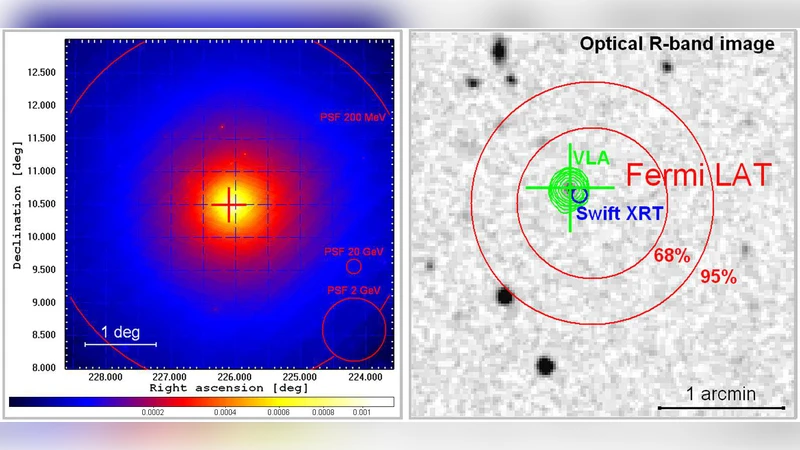
The Large Area Telescope (LAT) on board the Fermi Gamma-ray Space Telescope discovered a rapid (about 5 days duration), high-energy (E >100 MeV) gamma-ray outburst from a source identified with the blazar PKS 1502+106 (OR 103, S3 1502+10, z=1.839) starting on August 05, 2008 and followed by bright and variable flux over the next few months. Results on the gamma-ray localization and identification, as well as spectral and temporal behavior during the first months of the Fermi all-sky survey are reported here in conjunction with a multi-waveband characterization as a result of one of the first Fermi multi-frequency campaigns. The campaign included a Swift ToO (followed up by 16-day observations on August 07-22, MJD 54685-54700), VLBA (within the MOJAVE program), Owens Valley (OVRO) 40m, Effelsberg-100m, Metsahovi-14m, RATAN-600 and Kanata-Hiroshima radio/optical observations. Results from the analysis of archival observations by INTEGRAL, XMM-Newton and Spitzer space telescopes are reported for a more complete picture of this new gamma-ray blazar.
💡 Research Summary
The paper reports the discovery and multi‑wavelength follow‑up of a rapid, high‑energy gamma‑ray outburst from the flat‑spectrum radio quasar PKS 1502+106 (z = 1.839) by the Large Area Telescope (LAT) on board the Fermi Gamma‑ray Space Telescope. The outburst began on 5 August 2008, lasted roughly five days, and produced a peak flux above 100 MeV of ∼1 × 10⁻⁶ ph cm⁻² s⁻¹, an order of magnitude higher than the source’s typical LAT flux. Spectral analysis during the flare shows a power‑law photon index of Γ ≈ 2.2, with a modest hardening relative to the quiescent state, suggesting an increase in the maximum electron energy or a change in the dominant emission mechanism.
Localization with LAT yields a 95 % confidence error radius of ≈0.05°, fully consistent with the known radio/optical position of PKS 1502+106, confirming the identification. Simultaneous Swift‑XRT observations (0.3–10 keV) recorded a variable X‑ray flux and a photon index of Γ ≈ 1.6, compatible with a synchrotron self‑Compton (SSC) or external Compton (EC) origin that shares the same electron population responsible for the gamma‑rays.
Very Long Baseline Array (VLBA) imaging at 15 GHz (MOJAVE program) revealed a 30 % increase in core brightness and the emergence of a new super‑luminal component moving at ≈0.2 mas yr⁻¹ (∼15 c). This ejection appears temporally linked to the gamma‑ray flare, supporting the scenario where a shock propagates down the jet, compresses the magnetic field, and accelerates particles to ultra‑relativistic energies.
Complementary radio monitoring (OVRO 40 m, Effelsberg 100 m, Metsähovi 14 m, RATAN‑600) and optical photometry (Kanata‑Hiroshima) captured correlated variability: the radio flux showed a gradual rise over weeks, while the optical V‑band brightened by ∼0.5 mag contemporaneously with the gamma‑ray peak. Archival high‑energy data from INTEGRAL and XMM‑Newton, together with Spitzer infrared measurements, provide a baseline spectral energy distribution (SED) that displays the classic two‑hump shape of powerful FSRQs: a synchrotron peak in the far‑infrared (10¹³–10¹⁴ Hz) and a high‑energy peak in the MeV–GeV range.
Putting all observations together, the authors argue that the flare is best explained by a shock‑in‑jet model. The shock accelerates electrons, which then up‑scatter external photons from the broad‑line region or dusty torus (EC) and/or their own synchrotron photons (SSC) to gamma‑ray energies. The observed spectral hardening, the appearance of a super‑luminal knot, and the multi‑band flux correlations are all consistent with this picture. PKS 1502+106 thus becomes one of the first high‑redshift blazars whose gamma‑ray outburst has been captured in real time and studied across the electromagnetic spectrum, offering valuable constraints on particle acceleration, jet dynamics, and the location of the gamma‑ray emission zone in powerful quasars.
Comments & Academic Discussion
Loading comments...
Leave a Comment