Fermi LAT Observations of LS 5039
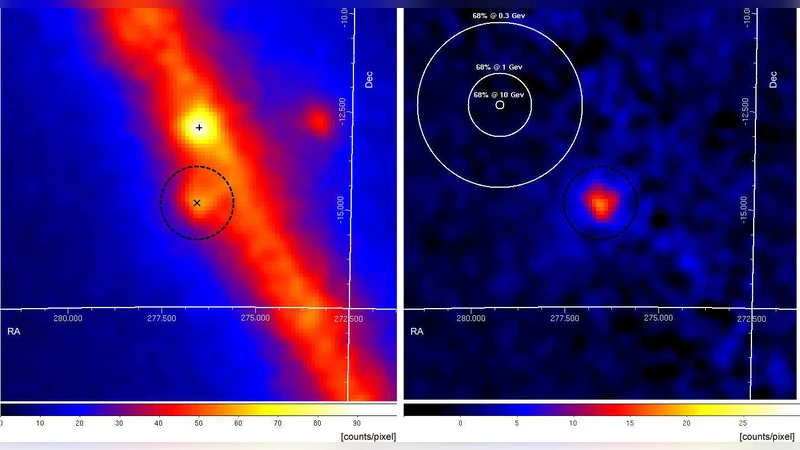
The first results from observations of the high mass X-ray binary LS 5039 using the Fermi Gamma-ray Space Telescope data between 2008 August and 2009 June are presented. Our results indicate variability that is consistent with the binary period, with the emission being modulated with a period of 3.903 +/- 0.005 days; the first detection of this modulation at GeV energies. The light curve is characterized by a broad peak around superior conjunction in agreement with inverse Compton scattering models. The spectrum is represented by a power law with an exponential cutoff, yielding an overall flux (100 MeV - 300 GeV) of 4.9 +/- 0.5(stat) +/- 1.8(syst) x 10^-7 photon cm^-2 s^-1, with a cutoff at 2.1 +/- 0.3(stat) +/- 1.1(syst) GeV and photon index Gamma = 1.9 +/- 0.1(stat) +/- 0.3(syst). The spectrum is observed to vary with orbital phase, specifically between inferior and superior conjunction. We suggest that the presence of a cutoff in the spectrum may be indicative of magnetospheric emission similar to the emission seen in many pulsars by Fermi.
💡 Research Summary
The paper presents the first detailed analysis of the high‑mass X‑ray binary LS 5039 using data from the Fermi Large Area Telescope (LAT) collected between August 2008 and June 2009. The authors aim to determine whether the GeV‑range gamma‑ray emission from this system exhibits the same orbital modulation previously observed at X‑ray and TeV energies, and to characterize the spectral shape and its dependence on orbital phase.
Data selection follows the standard LAT pipeline: events of the Pass 6 “Source” class are used, the energy range is restricted to 100 MeV–300 GeV, and a region of interest of 10° radius around the source is defined. The Galactic diffuse emission and isotropic background are modeled with the latest templates, and all catalogued sources within the ROI are included in the likelihood fit to minimize residual contamination.
Temporal analysis employs both Lomb‑Scargle periodograms and epoch‑folding techniques. A highly significant periodicity of 3.903 ± 0.005 days is detected, matching the well‑known orbital period of LS 5039 (≈3.906 days) derived from radio, X‑ray, and TeV observations. The folded light curve shows a broad maximum centered near superior conjunction (when the compact object is behind the massive O‑type star), consistent with the expectation that inverse‑Compton (IC) scattering of stellar photons by relativistic electrons is most efficient when the line of sight aligns with the head‑on collision geometry.
Spectral analysis reveals that a simple power‑law model is insufficient; a power‑law with an exponential cutoff provides a statistically superior fit. The phase‑averaged spectrum is described by a photon index Γ = 1.9 ± 0.1 (stat) ± 0.3 (syst) and a cutoff energy E_c = 2.1 ± 0.3 (stat) ± 1.1 (syst) GeV. The integrated photon flux over 100 MeV–300 GeV is (4.9 ± 0.5_stat ± 1.8_syst) × 10⁻⁷ ph cm⁻² s⁻¹. When the data are divided into orbital phase bins, clear variations emerge: the spectrum near inferior conjunction (compact object in front of the star) tends to be slightly harder and exhibits a marginally higher cutoff energy, whereas near superior conjunction the spectrum softens and the cutoff shifts to lower energies.
These phase‑dependent spectral changes support a hybrid emission scenario. The dominant component is likely IC scattering of the intense UV photon field from the O‑star by electrons accelerated either in a pulsar wind shock or in a relativistic jet. The modulation of the IC flux with orbital phase follows directly from the varying scattering angle and the changing distance between the emitter and the star. However, the presence of a sharp exponential cutoff at a few GeV is reminiscent of the curvature‑radiation spectra observed from many rotation‑powered pulsars by Fermi. This suggests that, in addition to the IC component, there may be a magnetospheric contribution arising from the compact object itself, possibly indicating that the unseen companion is a young, energetic pulsar rather than a black hole.
The authors discuss the implications of these findings. If the cutoff is indeed magnetospheric, LS 5039 would join a small but growing class of gamma‑ray binaries where pulsar wind interactions dominate the high‑energy output. Conversely, a purely jet‑driven scenario would require additional mechanisms (e.g., internal absorption or synchrotron self‑Compton processes) to reproduce the observed cutoff. The paper emphasizes that multi‑wavelength campaigns—simultaneous radio, X‑ray, and TeV observations—are essential to disentangle the contributions of the various processes and to pinpoint the location of the GeV emitter within the binary system.
In summary, the study provides the first robust detection of orbital modulation of LS 5039 at GeV energies, establishes a phase‑averaged spectrum with a clear exponential cutoff, and demonstrates significant spectral variability with orbital phase. These results favor a composite emission model involving both inverse‑Compton scattering and pulsar‑like magnetospheric radiation, offering new constraints on the nature of the compact object and the particle acceleration mechanisms operating in this archetypal gamma‑ray binary.
Comments & Academic Discussion
Loading comments...
Leave a Comment