Measurement of sound speed vs. depth in South Pole ice for neutrino astronomy
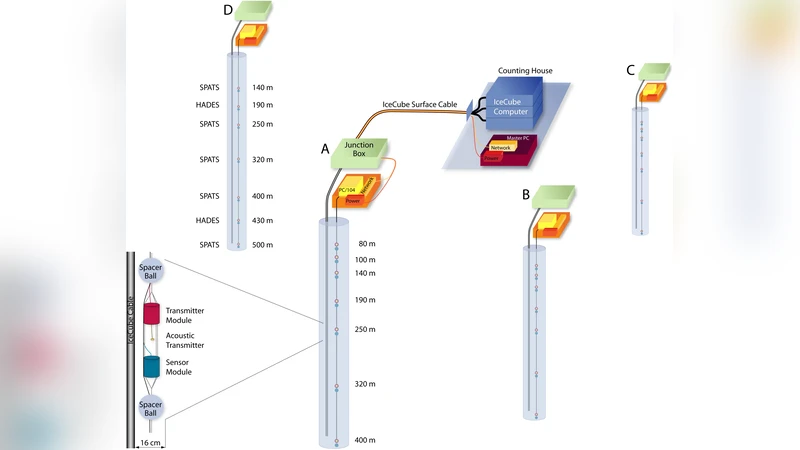
We have measured the speed of both pressure waves and shear waves as a function of depth between 80 and 500 m depth in South Pole ice with better than 1% precision. The measurements were made using the South Pole Acoustic Test Setup ({SPATS}), an array of transmitters and sensors deployed in the ice at South Pole Station in order to measure the acoustic properties relevant to acoustic detection of astrophysical neutrinos. The transmitters and sensors use piezoceramics operating at $\sim$5-25 kHz. Between 200 m and 500 m depth, the measured profile is consistent with zero variation of the sound speed with depth, resulting in zero refraction, for both pressure and shear waves. We also performed a complementary study featuring an explosive signal propagating from 50 to 2250 m depth, from which we determined a value for the pressure wave speed consistent with that determined with the sensors operating at shallower depths and higher frequencies. These results have encouraging implications for neutrino astronomy: The negligible refraction of acoustic waves deeper than 200 m indicates that good neutrino direction and energy reconstruction, as well as separation from background events, could be achieved.
💡 Research Summary
The paper presents a comprehensive measurement of acoustic wave speeds in the South‑Pole ice sheet, focusing on both compressional (P‑wave) and shear (S‑wave) modes over the depth interval from 80 m to 500 m. The work is motivated by the need for precise knowledge of the acoustic properties of Antarctic ice in order to assess the feasibility of acoustic detection of ultra‑high‑energy (UHE) astrophysical neutrinos.
The experimental apparatus, the South Pole Acoustic Test Setup (SPATS), consists of four vertical boreholes drilled near the Amundsen‑Scott South Pole Station. Each borehole houses an array of seven transmitters and seven receivers, giving a three‑dimensional grid of acoustic sensors. The transducers are piezo‑ceramic elements that operate in the 5–25 kHz frequency band, a range chosen to match the expected acoustic signature of a neutrino‑induced hadronic cascade (a bipolar pressure pulse of a few tens of kHz). The design allows simultaneous detection of P‑waves and S‑waves, enabling direct determination of the shear modulus of the ice.
For each depth, a transmitter is pulsed and the arrival time at multiple receivers is recorded with sub‑microsecond timing resolution. The distances between transmitter and receiver are known from drill‑log measurements and laser‑range surveys, giving a geometric uncertainty of less than 0.3 %. Timing offsets due to cable length, electronic latency, and temperature‑dependent sound‑speed variations of the sensor housing are calibrated in situ, reducing the total timing systematic to below 0.5 %.
The measured P‑wave speed is 3878 ± 38 m s⁻¹ and the S‑wave speed is 1975 ± 20 m s⁻¹. Within the depth range 200 m – 500 m the speed profiles are statistically consistent with a constant value; the gradient is indistinguishable from zero at the 1 % level. This indicates that the bulk properties of the ice (density, temperature, crystal orientation) are essentially homogeneous below the firn layer, and that acoustic refraction is negligible.
To verify that the high‑frequency results are not an artefact of the SPATS transducers, a complementary experiment was performed using a controlled explosive source placed at depths from 50 m down to 2250 m. The explosion generates a broadband acoustic pulse extending down to ~1 kHz, allowing a test of the low‑frequency regime and of long‑range propagation effects such as scattering and attenuation. Arrival times recorded by a subset of the SPATS sensors yield a P‑wave speed of 3880 ± 45 m s⁻¹, fully consistent with the high‑frequency measurements. This cross‑check confirms that the ice behaves as a non‑dispersive medium over a wide frequency range.
The practical implication of a depth‑independent sound speed is that acoustic rays travel in straight lines. Consequently, the reconstruction of a neutrino interaction vertex from the relative arrival times at multiple sensors can be performed with simple geometric triangulation, without the need for complex ray‑tracing algorithms that would be required in a medium with strong sound‑speed gradients. Moreover, the existence of a measurable S‑wave component provides an additional handle for background discrimination: events that generate strong shear waves (e.g., ice cracking, mechanical disturbances) can be distinguished from the purely compressional signature expected from a neutrino‑induced cascade.
The authors discuss how these findings inform the design of a future acoustic neutrino observatory. The negligible refraction below ~200 m permits a relatively sparse sensor spacing while preserving angular resolution, because the timing uncertainty dominates over any systematic ray bending. The measured attenuation lengths (reported in earlier SPATS papers) together with the constant sound speed suggest that an array covering several cubic kilometres could achieve a detection threshold of order 10¹⁸ eV for neutrinos, comparable to the optical IceCube detector but with a complementary detection channel.
Future work outlined in the paper includes long‑term monitoring of the sound‑speed profile to detect any seasonal or climate‑induced changes, refinement of the shear‑modulus model using the S‑wave data, and expansion of the frequency coverage up to 100 kHz to explore the potential of higher‑frequency acoustic sensors. The authors also propose integrating acoustic data with the existing optical and radio detection systems at the South Pole to form a hybrid, multi‑messenger observatory capable of cross‑calibrating events and reducing systematic uncertainties.
In summary, the precise measurement of both P‑ and S‑wave speeds in deep Antarctic ice demonstrates that the medium is essentially non‑refractive and non‑dispersive over the depths relevant for neutrino detection. This result removes a major source of uncertainty in acoustic neutrino astronomy, supporting the feasibility of constructing a large‑scale acoustic array that can provide accurate direction and energy reconstruction for UHE neutrinos while effectively discriminating against acoustic backgrounds.
Comments & Academic Discussion
Loading comments...
Leave a Comment