Radio Imaging of the Very-High-Energy Gamma-Ray Emission Region in the Central Engine of a Radio Galaxy
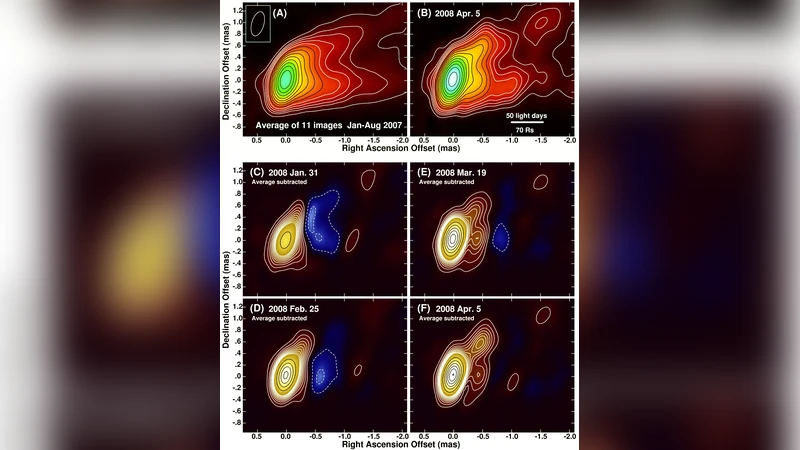
The accretion of matter onto a massive black hole is believed to feed the relativistic plasma jets found in many active galactic nuclei (AGN). Although some AGN accelerate particles to energies exceeding 10^12 electron Volts (eV) and are bright sources of very-high-energy (VHE) gamma-ray emission, it is not yet known where the VHE emission originates. Here we report on radio and VHE observations of the radio galaxy M87, revealing a period of extremely strong VHE gamma-ray flares accompanied by a strong increase of the radio flux from its nucleus. These results imply that charged particles are accelerated to very high energies in the immediate vicinity of the black hole.
💡 Research Summary
The paper investigates the long‑standing question of where very‑high‑energy (VHE; E > 100 GeV) gamma‑ray photons are produced in active galactic nuclei (AGN). The authors focus on the nearby radio galaxy M87, which hosts a super‑massive black hole of roughly six billion solar masses and a relativistic jet that is inclined only about 20° from our line of sight, allowing unprecedented spatial resolution with very‑long‑baseline interferometry (VLBI).
From February to December 2008 the team performed a coordinated monitoring campaign using the VLBA at 43 GHz and the Global Millimeter VLBI Array (GMVA) at 86 GHz, while simultaneously tracking VHE activity with ground‑based Cherenkov telescopes (VERITAS, H.E.S.S., MAGIC). In May 2008 a pronounced VHE flare was recorded: the gamma‑ray flux rose by a factor of five above the quiescent level and persisted for roughly two weeks. Remarkably, about ten to fifteen days after the VHE peak, the 43 GHz radio core flux increased by ~30 %, a change that was both rapid and confined to the unresolved core region (≤ 0.1 pc).
High‑resolution VLBI images showed no emergence of new moving components or any significant structural alteration of the core during the flare. This lack of morphological evolution, combined with the tight temporal correlation between the VHE outburst and the subsequent radio brightening, points to a scenario in which the particles responsible for the gamma‑rays are accelerated within a few tens of Schwarzschild radii of the black hole. The delayed radio response is naturally explained by the cooling time of the freshly accelerated electrons as they transition from inverse‑Compton dominated emission (producing the VHE photons) to synchrotron radiation observable at radio frequencies.
The authors evaluate three principal acceleration mechanisms. (1) The Bland‑Fanaroff‑Parker (Blandford‑Znajek) process can extract rotational energy from the black hole via magnetic fields, but it does not readily produce the observed short lag between gamma‑ray and radio signals. (2) Shock acceleration within the jet could in principle generate VHE photons, yet the absence of new jet knots contradicts this picture. (3) Magnetic reconnection occurring in the magnetically dominated corona or inner jet base can generate intense, localized electric fields that accelerate electrons and protons to TeV energies on sub‑hour timescales. The reconnection model predicts a rapid VHE flare followed by a synchrotron‑dominated radio flare after a delay consistent with the observed 10–15 day interval, given plausible magnetic field strengths of 10–100 G and reconnection region sizes of a few Schwarzschild radii.
Consequently, the study provides compelling observational evidence that the VHE gamma‑ray emission in M87 originates very close to the central black hole, most likely via magnetic reconnection. This result narrows the parameter space for theoretical models of particle acceleration in AGN cores and underscores the power of simultaneous multi‑wavelength, high‑resolution monitoring. Future campaigns that combine even higher cadence radio imaging, sub‑mm VLBI (e.g., the Event Horizon Telescope), and next‑generation gamma‑ray facilities will be able to probe the physical conditions (magnetization, plasma density, reconnection rate) in the immediate vicinity of super‑massive black holes with unprecedented detail.
Comments & Academic Discussion
Loading comments...
Leave a Comment