Cosmic Ray Measurements with the KASCADE-Grande Experiment
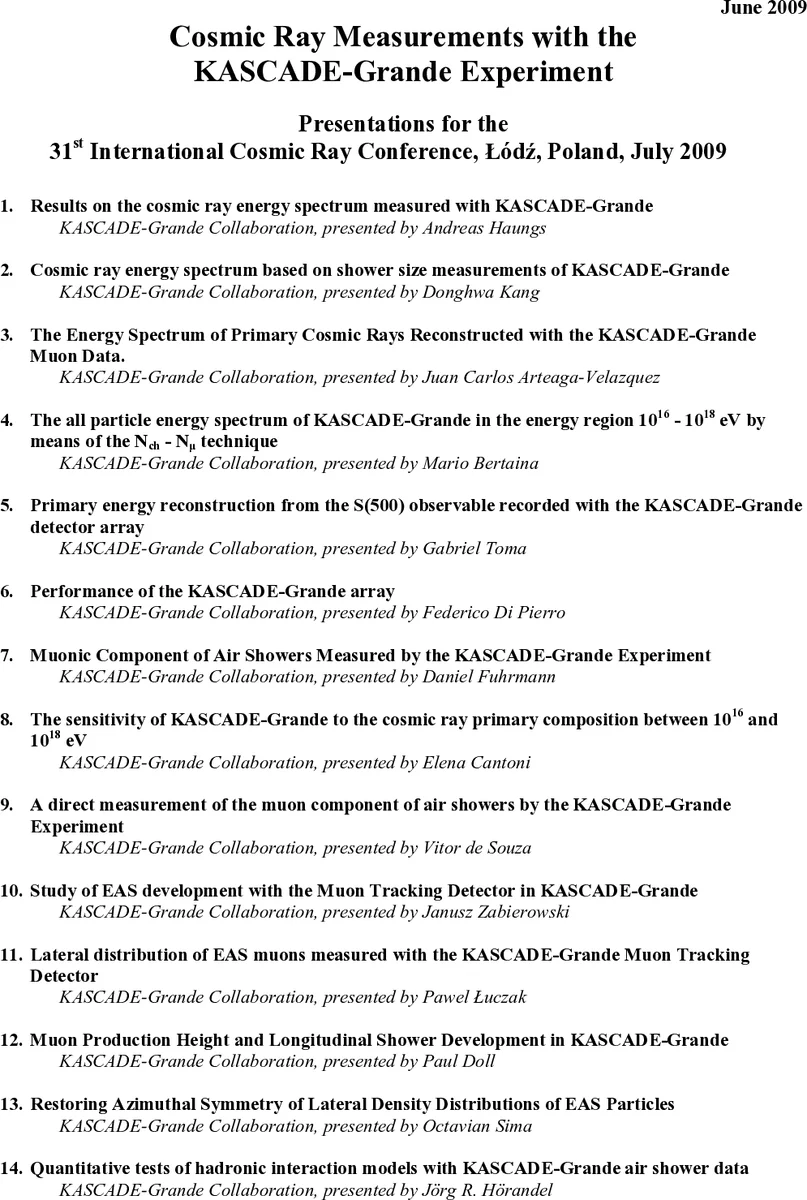
14 KASCADE-Grande reports submitted to the 31st International Cosmic Ray Conference, Lodz, Poland, July 2009
💡 Research Summary
The KASCADE‑Grande experiment combines the original KASCADE array (200 m × 200 m) with a much larger Grande array (700 m × 700 m, 37 stations of 10 m² scintillators) and a central Piccolo cluster for fast triggering. The Grande stations measure the total charged particle content (Nch) of extensive air showers, while the KASCADE detectors separately record the electromagnetic component and the muon component (Nµ). This multi‑detector setup enables precise reconstruction of the shower core position (≈ 5 m resolution), arrival direction (≈ 0.7°), total charged particle number (≈ 15 % resolution) and muon number (≈ 25 % resolution). Full trigger and reconstruction efficiency is achieved for primary energies above ≈ 2 × 10^16 eV.
Four independent reconstruction methods are applied to the same data set to derive the all‑particle energy spectrum and to assess systematic uncertainties:
-
Nch‑method – The charged particle size Nch is corrected for atmospheric attenuation using the constant intensity cut (CIC) technique. Monte‑Carlo simulations (QGSJet‑II/FLUKA) provide a calibration E ∝ Nch^α, assuming a given primary composition (proton or iron). This method yields high precision in Nch (better than 15 %) but is strongly composition‑dependent.
-
Nµ‑method – The muon size Nµ is treated analogously. Although Nµ has a larger reconstruction error (≈ 25 %) and a small core‑distance bias, its dependence on primary mass is much weaker, making it a more composition‑stable energy estimator.
-
Nch‑Nµ‑method – By combining Nch and Nµ on an event‑by‑event basis, a mixed calibration formula is derived that explicitly accounts for the mass sensitivity of each observable. This reduces the overall composition dependence at the cost of a slightly larger combined reconstruction uncertainty.
-
S(500)‑method – The particle density at a fixed lateral distance of 500 m from the shower axis, S(500), is used. This distance is chosen because the dependence of S(500) on primary mass is minimal, providing a composition‑independent estimator, albeit with a larger intrinsic measurement error.
Energy resolutions at 10^17 eV are reported as 12–20 % for the Nch‑method, 11–14 % for the Nµ‑method, and comparable values for the combined and S(500) methods. Systematic uncertainties arise from the calibration curves, the attenuation lengths (Λ(Nch)≈495 g cm⁻², Λ(Nµ)≈1100 g cm⁻², Λ(S(500))≈347 g cm⁻²), Monte‑Carlo statistics, assumed spectral slopes, and the choice of hadronic interaction model.
To probe model dependence, the Nch‑method is repeated with EPOS‑1.61 simulations. Despite limited EPOS statistics, the resulting spectrum is ≈ 30 % higher than that obtained with QGSJet‑II, illustrating the significant impact of the interaction model on absolute flux estimates. Nevertheless, all four methods produce mutually consistent spectra within their systematic bands, showing a smooth power‑law behavior from 10 PeV to 1 EeV with no pronounced features.
The comparison between proton‑ and iron‑based calibrations reveals that the Nch‑method yields a higher flux for iron, whereas the Nµ‑method gives a higher flux for proton. The true spectrum must lie between these extremes, implying a relatively heavy composition in the QGSJet‑II framework. The composition‑independent Nch‑Nµ and S(500) results fall inside the envelope defined by the composition‑dependent methods, confirming the robustness of the combined approach.
Finally, the KASCADE‑Grande spectrum agrees well with earlier measurements from KASCADE and EAS‑TOP in the overlapping energy range, supporting the reliability of the detector performance and analysis techniques. The experiment thus provides valuable data for investigating the “iron knee” around 10^17 eV and the transition from galactic to extragalactic cosmic rays.
Comments & Academic Discussion
Loading comments...
Leave a Comment