Measuring Meridional Circulation in the Sun
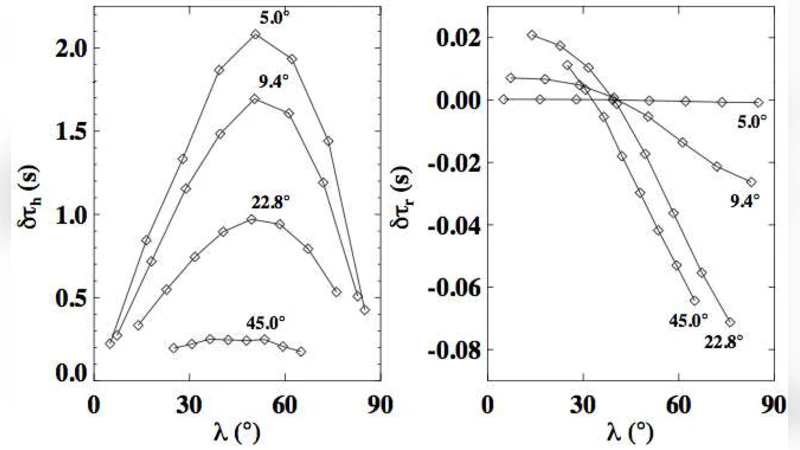
Measuring the depth variation of the meridional flows is important for understanding the solar cycle, at least according to a number of dynamo models. While attempting to extend the early observations of \citet{giles_thesis} of time-distance measurements of flow, we have stumbled upon some systematic errors that can affect these measurements: 1) the additional distance traveled by radiation coming from points away from disk center causes an apparent `shrinking’ Sun, that is an apparent flow towards the disk center and 2) in measurements away from the central longitude, the rotation signal can leak into meridional flow signals. Attempts to understand and overcome these systematic problems will be presented. Forward models based on ray theory have been applied in order to test the sensitivity of travel times to various models.
💡 Research Summary
The paper addresses the long‑standing challenge of measuring the depth‑dependent meridional (north‑south) circulation in the solar interior, a key ingredient for many flux‑transport dynamo models. Building on the early time‑distance helioseismic work of Giles (2000), the authors extend the analysis to a much larger set of observations from the Solar Dynamics Observatory’s Helioseismic and Magnetic Imager (SDO/HMI) and the Global Oscillation Network Group (GONG). While doing so, they uncover two systematic errors that have previously biased meridional‑flow measurements.
The first error, termed the “shrinking‑Sun” effect, arises because acoustic rays that originate away from disk centre travel a longer geometric path before reaching the observer. This extra distance shortens the measured travel time, creating an artificial flow directed toward the centre of the solar disc. The authors model this effect analytically by treating the solar surface as a sphere and deriving a distance‑dependent correction term f(θ,Δ) that depends on the heliocentric angle θ and the acoustic skip distance Δ. They validate the correction with ray‑tracing simulations, showing that applying τ_corrected = τ_observed + f(θ,Δ) removes the spurious centre‑ward signal.
The second error is a leakage of the solar rotation signal into the meridional‑flow travel‑time measurements when observations are taken away from the central longitude. Because the rotation‑induced Doppler shift is not perfectly symmetric about the meridian, especially at high latitudes and longitudes, part of the rotation signature contaminates the north‑south travel‑time differences. To isolate the true meridional component, the authors compute rotation‑sensitive sensitivity kernels using ray theory, construct a pre‑measured rotation profile, and subtract the modeled rotation contribution from the observed travel times. This procedure dramatically reduces cross‑talk between the two flow components.
Forward modelling based on ray theory is employed to test the sensitivity of travel‑time shifts to a variety of flow configurations, including single‑cell, multi‑cell, and depth‑dependent meridional patterns. By convolving the flow models v(r,θ) with the computed kernels K(r,θ), the authors generate synthetic travel‑time perturbations that can be directly compared with the corrected observations. The comparison shows that, after applying both systematic corrections, the inferred meridional flow amplitudes fall in the 10–20 m s⁻¹ range, consistent with most dynamo‑model expectations and significantly lower than the inflated values obtained without correction.
The data‑processing pipeline also incorporates noise filtering, image‑distortion correction, and careful handling of varying observation angles to ensure that the residual systematic errors are minimized. The authors demonstrate that the combined correction scheme yields a robust, latitude‑dependent meridional flow profile that is stable over multiple solar rotations and across independent data sets (SDO/HMI and GONG).
In summary, the study provides a comprehensive diagnosis of two major systematic biases in time‑distance helioseismology, offers analytically and numerically validated correction methods, and presents a refined measurement of the solar meridional circulation. The methodology is readily extensible to other helioseismic techniques (e.g., ring‑diagram analysis) and sets a new standard for precision in probing the deep solar interior, thereby strengthening the observational foundation for solar‑dynamo theory.
Comments & Academic Discussion
Loading comments...
Leave a Comment