The size of a formula as a measure of complexity
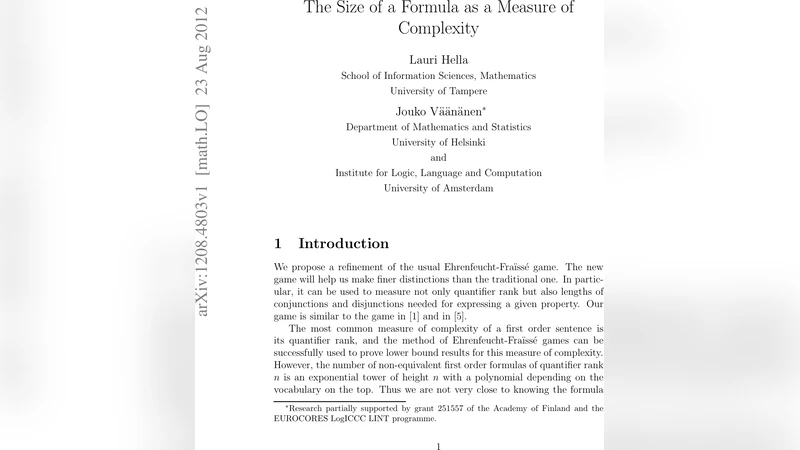
We introduce a refinement of the usual Ehrenfeucht-Fra"{\i}ss'e game. The new game will help us make finer distinctions than the traditional one. In particular, it can be used to measure the size formulas needed for expressing a given property. We will give two versions of the game: the first version characterizes the size of formulas in propositional logic, and the second version works for first-order predicate logic.
💡 Research Summary
The paper introduces a refined version of the classic Ehrenfeucht‑Fraïssé (EF) game designed to measure the size of logical formulas rather than merely their existence or quantifier depth. The authors argue that in many areas of finite model theory, descriptive complexity, and computer science, it is crucial to know not only whether a property can be expressed in a given logic but also how many logical resources—atomic propositions, connectives, quantifiers, and relation symbols—are required. To address this, they define two new game variants.
The first variant applies to propositional logic. In each round the Spoiler selects an atomic proposition, its negation, or a binary connective (∧, ∨). Each such selection counts as a single “unit”. The game proceeds until the Spoiler has built a propositional formula that distinguishes two structures (or valuations) while the Defender attempts to keep the two indistinguishable within the same budget of units. The authors prove a characterization theorem: the minimal number of units needed for a winning strategy for the Spoiler equals the minimal size of a propositional formula (measured as the total number of atomic occurrences plus connectives) that separates the two structures. Consequently, the game provides an exact lower bound on formula size for any propositional property.
The second variant extends the approach to first‑order predicate logic. Here the budget includes not only propositional connectives but also each quantifier introduction (∃, ∀) and each occurrence of a relation symbol, weighted by its arity. Variable binding is treated as a distinct round; each binding contributes one unit regardless of how many times the variable is later reused. The game’s rules ensure that any strategy that wins with at most k units corresponds to a first‑order sentence of size ≤k that separates the two structures, and conversely any sentence of size ≤k yields a winning Spoiler strategy. The authors prove a precise equivalence theorem analogous to the propositional case, thereby giving a tight lower bound on first‑order formula size.
To demonstrate the utility of the framework, the paper presents several case studies. For undirected graphs, the authors show that any propositional formula expressing connectivity must contain at least 2n‑3 connectives, where n is the number of vertices. Traditional EF games only reveal that unbounded depth is needed; the refined game quantifies the exact resource requirement. In the realm of order theory, they analyze the transitivity property and derive that at least three quantifier occurrences and a specific number of binary relation symbols are necessary in any first‑order definition. These examples illustrate how the game can be used to compute concrete lower bounds that were previously inaccessible.
The technical contributions can be summarized as follows:
- Definition of a size‑aware EF game that counts logical resources explicitly, providing a new quantitative tool for descriptive complexity.
- Formal characterization theorems for both propositional and first‑order settings, establishing an exact correspondence between game budgets and minimal formula size.
- A methodology for deriving lower bounds that relies on explicit Spoiler–Defender strategies rather than indirect model‑theoretic arguments, making the proofs more constructive and algorithmically interpretable.
- Concrete applications to graph connectivity, order transitivity, and other canonical properties, validating the approach on non‑trivial examples.
The authors conclude by outlining future research directions. They suggest extending the size‑aware game to higher‑order logics, modal logics, and probabilistic logics, where the notion of “size” may involve additional constructs such as modal operators or probability thresholds. They also propose integrating the game with automated strategy synthesis tools, which could automatically compute lower bounds for a wide class of properties. Finally, they discuss the potential to relate formula size to computational complexity measures (e.g., SAT solver runtime), thereby bridging descriptive complexity and algorithmic performance. In sum, the paper provides a robust, game‑theoretic framework for quantifying the expressive cost of logical formulas, opening new avenues for both theoretical investigation and practical analysis of logical specifications.
Comments & Academic Discussion
Loading comments...
Leave a Comment