Higher-dimensional normalisation strategies for acyclicity
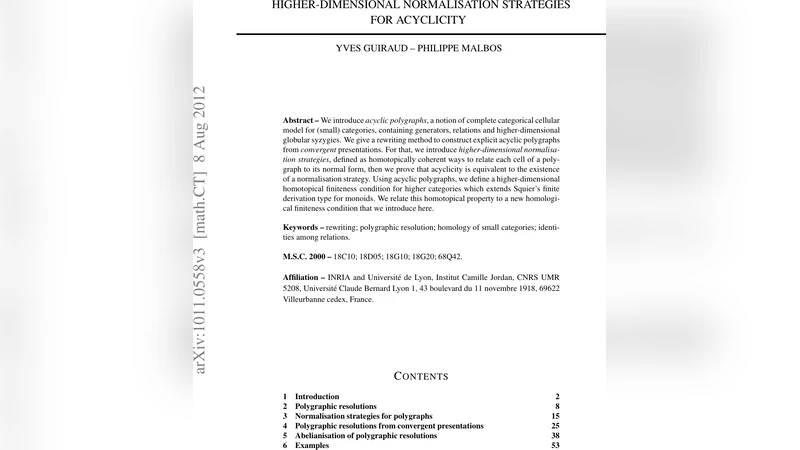
We introduce acyclic polygraphs, a notion of complete categorical cellular model for (small) categories, containing generators, relations and higher-dimensional globular syzygies. We give a rewriting method to construct explicit acyclic polygraphs from convergent presentations. For that, we introduce higher-dimensional normalisation strategies, defined as homotopically coherent ways to relate each cell of a polygraph to its normal form, then we prove that acyclicity is equivalent to the existence of a normalisation strategy. Using acyclic polygraphs, we define a higher-dimensional homotopical finiteness condition for higher categories which extends Squier’s finite derivation type for monoids. We relate this homotopical property to a new homological finiteness condition that we introduce here.
💡 Research Summary
The paper introduces acyclic polygraphs, a higher‑dimensional categorical cellular model that extends the classical notion of polygraphs (or rewriting systems) beyond the 2‑dimensional setting. An acyclic polygraph consists of generators (0‑cells), relations (1‑cells), and higher‑dimensional globular syzygies (2‑cells, 3‑cells, …) together with a coherence structure that links every cell to a chosen normal form. The authors’ central contribution is the definition of higher‑dimensional normalisation strategies: a family of homotopically coherent reductions that, for each cell, prescribe a specific path to its normal form and ensure that all such paths fit together across dimensions.
The paper proves that a polygraph is acyclic iff it admits a normalisation strategy. This equivalence generalises the classical correspondence between confluence and the existence of a unique normal form in term‑rewriting systems to the realm of higher categories, where coherence between different reduction paths must be expressed by higher cells.
To construct such strategies from a given presentation, the authors present an explicit algorithm. Starting from a convergent (terminating and confluent) presentation, one first fixes normal forms for generators. Then, for each relation a reduction rule is defined; whenever two reductions overlap, a 2‑cell (a “critical pair filler”) is added to witness their compatibility. If these 2‑cells themselves overlap, a 3‑cell is introduced, and so on. Because the underlying rewriting system is convergent, this process terminates after finitely many steps in each dimension, yielding a finite collection of higher cells that together form a normalisation strategy. Consequently the resulting polygraph is acyclic.
Having built acyclic polygraphs, the authors define a higher‑dimensional homotopical finiteness condition that extends Squier’s finite derivation type (FDT) from monoids to arbitrary higher categories. An n‑category satisfies this condition when it admits an acyclic polygraph with finitely many cells in each dimension. This condition captures both a finiteness of generators and a homotopical coherence (acyclicity) of the relations.
The paper then connects this homotopical finiteness to a new homological finiteness condition. By interpreting the cells of an acyclic polygraph as a chain complex, the authors show that the homological finiteness (finite generation of homology groups) follows from the higher‑dimensional FDT. Conversely, under mild hypotheses, homological finiteness implies the existence of a finite acyclic polygraph, establishing an equivalence between the two notions in many natural cases.
Several examples illustrate the theory. The authors treat a 3‑dimensional presentation of a braided monoidal category, construct its acyclic polygraph, and compute the resulting homology, confirming that the category satisfies the higher‑dimensional FDT. They also show how Squier’s original theorem is recovered when the dimension is restricted to 2.
In summary, the paper provides a robust framework for higher‑dimensional rewriting: it defines acyclic polygraphs, shows that they are exactly the structures admitting coherent normalisation strategies, and uses them to formulate and relate homotopical and homological finiteness conditions for higher categories. This work bridges rewriting theory, higher category theory, and homological algebra, opening new avenues for algorithmic manipulation of complex categorical structures and for the study of finiteness properties in higher‑dimensional algebra.
Comments & Academic Discussion
Loading comments...
Leave a Comment