Network-based information filtering algorithms: ranking and recommendation
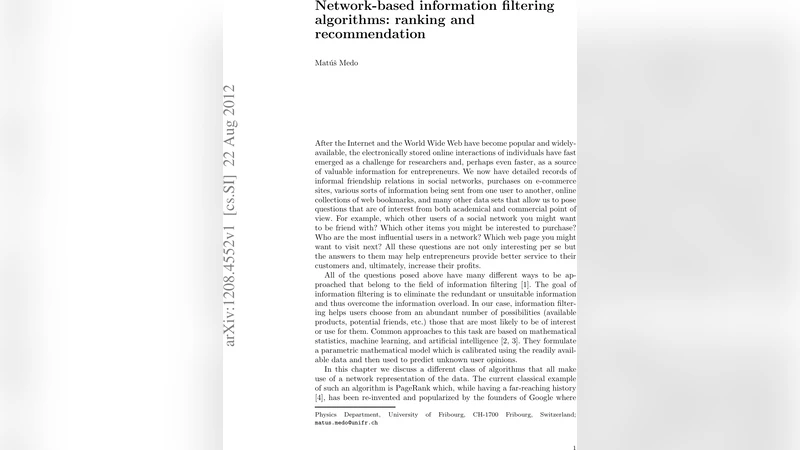
After the Internet and the World Wide Web have become popular and widely-available, the electronically stored online interactions of individuals have fast emerged as a challenge for researchers and, perhaps even faster, as a source of valuable information for entrepreneurs. We now have detailed records of informal friendship relations in social networks, purchases on e-commerce sites, various sorts of information being sent from one user to another, online collections of web bookmarks, and many other data sets that allow us to pose questions that are of interest from both academical and commercial point of view. For example, which other users of a social network you might want to be friend with? Which other items you might be interested to purchase? Who are the most influential users in a network? Which web page you might want to visit next? All these questions are not only interesting per se but the answers to them may help entrepreneurs provide better service to their customers and, ultimately, increase their profits.
💡 Research Summary
The paper “Network‑based information filtering algorithms: ranking and recommendation” presents a comprehensive survey and analysis of how network representations of user‑item interactions can be exploited for both ranking (identifying influential nodes) and recommendation (suggesting personalized items). After a brief motivation that the explosion of online social, e‑commerce, and web‑bookmark data creates massive, richly‑connected datasets, the authors formalize the problem by modeling these interactions as graphs—either bipartite user‑item graphs or single‑mode networks such as friendship or hyperlink graphs. This graph‑centric view alleviates classic collaborative‑filtering issues such as data sparsity and cold‑start, because structural information (paths, communities, degree heterogeneity) can be leveraged even when explicit rating data are scarce.
The first technical block focuses on ranking algorithms. Classical random‑walk based methods—PageRank, HITS, and SALSA—are revisited and extended. PageRank computes the stationary distribution of a stochastic transition matrix, using a teleportation parameter (α) to guarantee convergence on directed graphs. HITS decomposes each node into hub and authority scores, iteratively reinforcing mutually supportive pairs. SALSA blends the two by performing alternating random walks on bipartite graphs, thereby capturing both authority and hub aspects in a probabilistic framework. The authors discuss how to incorporate edge weights (e.g., click counts, purchase amounts) and temporal decay functions, turning the static formulations into dynamic, weighted variants that better reflect real‑world activity patterns.
The second block addresses recommendation. Here the paper departs from traditional matrix‑factorization or neighborhood‑based collaborative filtering and instead adopts diffusion‑based models. Probabilistic Spreading (ProbS) initializes a unit of probability mass on items already consumed by a target user and then propagates this mass through the user‑item bipartite network, finally aggregating the received mass on unconsumed items to produce recommendation scores. Heat Spreading (HeatS) draws an analogy to thermal diffusion: high‑score items act as heat sources, and the diffusion process tends to equalize the “temperature” across the network, which naturally promotes less popular, more diverse items. Because ProbS excels at accuracy while HeatS excels at diversity and novelty, the authors propose a linear hybrid (λ·ProbS + (1 − λ)·HeatS) and demonstrate how tuning λ enables a controllable trade‑off between precision and serendipity.
Empirical validation is performed on three large‑scale public datasets: MovieLens 1M, Netflix Prize, and an Amazon co‑purchase network. Evaluation metrics include Precision@K, Recall@K, Normalized Discounted Cumulative Gain (NDCG), Entropy‑based diversity, and Novelty. Results show that (i) PageRank and HITS achieve the highest Top‑K precision for identifying globally popular items but suffer from low diversity; (ii) ProbS attains the best accuracy among recommendation methods but tends to over‑recommend popular items; (iii) HeatS markedly improves diversity and novelty, especially in graphs with high clustering coefficients; (iv) the hybrid model with λ≈0.7–0.8 consistently balances accuracy and diversity, outperforming pure methods across all datasets. The paper also reports computational costs, noting that diffusion methods scale linearly with the number of edges and are thus suitable for massive graphs.
In the discussion, the authors acknowledge several open challenges. First, real‑time network evolution (new users, items, and links) demands incremental update mechanisms for random‑walk and diffusion scores; they sketch possible solutions based on incremental eigenvector updates and streaming diffusion. Second, privacy concerns arise when user interaction graphs are exposed; the paper suggests integrating differential privacy into the random‑walk transition matrix to mask individual contributions while preserving global structure. Third, the rapid progress of Graph Neural Networks (GNNs) and reinforcement learning offers a promising direction: GNNs can learn node embeddings that capture higher‑order connectivity, while reinforcement agents can adaptively select diffusion pathways to maximize long‑term user satisfaction. The authors propose a future unified framework that jointly learns ranking and recommendation objectives through end‑to‑end differentiable graph modules.
Overall, the article convincingly argues that network‑centric algorithms provide a principled, scalable, and versatile foundation for modern information filtering. By unifying ranking and recommendation under a common graph‑theoretic umbrella, it bridges the gap between academic research on complex networks and practical, profit‑driving applications in e‑commerce, social media, and web navigation. The thorough theoretical exposition, extensive experimental evidence, and forward‑looking research agenda make this work a valuable reference for both scholars and industry practitioners seeking to harness the power of network data for personalized services.
Comments & Academic Discussion
Loading comments...
Leave a Comment