B"acklund transformations for certain rational solutions of Painleve VI
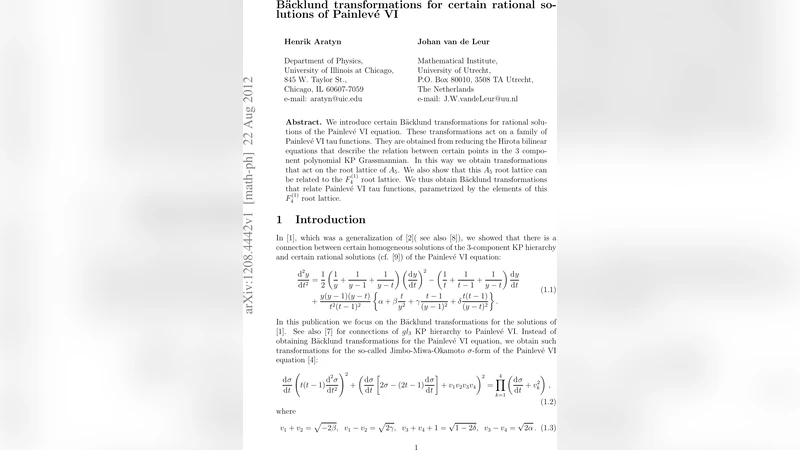
We introduce certain B"acklund transformations for rational solutions of the Painlev'e VI equation. These transformations act ona family of Painlev'e VI tau functions. They are obtained from reducing the Hirota bilinear equations that describe the relation between certain points in the 3 component polynomial KP Grassmannian. In this way we obtain transformations that act on the root lattice of sl(6). We also show that this sl(6) root lattice can be related to the $F_4^{(1)}$ root lattice. We thus obtain B"acklund transformations that relate Painlev'e VI tau functions, parametrized by the elements of this $F_4^{(1)}$ root lattice.
💡 Research Summary
The paper introduces a new family of Bäcklund transformations that act on rational solutions of the sixth Painlevé equation (PVI). The authors start by recalling that PVI can be written in terms of a τ‑function which satisfies Hirota bilinear equations. They then consider the three‑component polynomial KP Grassmannian, a geometric object that parametrises triples of KP τ‑functions (P₁,P₂,P₃). By reducing the Hirota bilinear relations on this Grassmannian they obtain a set of bilinear identities that involve τ‑functions indexed by points of the root lattice of the Lie algebra sl(6) (the A₅ lattice).
Each lattice point α = (a₁,…,a₆) with Σa_i = 0 corresponds to a τ‑function τ_α. The bilinear identities can be written in the compact form
τ_{α+e_i−e_j} τ_{α−e_i+e_j} = τ_α² − τ_{α+e_i+e_j} τ_{α−e_i−e_j},
where e_i are the standard basis vectors. This relation is precisely the action of a simple reflection in the Weyl group W(A₅) on the lattice. Consequently, the authors obtain explicit formulas for Bäcklund transformations that move from τ_α to τ_{α+e_i−e_j}, preserving the degree of the rational solution while changing the four Painlevé parameters (θ₀,θ₁,θ_t,θ_∞) in a controlled way.
The central novelty lies in relating the sl(6) lattice to the affine root lattice of type F₄^{(1)}. By constructing a linear map L: ℝ⁶ → ℝ⁴ the authors send each α to a root β = L(α) of F₄^{(1)}. Under this map the Weyl group of sl(6) embeds into the extended Weyl group of F₄^{(1)}. Hence the Bäcklund transformations derived from the KP reduction are not only the familiar Okamoto transformations (which correspond to the D₄ symmetry of PVI) but belong to a larger symmetry group that includes additional reflections and diagram automorphisms characteristic of F₄^{(1)}.
To illustrate the theory, the paper works out explicit examples for rational solutions parametrised by a pair of non‑negative integers (m,n). In this case the τ‑functions take the form
τ_{m,n}(t) = P_{m,n}(t) / Q_{m,n}(t),
with P_{m,n} and Q_{m,n} being explicit polynomials in the independent variable t. The Bäcklund moves correspond to lattice steps (m,n) → (m±1,n∓1) or (m,n) → (m,n±2), which translate into concrete algebraic relations between the corresponding rational functions. By iterating these moves any rational solution can be generated from a single seed solution (for instance the trivial solution at (0,0)).
The authors also discuss the broader implications of their construction. Because the F₄^{(1)} lattice appears naturally in the theory of affine Weyl groups, the same methodology could be adapted to other Painlevé equations, to discrete integrable systems, or to the study of special function identities arising from representation theory. Moreover, the connection with the three‑component KP hierarchy suggests possible links with multi‑matrix models, isomonodromic deformations of higher‑rank linear systems, and the geometry of moduli spaces of bundles.
In summary, the paper provides a systematic derivation of a rich set of Bäcklund transformations for rational PVI solutions by exploiting the Hirota bilinear structure on a three‑component KP Grassmannian, mapping the sl(6) root lattice onto the affine F₄^{(1)} lattice, and thereby extending the known symmetry group of PVI. This work deepens the algebraic understanding of Painlevé equations and opens new avenues for constructing explicit solutions and exploring their geometric and representation‑theoretic contexts.